Tawny Mining Bee
Daily sighting probability <5% · Rare
at Lyon

In 3 days ~10% in a week ~30%

7 Verified sightings at Lyon
37 In all 2 parks From 2019 to 2026
April Best month
☀️ Diurnal When it's spotted

About the Tawny Mining Bee

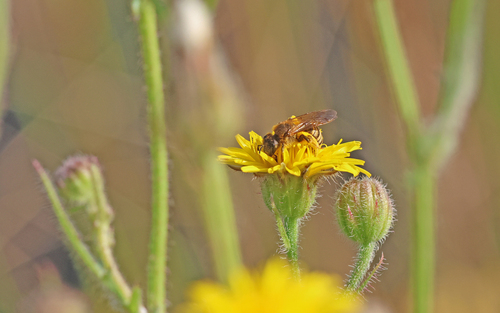
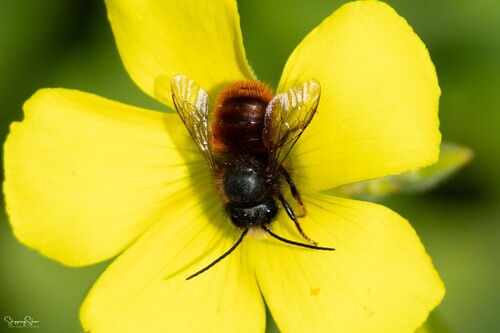
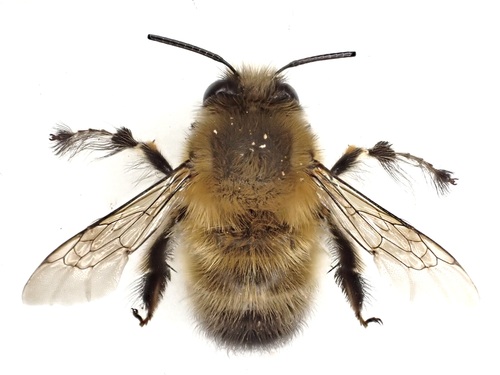
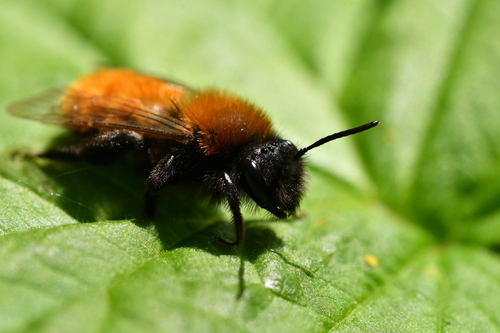
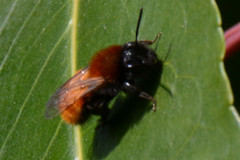
The tawny mining bee, Andrena fulva, is a European species of the sand bee (Andrena) genus. The males are 10–12 mm (0.4–0.5 in) and the females 8–10 mm (0.3–0.4 in) long. The female is covered with fox-red hair on the dorsal surface of its thorax and abdomen and black hair on its head and ventral surface. The male is less distinctive, being clad in golden-brown or reddish-brown hairs, with some long white hairs on the face, and a tooth on each of the mandibles.

The tawny mining bee lives in Europe, ranging from the Balkans to southern Scandinavia, the United Kingdom and Ireland. It lives among short vegetation in light woodlands and dry grasslands, and also in parks and gardens. It is widely distributed but has a low population density. It is present in lowland England and Wales and at a few sites in southern Scotland. In Ireland it was only known at two locations in County Kilkenny in 1927, and until 2012 was considered extinct, when it was rediscovered at several locations throughout Ireland.

The tawny mining bee flies from March until May. It prefers to fly to a range of different nectar-producing and pollen-bearing plants; these include beech (Fagus sylvatica), blackthorn (Prunus spinosa), buttercup (Ranunculus sp.), daffodils, garlic mustard (Alliaria petiolata), gooseberry (Ribes uva-crispa), hawthorn (Crataegus monogyna), holly (Ilex aquifolium), maple (Acer sp.), oak (Quercus sp.), plum (Prunus domestica), sallow (Salix sp.), sycamore (Acer pseudoplatanus) and wayfaring-tree (Viburnum lantana).

It mates in spring, after which the male dies and the female starts to build a nest. Sometimes more than a hundred females build nests in a few square metres but the tawny mining bee does not create a colony, each female having her own nest. The tawny mining bee is therefore classified amongst solitary bees. The nest is a vertical shaft 200–300 mm (8–12 in) deep, with several brood cells branching off it. The female fills these cells with a mixture of nectar and pollen, on which she lays one egg in each cell. The larva hatches within a few days, grows quickly and pupates within a few weeks. The adults emerge in spring after hibernation. Wikipedia →
Global Distribution

Parks Where Found

# Park Country Daily sighting probability
1 Bavarian Forest National Park 🇩🇪 Germany
~10%
2 Wadden Sea National Park 🇩🇪 Germany
~10%

Cities Where Found

# City Country Daily sighting probability
1 Liverpool 🇬🇧 United Kingdom
~20%
2 Birmingham 🇬🇧 United Kingdom
~20%
3 Manchester 🇬🇧 United Kingdom
~20%
4 Copenhagen 🇩🇰 Denmark
~10%
5 Warsaw 🇵🇱 Poland
~10%
6 Leeds 🇬🇧 United Kingdom
~10%
7 Hamburg 🇩🇪 Germany
~10%
8 London 🇬🇧 United Kingdom
~10%
9 Berlin 🇩🇪 Germany
~10%
10 Brussels 🇧🇪 Belgium
~10%

Before you go

What are the chances of seeing a Tawny Mining Bee in Lyon?

Rare

Under 5% of wildlife watchers report a Tawny Mining Bee sighting in Lyon on a given day, based on 7 verified sightings from GBIF citizen-science data. It is the 289th most-seen of the 411 insects we can rate there. Over three days the chance rises to about 10%, and over a week to about 30%, if each day is a fresh chance.

When is the best time to see a Tawny Mining Bee in Lyon?

March and April

In those months about 10% of wildlife watchers report a Tawny Mining Bee in Lyon on a given day, against under 5% in May to February, the lowest months.

What time of day is best to see a Tawny Mining Bee?

Between 2 and 5 pm

Across all the parks we cover, that three-hour window holds the most Tawny Mining Bee sightings with a recorded time, and about 9 in 10 of them come between 6 am and 6 pm: it is a daytime animal.

Is Lyon the best place to see a Tawny Mining Bee?

14th of 18

Of the 18 cities where we can rate Tawny Mining Bee sightings, Lyon ranks 14th at under 5%. The best odds are in Liverpool (United Kingdom, about 20%), Birmingham (United Kingdom, about 20%) and Manchester (United Kingdom, about 20%).

Where does the Tawny Mining Bee sighting chance come from?

GBIF citizen-science records

It is estimated from how often the Tawny Mining Bee is recorded against all the insects logged in Lyon (7 verified sightings), calibrated against known sighting rates. Figures are rounded to the nearest 10% because citizen-science data supports honest approximations, not decimals, and months with records from fewer than five people show "—". How it works.

← Back to Lyon