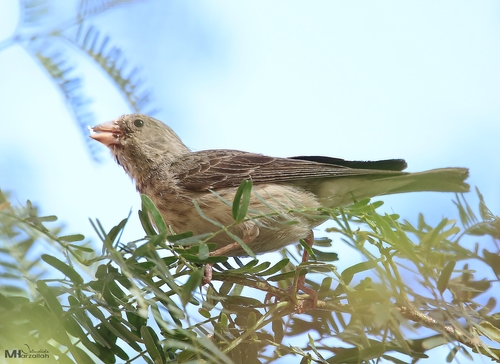
Black-rumped Waxbill

Black-rumped Waxbill

Estrilda troglodytes

Silhouette: Ferran Sayol · PhyloPic

LCLeast ConcernNTVUENCR
Daily sighting probability ~20% · Possible
at Maiduguri

In 3 days ~60% in a week ~90%

29 Verified sightings at Maiduguri
384 In all 6 parks From 2019 to 2026
February Best month
☀️ Diurnal When it's spotted

About the Black-rumped Waxbill

The black-rumped waxbill (Estrilda troglodytes) is a common species of estrildid finch found in Southern Africa. It has an estimated global extent of occurrence of 2,000,000 km2. It is found in Benin, Burkina Faso, Cameroon, Central African Republic, Chad, The Democratic Republic of the Congo, Côte d'Ivoire, Eritrea, Ethiopia, Gambia, Ghana, Guinea, Kenya, Liberia, Mali, Mauritania, Niger, Nigeria, Puerto Rico, Senegal, Sudan, Togo, Uganda. The status of the species is evaluated as Least Concern. It is introduced in France (Guadeloupe), Portugal, the United States (Puerto Rico) and Virgin Islands (possibly died out).

The black-rumped waxbill was first described by Hinrich Lichtenstein in 1823, and at the time was placed in the genus Fringilla. When the genus Estrilda was described in 1850, this species was moved there. It was at one point thought to be conspecific with the Arabian waxbill.

Japan: カエデチョウ 【かえでちょう】(kae de chō) The black-rumped waxbill was introduced into Japan as a pet bird since the 1960s. It has a record of breeding in Tokyo and was also sighted in Osaka and Saitama Prefs. Its impact on the country is unknown, and there is no current... Wikipedia →

Sounds

Call0:17

Gambia · 2025

© Romuald Mikusek · XC1018309 · CC BY-NC-SA 4.0

Song0:11

Ghana · 2022

© Peter Boesman · XC719132 · CC BY-NC-ND 4.0

Recording0:35

Nigeria · 2020

© Sun Madakan · XC598657 · CC BY-NC-SA 4.0

Global Distribution

Parks Where Found

# Park Country Daily sighting probability
1 Niokolo-Koba National Park 🇸🇳 Senegal
~40%
2 Murchison Falls National Park 🇺🇬 Uganda
~20%
3 Kidepo Valley National Park 🇺🇬 Uganda
<5%
4 Serengeti National Park 🇹🇿 Tanzania
<5%
5 Queen Elizabeth National Park 🇺🇬 Uganda
<5%
6 Masai Mara National Reserve 🇰🇪 Kenya
<5%

Cities Where Found

# City Country Daily sighting probability
1 Maiduguri 🇳🇬 Nigeria
~20%
2 Los Angeles 🇺🇸 United States
<5%
3 Serrekunda 🇬🇲 Gambia
<5%
4 Doha 🇶🇦 Qatar
<5%
5 Singapore 🇸🇬 Singapore
<5%
6 Barcelona 🇪🇸 Spain
<5%

Before you go

What are the chances of seeing a Black-rumped Waxbill in Maiduguri?

Possible

About 20% of wildlife watchers report a Black-rumped Waxbill sighting in Maiduguri on a given day, based on 29 verified sightings from GBIF citizen-science data. It is the 30th most-seen of the 65 birds we can rate there. Over three days the chance rises to about 60%, and over a week to about 90%, if each day is a fresh chance.

When is the best time to see a Black-rumped Waxbill in Maiduguri?

February and March

In those months about 40% of wildlife watchers report a Black-rumped Waxbill in Maiduguri on a given day, against about 10% in August and September, the lowest months. Those are among Maiduguri's driest months, with almost no rain against 180 mm in August. November has too few records to rate.

What time of day is best to see a Black-rumped Waxbill?

Between 5 and 8 pm

Across all the parks we cover, that three-hour window holds the most Black-rumped Waxbill sightings with a recorded time, and about 7 in 10 of them come between 6 am and 6 pm: it is a daytime animal.

Is Maiduguri the best place to see a Black-rumped Waxbill?

Yes

Of the 6 cities where we can rate Black-rumped Waxbill sightings, Maiduguri has the highest daily chance: about 20%. Next come Los Angeles (United States, under 5%) and Serrekunda (Gambia, under 5%).

Which relatives of the Black-rumped Waxbill live in Maiduguri?

Same family: Estrildidae

The closest relatives of the Black-rumped Waxbill that you can see in Maiduguri (family Estrildidae, Waxbills and Allies) are Red-billed Firefinch (about 50%), Red-cheeked Cordon-bleu (about 40%) and African Silverbill (about 20%), with each one's daily chance of a sighting.

Where does the Black-rumped Waxbill sighting chance come from?

GBIF citizen-science records

It is estimated from how often the Black-rumped Waxbill is recorded against all the birds logged in Maiduguri (29 verified sightings), calibrated against known sighting rates. Figures are rounded to the nearest 10% because citizen-science data supports honest approximations, not decimals, and months with records from fewer than five people show "—". How it works.

← Back to Maiduguri