African Silverbill

African Silverbill

Euodice cantans

Silhouette: Sheatherius · PhyloPic

LCLeast ConcernNTVUENCR
Daily sighting probability ~20% · Possible
at Maiduguri

In 3 days ~40% in a week ~70%

19 Verified sightings at Maiduguri
211 In all 8 parks From 2019 to 2026
January Best month
☀️ Diurnal When it's spotted

About the African Silverbill

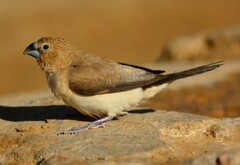
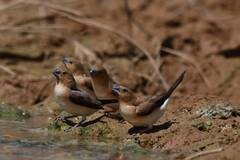
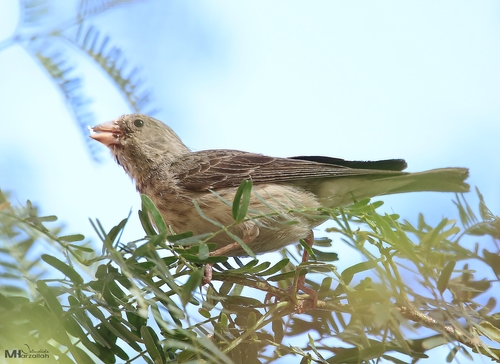
The African silverbill (Euodice cantans) is a small passerine bird formerly considered conspecific with the Asian species Indian silverbill, (Euodice malabarica). This estrildid finch is a common resident breeding bird in dry savanna habitat, south of the Sahara Desert. This species has also been introduced to other countries such as Portugal, Qatar and United States.

The African silverbill was formally described in 1789 by the German naturalist Johann Friedrich Gmelin under the binomial name Loxia cantans. The specific epithet is from Latin and means "singing". Gmemlin specified the locality as Africa but this was restricted to Dakar in Senegal by William Lutley Sclater and Cyril Mackworth-Praed in 1918. It is now placed with the Indian silverbill in the genus Euodice that was introduced in 1862 by the German naturalist Ludwig Reichenbach.

In early literature, the African silverbill and the Indian silverbill (E. malabarica) were treated as conspecific. In 1943, Jean Théodore Delacour united both species in his revision of the Estrildinae. However, in 1964, Colin Harrison studied the two in a strictly comparative manner and concluded that they were two separate species... Wikipedia →

Sounds

Call0:21

Saudi Arabia · 2025

© Zsombor Károlyi · XC1163939 · CC BY-NC-SA 4.0

Flight call0:07

Saudi Arabia · 2022

© David Darrell-Lambert · XC746428 · CC BY-NC-SA 4.0

Call0:17

Oman · 2025

© Nicolas Martinez · XC965685 · CC BY-NC-SA 4.0

Global Distribution

Parks Where Found

# Park Country Daily sighting probability
1 Awash National Park 🇪🇹 Ethiopia
~20%
2 Samburu National Reserve 🇰🇪 Kenya
~10%
3 Tsavo East National Park 🇰🇪 Kenya
<5%
4 Mkomazi National Park 🇹🇿 Tanzania
<5%
5 Amboseli National Park 🇰🇪 Kenya
<5%
6 Tsavo West National Park 🇰🇪 Kenya
<5%
7 Tarangire National Park 🇹🇿 Tanzania
<5%
8 Serengeti National Park 🇹🇿 Tanzania
<5%

Cities Where Found

# City Country Daily sighting probability
1 Dakar 🇸🇳 Senegal
~50%
2 Ouagadougou 🇧🇫 Burkina Faso
~20%
3 Maiduguri 🇳🇬 Nigeria
~20%
4 N'Djamena 🇹🇩 Chad
~10%
5 Addis Ababa 🇪🇹 Ethiopia
~10%
6 Serrekunda 🇬🇲 Gambia
<5%

Zoos & Centres Where Found

# Zoo / Centre Country
1 San Diego Zoo 🇺🇸 United States In captivity
2 Tierwelt Herberstein 🇦🇹 Austria In captivity

Before you go

What are the chances of seeing an African Silverbill in Maiduguri?

Possible

About 20% of wildlife watchers report an African Silverbill sighting in Maiduguri on a given day, based on 19 verified sightings from GBIF citizen-science data. It is the 40th most-seen of the 65 birds we can rate there. Over three days the chance rises to about 40%, and over a week to about 70%, if each day is a fresh chance.

When is the best time to see an African Silverbill in Maiduguri?

January

In that month about 30% of wildlife watchers report an African Silverbill in Maiduguri on a given day, against about 10% in February–March, June–July and September–October, the lowest months. That is one of Maiduguri's driest months, with almost no rain against 180 mm in August. November has too few records to rate.

What time of day is best to see an African Silverbill?

Between noon and 3 pm

Across all the parks we cover, that three-hour window holds the most African Silverbill sightings with a recorded time, and about 9 in 10 of them come between 6 am and 6 pm: it is a daytime animal.

Is Maiduguri the best place to see an African Silverbill?

3rd of 6

Of the 6 cities where we can rate African Silverbill sightings, Maiduguri ranks 3rd at about 20%. The best odds are in Dakar (Senegal, about 50%) and Ouagadougou (Burkina Faso, about 20%).

Where does the African Silverbill sighting chance come from?

GBIF citizen-science records

It is estimated from how often the African Silverbill is recorded against all the birds logged in Maiduguri (19 verified sightings), calibrated against known sighting rates. Figures are rounded to the nearest 10% because citizen-science data supports honest approximations, not decimals, and months with records from fewer than five people show "—". How it works.

← Back to Maiduguri