Western Olivaceous Warbler

Western Olivaceous Warbler

Iduna opaca

Silhouette: Sheatherius · PhyloPic

LCLeast ConcernNTVUENCR
Daily sighting probability ~10% · With luck
at Maiduguri

In 3 days ~30% in a week ~50%

12 Verified sightings at Maiduguri
257 In all 2 parks From 2019 to 2026
March Best month
☀️ Diurnal When it's spotted

About the Western Olivaceous Warbler

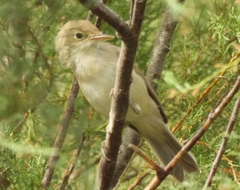
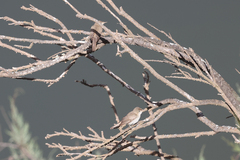
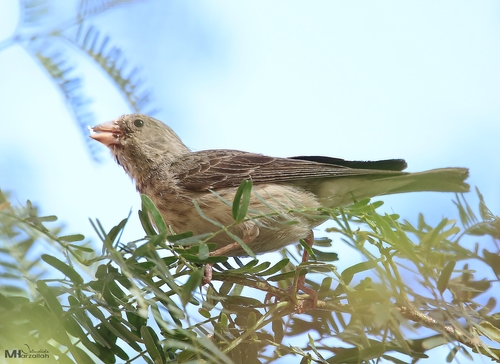
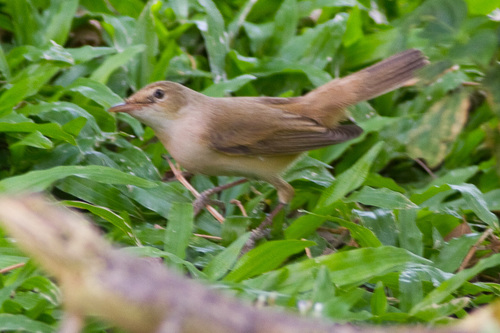
The western olivaceous warbler (Iduna opaca), also known as the isabelline warbler, is a "warbler", formerly placed in the Old World warblers when these were a paraphyletic wastebin taxon. It is now considered a member of the acrocephaline warblers, Acrocephalidae, in the tree warbler genus Iduna. It was formerly regarded as part of a wider "olivaceous warbler" species, but as a result of modern taxonomic developments, this species is now usually considered distinct from the eastern olivaceous warbler, Iduna pallida.

It is a small passerine bird, found in dry open country, including cultivation, with bushes or some trees. Two or three eggs are laid in a nest in low undergrowth or a bush. Like most warblers, the western olivaceous warbler is insectivorous.

It is a medium-sized warbler, more like a very pale reed warbler than its relative the melodious warbler. The adults have a plain pale brown back and whitish underparts. Its body length is about 13–14 centimetres (5.1–5.5 in), wingspan 18–21 centimetres (7.1–8.3 in) and weight 8–13 grams (0.28–0.46 oz). The bill is strong and pointed and the legs grey. The sexes are identical, as with most warblers, but young... Wikipedia →
Sounds

Call0:20

Senegal · 2026

© Peter Boesman · XC1081236 · CC BY-NC-ND 4.0

Song0:52

Burkina Faso · 2025

© Marc Languy · XC1068146 · CC BY-NC-SA 4.0

Call0:37

Spain · 2025

© Esperanza Poveda · XC1052088 · CC BY-NC-SA 4.0

Global Distribution

Parks Where Found

# Park Country Daily sighting probability
1 Niokolo-Koba National Park 🇸🇳 Senegal
~20%
2 Doñana National Park 🇪🇸 Spain
~10%

Cities Where Found

# City Country Daily sighting probability
1 Marrakesh 🇲🇦 Morocco
~10%
2 Maiduguri 🇳🇬 Nigeria
~10%
3 Ouagadougou 🇧🇫 Burkina Faso
~10%
4 Rabat 🇲🇦 Morocco
<5%
5 Serrekunda 🇬🇲 Gambia
<5%
6 Dakar 🇸🇳 Senegal
<5%

Before you go

What are the chances of seeing a Western Olivaceous Warbler in Maiduguri?

With luck

About 10% of wildlife watchers report a Western Olivaceous Warbler sighting in Maiduguri on a given day, based on 12 verified sightings from GBIF citizen-science data. It is the 47th most-seen of the 65 birds we can rate there. Over three days the chance rises to about 30%, and over a week to about 50%, if each day is a fresh chance.

When is the best time to see a Western Olivaceous Warbler in Maiduguri?

March

In that month about 30% of wildlife watchers report a Western Olivaceous Warbler in Maiduguri on a given day, against under 5% in May and June, the lowest months. That is one of Maiduguri's driest months, with almost no rain against 180 mm in August. November has too few records to rate.

What time of day is best to see a Western Olivaceous Warbler?

Between 9 am and noon

Across all the parks we cover, that three-hour window holds the most Western Olivaceous Warbler sightings with a recorded time, and about 8 in 10 of them come between 6 am and 6 pm: it is a daytime animal.

Is Maiduguri the best place to see a Western Olivaceous Warbler?

Among the best

Of the 6 cities where we can rate Western Olivaceous Warbler sightings, Maiduguri ranks 2nd at about 10%, level with the leaders once rounded. The best odds are in Marrakesh (Morocco, about 10%).

Where does the Western Olivaceous Warbler sighting chance come from?

GBIF citizen-science records

It is estimated from how often the Western Olivaceous Warbler is recorded against all the birds logged in Maiduguri (12 verified sightings), calibrated against known sighting rates. Figures are rounded to the nearest 10% because citizen-science data supports honest approximations, not decimals, and months with records from fewer than five people show "—". How it works.

← Back to Maiduguri