Pale-headed Munia

Pale-headed Munia

Lonchura pallida

Silhouette: Ferran Sayol · PhyloPic

LCLeast ConcernNTVUENCR
Daily sighting probability ~40% · Likely
at Makassar

In 3 days ~80% in a week >90%

37 Verified sightings at Makassar
May Best month
☀️ Diurnal When it's spotted

About the Pale-headed Munia

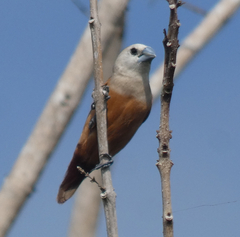
The pale-headed munia (Lonchura pallida) is a species of estrildid finch native to eastern Indonesia and Timor-Leste. It inhabits subtropical and tropical lowlands, dry shrubland, grassland, marshes and agricultural areas. The species has shown recent range expansion due to increasing agriculture and land clearance. It has recently crossed the Wallace Line to establish breeding populations on Nusa Penida, and is now recorded on Bali. It has also become an increasingly frequent vagrant in northwestern Australia from the 2020s onward, with arrivals likely aided by monsoon winds and cyclones.

The species was first described by the British naturalist Alfred Russel Wallace in 1864 under the binomial Munia pallida, based on specimens from the Lesser Sunda Islands. Its type locality is generally given as Lombok and Flores.

It is now placed in the genus Lonchura and is commonly regarded as having no subspecies. A population described as Lonchura pallida subcastanea from the Palu Valley of Sulawesi is generally considered synonymous with the nominate form.

The pale-headed munia belongs to a complex of pale-capped species within Lonchura, including the white-headed munia (L. maja... Wikipedia →

Sounds

Call0:58

Indonesia · 2012

© Frank Lambert · XC166513 · CC BY-NC-ND 4.0

Global Distribution

Parks Where Found

# Park Country Daily sighting probability

More parks will be added in future updates.

Cities Where Found

# City Country Daily sighting probability
1 Makassar 🇮🇩 Indonesia
~40%

Before you go

What are the chances of seeing a Pale-headed Munia in Makassar?

Likely

About 40% of wildlife watchers report a Pale-headed Munia sighting in Makassar on a given day, based on 37 verified sightings from GBIF citizen-science data. It is the 5th most-seen of the 66 birds we can rate there. Over three days the chance rises to about 80%, and over a week to over 90%, if each day is a fresh chance.

What time of day is best to see a Pale-headed Munia?

Between 7 and 10 am

Across all the parks we cover, that three-hour window holds the most Pale-headed Munia sightings with a recorded time, and about 9 in 10 of them come between 6 am and 6 pm: it is a daytime animal.

Where else can you see a Pale-headed Munia?

Only Makassar, in our data

Makassar is the only city on Wallace's Line with enough records to rate Pale-headed Munia sightings: about 40% of wildlife watchers there report one on a given day.

Where does the Pale-headed Munia sighting chance come from?

GBIF citizen-science records

It is estimated from how often the Pale-headed Munia is recorded against all the birds logged in Makassar (37 verified sightings), calibrated against known sighting rates. Figures are rounded to the nearest 10% because citizen-science data supports honest approximations, not decimals, and months with records from fewer than five people show "—". How it works.

← Back to Makassar