Yellow-bellied White-eye

Yellow-bellied White-eye

Zosterops chloris

Silhouette: Ferran Sayol · PhyloPic

LCLeast ConcernNTVUENCR Endemic
Daily sighting probability ~40% · Likely
at Makassar

In 3 days ~70% in a week >90%

31 Verified sightings at Makassar
298 In all 3 parks From 2019 to 2026
August Best month
🌅 Crepuscular When it's spotted

About the Yellow-bellied White-eye

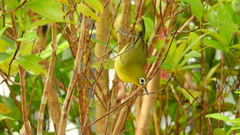
The lemon-bellied white-eye (Zosterops chloris) is a species of bird in the family Zosteropidae. It is endemic to Indonesia, where it occurs on a number of islands from the Sunda Strait to the Aru Islands. It is present on several of the Lesser Sunda Islands as well as on parts of Sulawesi, as well as many smaller islands, but is absent from the larger islands of Borneo, Java, Sumatra and Timor. Currently (May 2017), HBW describes five sub-species of lemon-bellied white-eye.

The lemon-bellied white-eye's natural habitats are subtropical or tropical moist lowland forests and subtropical or tropical mangrove forests. On the islands of Buton and Kabaena the lemon-bellied white-eye appears limited to coastal regions, perhaps as a result of competition with the pale-bellied white-eye. Observations from Buton suggest that the lemon-bellied white-eye prefers more disturbed habitats. Their diet consists of invertebrates, fruits, and nectar. They have strong dark grey legs, a dark colored beak, and generally range in size from 11 to 12 cm. They are a yellow-olive color on the dorsal side, with characteristic bright yellow underparts. Wikipedia →

Global Distribution

Parks Where Found

# Park Country Daily sighting probability
1 Komodo National Park 🇮🇩 Indonesia
~30%
2 Bali Barat National Park 🇮🇩 Indonesia
~10%
3 Raja Ampat 🇮🇩 Indonesia
~10%

Cities Where Found

# City Country Daily sighting probability
1 Makassar 🇮🇩 Indonesia
~40%
2 Jakarta 🇮🇩 Indonesia
<5%
3 Denpasar 🇮🇩 Indonesia
<5%

Before you go

What are the chances of seeing a Yellow-bellied White-eye in Makassar?

Likely

About 40% of wildlife watchers report a Yellow-bellied White-eye sighting in Makassar on a given day, based on 31 verified sightings from GBIF citizen-science data. It is the 8th most-seen of the 66 birds we can rate there. Over three days the chance rises to about 70%, and over a week to over 90%, if each day is a fresh chance.

What time of day is best to see a Yellow-bellied White-eye?

Between 2 and 5 am

Across all the parks we cover, that three-hour window holds the most Yellow-bellied White-eye sightings with a recorded time, and about 6 in 10 of them come between 6 pm and 6 am: it is most active around dawn and dusk.

Is Makassar the best place to see a Yellow-bellied White-eye?

Yes

Of the 3 cities where we can rate Yellow-bellied White-eye sightings, Makassar has the highest daily chance: about 40%. Next come Jakarta (Indonesia, under 5%) and Denpasar (Indonesia, under 5%).

Which relatives of the Yellow-bellied White-eye live in Makassar?

Same order: Passeriformes

The closest relatives of the Yellow-bellied White-eye that you can see in Makassar (order Passeriformes, Perching Birds) are Eurasian Tree Sparrow (about 60%), Yellow-vented Bulbul (about 50%) and Pacific Swallow (about 50%), with each one's daily chance of a sighting.

Where does the Yellow-bellied White-eye sighting chance come from?

GBIF citizen-science records

It is estimated from how often the Yellow-bellied White-eye is recorded against all the birds logged in Makassar (31 verified sightings), calibrated against known sighting rates. Figures are rounded to the nearest 10% because citizen-science data supports honest approximations, not decimals, and months with records from fewer than five people show "—". How it works.

← Back to Makassar