Pacific Parakeet

Pacific Parakeet

Aratinga strenua

Silhouette: Myriam_Ramirez · PhyloPic

Daily sighting probability <5% · Rare
at Managua

In 3 days ~10% in a week ~30%

90 Verified sightings at Managua
220 In 1 park From 2019 to 2026
July Best month
☀️ Diurnal When it's spotted

About the Pacific Parakeet

The Pacific parakeet (Psittacara strenuus), known as Pacific conure or Nicaraguan green conure in aviculture, is a species of bird in subfamily Arinae of the family Psittacidae, the African and New World parrots. It is found in southern Mexico, Guatemala, El Salvador, Honduras, and Nicaragua.

The Pacific parakeet was for a time placed in the genus Aratinga but from about 2013 has been in its present genus Psittacara. Its taxonomy is otherwise unsettled. The International Ornithological Committee, the American Ornithological Society, and the Clements taxonomy treat it as a full, monotypic, species. BirdLife International's Handbook of the Birds of the World (HBW) considers it to be a subspecies of the green parakeet (P. holochlorus).

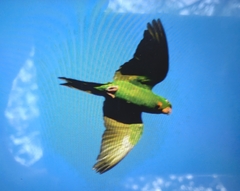
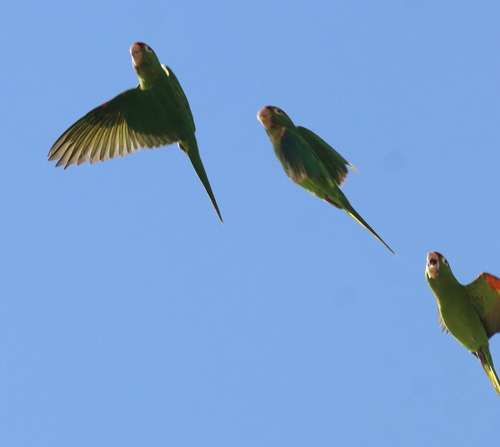
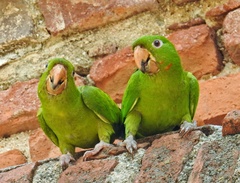
The Pacific parakeet is about 32 cm (13 in) long. The sexes are alike. Adults are generally olive green which is slightly yellowish on the underparts; some have red speckles on their neck. The undersides of their flight feathers and tail are olive-yellow. Their iris is orange-red surrounded by bare pale beige skin, their bill horn colored, and their legs and feet are brownish. Wikipedia →

Sounds

Recording1:21

El Salvador · 2021

© Rodríguez Viky · iNaturalist · CC BY-NC 4.0

Recording0:12

Guatemala · 2024

© Juan QG · iNaturalist · CC BY-NC 4.0

Recording0:16

Guatemala · 2020

© Heidi Pasch de Viteri · iNaturalist · CC BY-NC 4.0

Global Distribution

Parks Where Found

# Park Country Daily sighting probability
1 Masaya Volcano National Park 🇳🇮 Nicaragua
~10%

More parks will be added in future updates.

Cities Where Found

# City Country Daily sighting probability
1 San Salvador 🇸🇻 El Salvador
~30%
2 Guatemala City 🇬🇹 Guatemala
~30%
3 Managua 🇳🇮 Nicaragua
<5%

Zoos & Centres Where Found

# Zoo / Centre Country
1 Cologne Zoological Garden 🇩🇪 Germany In captivity
2 Rio de Janeiro Zoological Garden 🇧🇷 Brazil In captivity
3 Philip's Animal Garden (Aruba) 🇦🇼 Aruba In captivity
4 Cologne Zoo Aquarium 🇩🇪 Germany In captivity
5 Zoológico Miguél Álvarez del Toro 🇲🇽 Mexico In captivity

Before you go

What are the chances of seeing a Pacific Parakeet in Managua?

Rare

Under 5% of wildlife watchers report a Pacific Parakeet sighting in Managua on a given day, based on 90 verified sightings from GBIF citizen-science data. It is the 50th most-seen of the 132 birds we can rate there. Over three days the chance rises to about 10%, and over a week to about 30%, if each day is a fresh chance.

When is the best time to see a Pacific Parakeet in Managua?

July–September and November

In those months about 10% of wildlife watchers report a Pacific Parakeet in Managua on a given day, against under 5% in October and December–June, the lowest months. Those are among Managua's wettest months, with about 170 mm of rain a month against almost none in January.

What time of day is best to see a Pacific Parakeet?

Between 7 and 10 am

Across all the parks we cover, that three-hour window holds the most Pacific Parakeet sightings with a recorded time, and about 9 in 10 of them come between 6 am and 6 pm: it is a daytime animal.

Is Managua the best place to see a Pacific Parakeet?

3rd of 3

Of the 3 cities where we can rate Pacific Parakeet sightings, Managua ranks 3rd at under 5%. The best odds are in San Salvador (El Salvador, about 30%) and Guatemala City (Guatemala, about 30%).

Where does the Pacific Parakeet sighting chance come from?

GBIF citizen-science records

It is estimated from how often the Pacific Parakeet is recorded against all the birds logged in Managua (90 verified sightings), calibrated against known sighting rates. Figures are rounded to the nearest 10% because citizen-science data supports honest approximations, not decimals, and months with records from fewer than five people show "—". How it works.

← Back to Managua