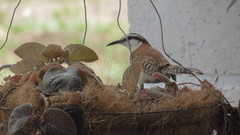

Rufous-backed Wren

Rufous-backed Wren

Campylorhynchus capistratus

Silhouette: Andy Wilson · PhyloPic

LCLeast ConcernNTVUENCR
Daily sighting probability ~70% · Very likely
at Managua

In 3 days >90%

1,694 Verified sightings at Managua
11,817 In all 18 parks From 2019 to 2026
December Best month
☀️ Diurnal When it's spotted

About the Rufous-backed Wren

The rufous-backed wren (Campylorhynchus capistratus) is a species of songbird in the family Troglodytidae. It is a resident breeding species distributed from southwestern Mexico to northwestern Costa Rica. What is now classified as the rufous-backed wren was formerly treated as six of the eight subspecies of rufous-naped wren (Campylorhynchus rufinucha). Following a 2009 proposal to split C. rufinucha (sensu lato) into three distinct species, the International Ornithological Committee (IOC) formally recognized the reclassification. Under this revision, C. r. humilis was elevated to full species status as Sclater's wren (Campylorhynchus humilis). The restricted C. rufinucha received the new English name Veracruz wren, and the remaining six subspecies were regrouped under rufous-backed wren.

While BirdLife International implemented the split, retaining the English name rufous-naped wren for C. rufinucha, major authorities such as the North American Classification Committee of the American Ornithological Society (NACC/AOS) and the Clements taxonomy had not accepted the revision as of early 2021.

The six subspecies of rufous-backed wren accepted by the IOC... Wikipedia →

Sounds

Song0:13

Costa Rica · 2013

© Albert Lastukhin · XC1101662 · CC BY-NC-ND 4.0

Duet0:11

Costa Rica · 2018

© Simon Elliott · XC597461 · CC BY-NC-ND 4.0

Call0:55

Honduras · 2018

© Oscar Campbell · XC436486 · CC BY-NC-SA 4.0

Global Distribution

Parks Where Found

# Park Country Daily sighting probability
1 Masaya Volcano National Park 🇳🇮 Nicaragua
~90%
2 Ostional Wildlife Refuge 🇨🇷 Costa Rica
~70%
3 Las Baulas Marine National Park 🇨🇷 Costa Rica
~60%
4 Carara National Park 🇨🇷 Costa Rica
~50%
5 Cabo Blanco Absolute Nature Reserve 🇨🇷 Costa Rica
~50%
6 Santa Rosa National Park 🇨🇷 Costa Rica
~50%
7 Palo Verde National Park 🇨🇷 Costa Rica
~40%
8 Rincón de la Vieja National Park 🇨🇷 Costa Rica
~40%
9 Lago de Yojoa 🇭🇳 Honduras
~30%
10 Cerro Azul Meámbar National Park 🇭🇳 Honduras
~20%
11 La Tigra National Park 🇭🇳 Honduras
~20%
12 El Triunfo 🇲🇽 Mexico
~10%
13 Manuel Antonio National Park 🇨🇷 Costa Rica
<5%
14 Marino Ballena National Park 🇨🇷 Costa Rica
<5%
15 Braulio Carrillo National Park 🇨🇷 Costa Rica
<5%
16 Monteverde Cloud Forest Reserve 🇨🇷 Costa Rica
<5%
17 Tenorio Volcano National Park 🇨🇷 Costa Rica
<5%
18 Arenal Volcano National Park 🇨🇷 Costa Rica
<5%

Cities Where Found

# City Country Daily sighting probability
1 Managua 🇳🇮 Nicaragua
~70%
2 Tegucigalpa 🇭🇳 Honduras
~70%
3 San Salvador 🇸🇻 El Salvador
~60%
4 San José 🇨🇷 Costa Rica
~60%
5 San Pedro Sula 🇭🇳 Honduras
~40%
6 Guatemala City 🇬🇹 Guatemala
<5%

Before you go

What are the chances of seeing a Rufous-backed Wren in Managua?

Very likely

About 70% of wildlife watchers report a Rufous-backed Wren sighting in Managua on a given day, based on 1,694 verified sightings from GBIF citizen-science data. It is the 8th most-seen of the 132 birds we can rate there. Over three days the chance rises to over 90%, if each day is a fresh chance.

When is the best time to see a Rufous-backed Wren in Managua?

August and November–December

In those months about 80% of wildlife watchers report a Rufous-backed Wren in Managua on a given day, against about 60% in January, the lowest month.

What time of day is best to see a Rufous-backed Wren?

Between 6 and 9 am

Across all the parks we cover, that three-hour window holds the most Rufous-backed Wren sightings with a recorded time, and about 9 in 10 of them come between 6 am and 6 pm: it is a daytime animal.

Is Managua the best place to see a Rufous-backed Wren?

Yes

Of the 6 cities where we can rate Rufous-backed Wren sightings, Managua has the highest daily chance: about 70%. Next come Tegucigalpa (Honduras, about 70%) and San Salvador (El Salvador, about 60%).

Where does the Rufous-backed Wren sighting chance come from?

GBIF citizen-science records

It is estimated from how often the Rufous-backed Wren is recorded against all the birds logged in Managua (1,694 verified sightings), calibrated against known sighting rates. Figures are rounded to the nearest 10% because citizen-science data supports honest approximations, not decimals, and months with records from fewer than five people show "—". How it works.

← Back to Managua