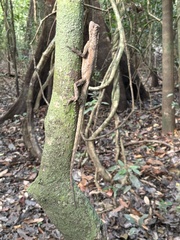
Diving Lizard

Diving Lizard

Uranoscodon superciliosus

Silhouette: Natalie Claunch · PhyloPic

LCLeast ConcernNTVUENCR
Daily sighting probability ~20% · Possible
at Manaus

In 3 days ~60% in a week ~90%

10 Verified sightings at Manaus
June Best month
☀️🌙 Day & Night When it's spotted

About the Diving Lizard

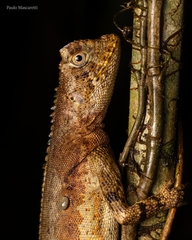
Uranoscodon is a monotypic genus of iguanomorph lizard belonging to the family Tropiduridae, the Neotropical ground lizards. Its sole member, Uranoscodon superciliosus, is commonly known as the diving lizard, brown tree climber or mophead iguana. It is found near water in the Amazon rainforest of South America.

Uranoscodon was first described as a genus in 1825 by the German naturalist Johann Jakob Kaup, its only species being Lacerta superciliosa which had been described by Carl Linnaeus in the 10th edition of his Systema Naturae published in 1758. Linnaeus gave the type locality as "Indiis", however, in 1973 this was narrowed down to the confluence of the Cottica River and Perica Creek in Suriname. The genus Uranoscodon is classified within the family Tropiduridae which, in turn, is within the clade Iguanoidea within the infraorder Iguanomorpha, which is also known as Iguania.

Uranoscodon superciliosus has a relatively small head, with a body and tail which show latero-lateral compression but it is not extremely flattened. It has a relatively long tail and legs. The overall colour is brown. There is a frill around the heads of adults which gives rise... Wikipedia →

Global Distribution

Parks Where Found

# Park Country Daily sighting probability

More parks will be added in future updates.

Cities Where Found

# City Country Daily sighting probability
1 Manaus 🇧🇷 Brazil
~20%

Before you go

What are the chances of seeing a Diving Lizard in Manaus?

Possible

About 20% of wildlife watchers report a Diving Lizard sighting in Manaus on a given day, based on 10 verified sightings from GBIF citizen-science data. It is the 12th most-seen of the 20 reptiles we can rate there. Over three days the chance rises to about 60%, and over a week to about 90%, if each day is a fresh chance.

When is the best time to see a Diving Lizard in Manaus?

June and September

In those months about 40% of wildlife watchers report a Diving Lizard in Manaus on a given day, against under 5% in February–April, August and November–December, the lowest months. Those are among Manaus's driest months, with about 95 mm of rain a month against 270 mm in March.

What time of day is best to see a Diving Lizard?

Between 8 and 11 pm

Across all the parks we cover, that three-hour window holds the most Diving Lizard sightings with a recorded time, and about half of them come between 6 am and 6 pm: it is seen both by day and at night.

Where else can you see a Diving Lizard?

Only Manaus, in our data

Manaus is the only city on Wallace's Line with enough records to rate Diving Lizard sightings: about 20% of wildlife watchers there report one on a given day.

Where does the Diving Lizard sighting chance come from?

GBIF citizen-science records

It is estimated from how often the Diving Lizard is recorded against all the reptiles logged in Manaus (10 verified sightings), calibrated against known sighting rates. Figures are rounded to the nearest 10% because citizen-science data supports honest approximations, not decimals, and months with records from fewer than five people show "—". How it works.

← Back to Manaus