Barba Amarilla

Barba Amarilla

Bothrops atrox

Silhouette: Steven Traver · PhyloPic

LCLeast ConcernNTVUENCR
Daily sighting probability ~30% · Possible
at Manaus

In 3 days ~70% in a week ~90%

15 Verified sightings at Manaus
126 In all 6 parks From 2019 to 2026
January Best month
☀️🌙 Day & Night When it's spotted

About the Barba Amarilla

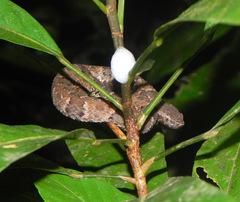
Bothrops atrox — also known as the common lancehead, fer-de-lance, barba amarilla, and mapepire balsain — is a highly venomous pit viper species found in the tropical lowlands of northern South America east of the Andes, as well as the Caribbean island of Trinidad. No subspecies are currently recognized.

The common lancehead was one of the many reptile and amphibian species described by Carl Linnaeus in the landmark 1758 10th edition of his Systema Naturae, where it was given the binomial name Coluber atrox. The taxonomy of this species is controversial; it may include B. leucurus and B. moojeni, and some of its populations are sometimes said to be separate species. B. asper was formerly included in this species, but most authorities now consider it distinct.

Common names include lancehead, fer-de-lance, barba amarilla, and mapepire balsain, among others. The Spanish common name barba amarilla (yellow beard), an allusion to the pale-yellow chin color, is also used in English. In Venezuela, it is called mapanare. In Colombia, it is known as mapaná (Llanos of Vichada) and talla equis. In Guyana and Suriname, it is called labaria or labarria. In Peru, it is... Wikipedia →

Global Distribution

Parks Where Found

# Park Country Daily sighting probability
1 Brownsberg Nature Park 🇸🇷 Suriname
~70%
2 Manu National Park 🇵🇪 Peru
~30%
3 Henri Pittier National Park 🇻🇪 Venezuela
~20%
4 Yasuní National Park 🇪🇨 Ecuador
~20%
5 Podocarpus National Park 🇪🇨 Ecuador
~20%
6 Tambopata National Reserve 🇵🇪 Peru
~10%

Cities Where Found

# City Country Daily sighting probability
1 Manaus 🇧🇷 Brazil
~30%

Zoos & Centres Where Found

# Zoo / Centre Country
1 ABQ BioPark Zoo 🇺🇸 United States In captivity
2 Rio de Janeiro Zoological Garden 🇧🇷 Brazil In captivity
3 Amaru 🇪🇨 Ecuador In captivity
4 Bioparque Los Ocarros 🇨🇴 Colombia In captivity
5 Refugio Silvestre Yanacocha 🇪🇨 Ecuador In captivity
6 Yanacocha Animal Rescue Centre 🇪🇨 Ecuador In captivity
7 Dantas 🇨🇴 Colombia In captivity

Closest Relatives at Manaus

No species of the same family or order lives in Manaus, so these are its closest relatives here: other reptiles.

Before you go

What are the chances of seeing a Barba Amarilla in Manaus?

Possible

About 30% of wildlife watchers report a Barba Amarilla sighting in Manaus on a given day, based on 15 verified sightings from GBIF citizen-science data. It is the 8th most-seen of the 20 reptiles we can rate there. Over three days the chance rises to about 70%, and over a week to about 90%, if each day is a fresh chance.

When is the best time to see a Barba Amarilla in Manaus?

March, May and December–January

In those months about 50% of wildlife watchers report a Barba Amarilla in Manaus on a given day, against under 5% in February, April, July–August and October–November, the lowest months.

What time of day is best to see a Barba Amarilla?

Between 8 and 11 pm

Across all the parks we cover, that three-hour window holds the most Barba Amarilla sightings with a recorded time, and about 6 in 10 of them come between 6 pm and 6 am: it is seen both by day and at night.

Where else can you see a Barba Amarilla?

Only Manaus, in our data

Manaus is the only city on Wallace's Line with enough records to rate Barba Amarilla sightings: about 30% of wildlife watchers there report one on a given day.

Where does the Barba Amarilla sighting chance come from?

GBIF citizen-science records

It is estimated from how often the Barba Amarilla is recorded against all the reptiles logged in Manaus (15 verified sightings), calibrated against known sighting rates. Figures are rounded to the nearest 10% because citizen-science data supports honest approximations, not decimals, and months with records from fewer than five people show "—". How it works.

← Back to Manaus