Pipe Snake

Pipe Snake

Anilius scytale

Silhouette: Eduardo Santos (photograph) · PhyloPic

LCLeast ConcernNTVUENCR
Daily sighting probability ~20% · Possible
at Manaus

In 3 days ~60% in a week ~90%

11 Verified sightings at Manaus
9 In 1 park From 2019 to 2026
November Best month
☀️🌙 Day & Night When it's spotted

About the Pipe Snake

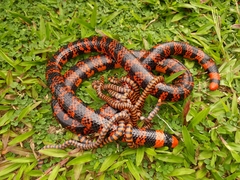
The Aniliidae are a monotypic family created for the monotypic genus Anilius that contains the single species Anilius scytale. Common names include the American pipe snake and false coral snake. It is found in South America. This snake possesses a vestigial pelvic girdle that is visible as a pair of cloacal spurs. It is ovoviviparous. It is non-venomous, and its diet consists mainly of amphibians and other reptiles. Two subspecies are recognized, including the nominate subspecies described here.

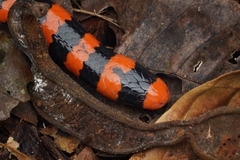
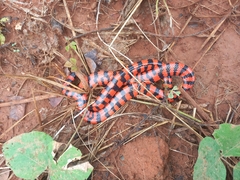
This species is found in the Amazon rainforest of South America, the Guianas, and Trinidad and Tobago. It is a moderate-sized snake attaining a size of about 70 cm (28 in) in length. It is fossorial and is rarely seen. It is reported to be ovoviviparous and feeds on beetles, caecilians (burrowing legless amphibians), amphisbaenids or worm lizards (legless lizards), small fossorial snakes, fish (particularly swamp eels), and frogs. It forages for food on the ground, and sometimes in the water, at night. It has a cylindrical body of uniform diameter and a very short tail; it is brightly banded in red and black and its reduced eyes lie beneath large head scales. It is considered... Wikipedia →

Global Distribution

Parks Where Found

# Park Country Daily sighting probability
1 Manu National Park 🇵🇪 Peru
~10%

More parks will be added in future updates.

Cities Where Found

# City Country Daily sighting probability
1 Manaus 🇧🇷 Brazil
~20%

Closest Relatives at Manaus

No species of the same family or order lives in Manaus, so these are its closest relatives here: other reptiles.

Before you go

What are the chances of seeing a Pipe Snake in Manaus?

Possible

About 20% of wildlife watchers report a Pipe Snake sighting in Manaus on a given day, based on 11 verified sightings from GBIF citizen-science data. It is the 12th most-seen of the 20 reptiles we can rate there. Over three days the chance rises to about 60%, and over a week to about 90%, if each day is a fresh chance.

When is the best time to see a Pipe Snake in Manaus?

November

In that month about 50% of wildlife watchers report a Pipe Snake in Manaus on a given day, against under 5% in April, July–October and December, the lowest months.

What time of day is best to see a Pipe Snake?

Between 7 and 10 pm

Across all the parks we cover, that three-hour window holds the most Pipe Snake sightings with a recorded time, and about 6 in 10 of them come between 6 pm and 6 am: it is seen both by day and at night.

Where else can you see a Pipe Snake?

Only Manaus, in our data

Manaus is the only city on Wallace's Line with enough records to rate Pipe Snake sightings: about 20% of wildlife watchers there report one on a given day.

Where does the Pipe Snake sighting chance come from?

GBIF citizen-science records

It is estimated from how often the Pipe Snake is recorded against all the reptiles logged in Manaus (11 verified sightings), calibrated against known sighting rates. Figures are rounded to the nearest 10% because citizen-science data supports honest approximations, not decimals, and months with records from fewer than five people show "—". How it works.

← Back to Manaus