Colorado River Toad

Colorado River Toad

Incilius alvarius

Silhouette: Jose Carlos Arenas-Monroy · PhyloPic

LCLeast ConcernNTVUENCR
Daily sighting probability ~10% · With luck
at Mesa

In 3 days ~20% in a week ~40%

20 Verified sightings at Mesa
295 In 1 park From 2019 to 2026
July Best month
🌙 Nocturnal When it's spotted

About the Colorado River Toad

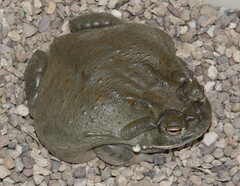
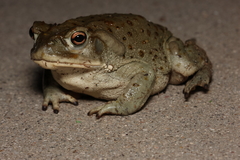
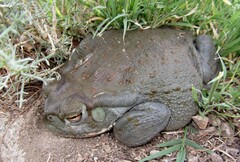
The Colorado River toad (Incilius alvarius), (previously Bufo alvarius) also known as the Sonoran Desert toad, is a toad species found in northwestern Mexico and the southwestern United States. It is well known for its ability to exude toxins from glands within its skin that have psychoactive properties.

The toad's scientific name used to be Bufo alvarius, the name for which the toad is generally colloquially still known as. In the early 2000s, the increasingly important role of molecular genetic techniques in taxonomy and their ability to examine phylogenetic relationships allowed scientists to discover numerous distinct genera within the old Bufo group.

The Colorado River toad's name was subsequently changed to Incilius alvarius. The Colorado River toad can grow to about 190 millimetres (7.5 in) long and is the largest toad in the United States apart from the non-native cane toad (Rhinella marina). It has a smooth, leathery skin and is olive green or mottled brown in color. Just behind the large golden eye with a horizontal pupil is a bulging kidney-shaped parotoid gland. Below this is a large circular pale green area which is the tympanum or ear drum. By the corner... Wikipedia →

Sounds

Recording0:32

United States · 2025

© C. Mallory · iNaturalist · CC BY-NC 4.0

Recording0:10

United States · 2023

© Emilio Romero · iNaturalist · CC BY-NC 4.0

Recording1:04

United States · 2025

© Logan Young · iNaturalist · CC BY-NC 4.0

Global Distribution

Parks Where Found

# Park Country Daily sighting probability
1 Saguaro National Park 🇺🇸 United States
~30%

More parks will be added in future updates.

Cities Where Found

# City Country Daily sighting probability
1 Mesa 🇺🇸 United States
~10%
2 Phoenix 🇺🇸 United States
~10%

Zoos & Centres Where Found

# Zoo / Centre Country
1 San Diego Zoo 🇺🇸 United States In captivity
2 Pairi Daiza 🇧🇪 Belgium In captivity
3 Prague Zoo 🇨🇿 Czechia In captivity
4 Leipzig Zoological Garden 🇩🇪 Germany In captivity
5 Zürich Zoo 🇨🇭 Switzerland In captivity
6 North Carolina Zoo 🇺🇸 United States In captivity
7 Living Desert Zoo and Gardens 🇺🇸 United States In captivity
8 Sedgwick County Zoo 🇺🇸 United States In captivity
9 Oakland Zoo 🇺🇸 United States In captivity
10 Phoenix Zoo 🇺🇸 United States In captivity
11 Toledo Zoo 🇺🇸 United States In captivity
12 Louisville Zoo 🇺🇸 United States In captivity
13 Yaroslavl Zoo 🇷🇺 Russia In captivity
14 ABQ BioPark: Zoo, Aquarium, Botanic Garden 🇺🇸 United States In captivity
15 Burgers' Ocean 🇳🇱 Netherlands In captivity
16 Berlin Zoological Garden 🇩🇪 Germany In captivity
17 Royal Burgers' Zoo 🇳🇱 Netherlands In captivity
18 Wrocław Zoological Garden 🇵🇱 Poland In captivity
19 Zoologischer Garten Leipzig 🇩🇪 Germany In captivity
20 Indianapolis Zoo 🇺🇸 United States In captivity
21 Arizona-Sonora Desert Museum 🇺🇸 United States In captivity
22 Philadelphia Zoo 🇺🇸 United States In captivity
23 Schönbrunn Zoo 🇦🇹 Austria In captivity
24 Hogle Zoo 🇺🇸 United States In captivity
25 Łódź Zoo 🇵🇱 Poland In captivity
26 Tierpark Bern 🇨🇭 Switzerland In captivity
27 Little Rock Zoo 🇺🇸 United States In captivity
28 Zoo Neuwied 🇩🇪 Germany In captivity
29 Frankfurt Zoological Garden 🇩🇪 Germany In captivity
30 Leningrad Zoo 🇷🇺 Russia In captivity
31 Alligator Adventure 🇺🇸 United States In captivity
32 Peoria Zoo 🇺🇸 United States In captivity
33 Elmwood Park Zoo 🇺🇸 United States In captivity
34 Downtown Aquarium, Denver 🇺🇸 United States In captivity
35 Africarium 🇵🇱 Poland In captivity
36 Oceanium 🇳🇱 Netherlands In captivity
37 OdySea Aquarium 🇺🇸 United States In captivity
38 Haus des Meeres 🇦🇹 Austria In captivity
39 Aquarium Berlin 🇩🇪 Germany In captivity
40 Children's Aquarium at Fair Park 🇺🇸 United States In captivity
41 Rákosův pavilon 🇨🇿 Czechia In captivity
42 Velemlokárium 🇨🇿 Czechia In captivity
43 Chehaw Park 🇺🇸 United States In captivity
44 Kung Fu Corals 🇺🇸 United States In captivity
45 terrarium ogrodu zoologicznego we Wrocławiu 🇵🇱 Poland In captivity
46 Wolfgang-Köhler-Primaten-Forschungszentrum 🇩🇪 Germany In captivity

Before you go

What are the chances of seeing a Colorado River Toad in Mesa?

With luck

About 10% of wildlife watchers report a Colorado River Toad sighting in Mesa on a given day, based on 20 verified sightings from GBIF citizen-science data. It is the 3rd most-seen of the 6 amphibians we can rate there. Over three days the chance rises to about 20%, and over a week to about 40%, if each day is a fresh chance.

When is the best time to see a Colorado River Toad in Mesa?

June to August

In those months about 20% of wildlife watchers report a Colorado River Toad in Mesa on a given day, against under 5% in January–April and October–November, the lowest months.

What time of day is best to see a Colorado River Toad?

Between 7 and 10 pm

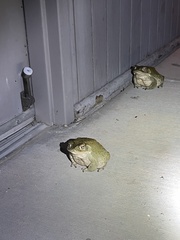
Across all the parks we cover, that three-hour window holds the most Colorado River Toad sightings with a recorded time, and about 8 in 10 of them come between 6 pm and 6 am: it is mostly seen at night.

Is Mesa the best place to see a Colorado River Toad?

Yes

Of the 2 cities where we can rate Colorado River Toad sightings, Mesa has the highest daily chance: about 10%. Next come Phoenix (United States, about 10%).

Which relatives of the Colorado River Toad live in Mesa?

Same family: Bufonidae

The closest relatives of the Colorado River Toad that you can see in Mesa (family Bufonidae, True Toads) are Woodhouse's Toad (about 20%) and Red-spotted Toad (about 10%), with each one's daily chance of a sighting.

Where does the Colorado River Toad sighting chance come from?

GBIF citizen-science records

It is estimated from how often the Colorado River Toad is recorded against all the amphibians logged in Mesa (20 verified sightings), calibrated against known sighting rates. Figures are rounded to the nearest 10% because citizen-science data supports honest approximations, not decimals, and months with records from fewer than five people show "—". How it works.

← Back to Mesa