Couch's Spadefoot

Couch's Spadefoot

Scaphiopus couchii

Silhouette: Jose Carlos Arenas-Monroy · PhyloPic

LCLeast ConcernNTVUENCR
Daily sighting probability ~10% · With luck
at Mesa

In 3 days ~20% in a week ~50%

28 Verified sightings at Mesa
155 In all 4 parks From 2019 to 2026
September Best month
🌙 Nocturnal When it's spotted

About the Couch's Spadefoot

Couch's spadefoot toad or Couch's spadefoot (Scaphiopus couchii) is a species of North American spadefoot toad (family Scaphiopodidae). The specific epithet couchii is in honor of American naturalist Darius Nash Couch, who collected the first specimen while on a personal expedition to northern Mexico to collect plant, mineral, and animal specimens for the Smithsonian Institution.

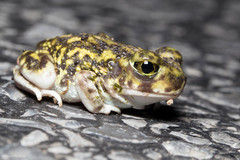
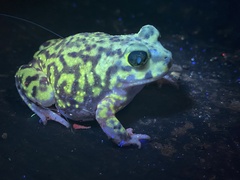
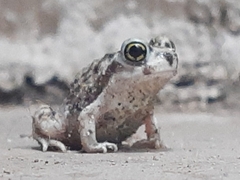
Unlike other toads which have horizontal pupils, spadefoot toads have vertical pupils. On the underside of the hind foot is a hard, dark "spade" that gives spadefoot toads their name. The length of this spadefoot ranges from 5.5 to 9 cm (2.2 to 3.5 in), and body color being yellow to yellow-green, with darker mottling. These "spades" are used by the toads to burrow into the ground to prevent water loss and hide from predators. There are two spadefoot species in the Sonoran Desert of Arizona and California. Couch's spadefoot toad (Scaphiopus couchi) has a sickle-shaped "spade", whereas the western spadefoot toad (Spea hammondii) has a rounded "spade". Contrary to the name, spadefoots are not true toads

Couch's spadefoot is native to the United States southwest of southeastern... Wikipedia →

Sounds

Advertisement call0:10

United States · 2013

© Chris Harrison · XC893997 · CC BY-NC-SA 4.0

Recording0:14

United States · 2019

© Jon McIntyre · iNaturalist · CC BY-NC 4.0

Recording0:11

Mexico · 2026

© Bjorn V. Peterson · iNaturalist · CC BY-NC 4.0

Global Distribution

Parks Where Found

# Park Country Daily sighting probability
1 Cabo Pulmo National Park 🇲🇽 Mexico
~40%
2 Saguaro National Park 🇺🇸 United States
~20%
3 El Vizcaíno Biosphere Reserve 🇲🇽 Mexico
~10%
4 Big Bend National Park 🇺🇸 United States
~10%

Cities Where Found

# City Country Daily sighting probability
1 Mesa 🇺🇸 United States
~10%
2 Phoenix 🇺🇸 United States
~10%

Zoos & Centres Where Found

# Zoo / Centre Country
1 Phoenix Zoo 🇺🇸 United States In captivity

Before you go

What are the chances of seeing a Couch's Spadefoot in Mesa?

With luck

About 10% of wildlife watchers report a Couch's Spadefoot sighting in Mesa on a given day, based on 28 verified sightings from GBIF citizen-science data. It is the 2nd most-seen of the 6 amphibians we can rate there. Over three days the chance rises to about 20%, and over a week to about 50%, if each day is a fresh chance.

When is the best time to see a Couch's Spadefoot in Mesa?

September

In that month about 30% of wildlife watchers report a Couch's Spadefoot in Mesa on a given day, against under 5% in November to May, the lowest months.

What time of day is best to see a Couch's Spadefoot?

Between 8 and 11 pm

Across all the parks we cover, that three-hour window holds the most Couch's Spadefoot sightings with a recorded time, and about 9 in 10 of them come between 6 pm and 6 am: it is mostly seen at night.

Is Mesa the best place to see a Couch's Spadefoot?

Yes

Of the 2 cities where we can rate Couch's Spadefoot sightings, Mesa has the highest daily chance: about 10%. Next come Phoenix (United States, about 10%).

Which relatives of the Couch's Spadefoot live in Mesa?

Same order: Anura

The closest relatives of the Couch's Spadefoot that you can see in Mesa (order Anura, Frogs and Toads) are Woodhouse's Toad (about 20%), Colorado River Toad (about 10%) and Red-spotted Toad (about 10%), with each one's daily chance of a sighting.

Where does the Couch's Spadefoot sighting chance come from?

GBIF citizen-science records

It is estimated from how often the Couch's Spadefoot is recorded against all the amphibians logged in Mesa (28 verified sightings), calibrated against known sighting rates. Figures are rounded to the nearest 10% because citizen-science data supports honest approximations, not decimals, and months with records from fewer than five people show "—". How it works.

← Back to Mesa