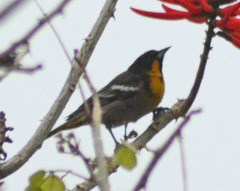
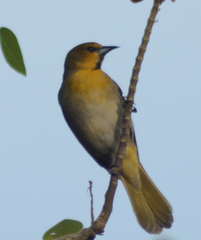
Black-backed Oriole

Black-backed Oriole

Icterus abeillei

Silhouette: Matt Wilkins · PhyloPic

LCLeast ConcernNTVUENCR Endemic
Daily sighting probability ~20% · Possible
at Mexico City

In 3 days ~50% in a week ~80%

2,650 Verified sightings at Mexico City
9 In 1 park From 2019 to 2026
May Best month
☀️ Diurnal When it's spotted

About the Black-backed Oriole

The black-backed oriole (Icterus abeillei) is a species of bird in the family Icteridae, the oropendolas, New World orioles, and New World blackbirds. It is endemic to Mexico. The black-backed oriole was formally described in 1839 with the binomial Xanthornis Abeillei (sic). At one time it and what are now Bullock's oriole (I. bullockiorum) and the Baltimore oriole (I. galbula) were treated as conspecific.

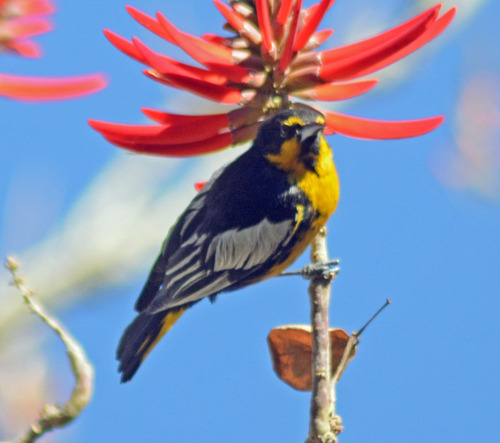
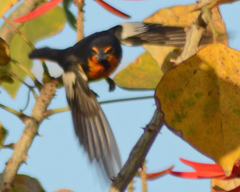
The black-backed oriole is monotypic. The black-backed oriole is 18 to 20.5 cm (7.1 to 8.1 in) long and weighs 31 to 37 g (1.1 to 1.3 oz). Adult males are black on the crown, sides of the head, nape, and upperparts. They have an orange line above the lores, thin orange crescents above and below the eye, and orange cheeks. Their upperwing is mostly black with wide white edges on the flight feathers. The wing's median and greater coverts are white and show as a large patch on the closed wing. Their tail's three outer pairs of feathers are yellow with black tips and the rest are black. They have a black chin that extends in a thin stripe down the throat. The rest of their throat and their underparts are orange-yellow. Their flanks and... Wikipedia →

Sounds

Call0:55

Mexico · 2019

© Manuel Grosselet · XC462195 · CC BY-NC-SA 4.0

Song1:01

Mexico · 2020

© Isain Contreras Rodríguez · XC586473 · CC BY-NC-SA 4.0

Call0:30

Mexico · 2017

© JAVIER SALGADO-ORTIZ · XC370919 · CC BY-NC-SA 4.0

Global Distribution

Parks Where Found

# Park Country Daily sighting probability
1 Reserva de la Biosfera Mariposa Monarca 🇲🇽 Mexico
<5%

More parks will be added in future updates.

Cities Where Found

# City Country Daily sighting probability
1 Mexico City 🇲🇽 México
~20%
2 León 🇲🇽 México
~10%
3 Puebla 🇲🇽 México
<5%
4 Toluca 🇲🇽 México
<5%
5 Guadalajara 🇲🇽 México
<5%

Before you go

What are the chances of seeing a Black-backed Oriole in Mexico City?

Possible

About 20% of wildlife watchers report a Black-backed Oriole sighting in Mexico City on a given day, based on 2,650 verified sightings from GBIF citizen-science data. It is the 43rd most-seen of the 332 birds we can rate there. Over three days the chance rises to about 50%, and over a week to about 80%, if each day is a fresh chance.

When is the best time to see a Black-backed Oriole in Mexico City?

May to July

In those months about 30% of wildlife watchers report a Black-backed Oriole in Mexico City on a given day, against about 20% in August to April, the lowest months. Those are among Mexico City's wettest months, with about 110 mm of rain a month against 5 mm in December.

What time of day is best to see a Black-backed Oriole?

Between 9 am and noon

Across all the parks we cover, that three-hour window holds the most Black-backed Oriole sightings with a recorded time, and about 9 in 10 of them come between 6 am and 6 pm: it is a daytime animal.

Is Mexico City the best place to see a Black-backed Oriole?

Yes

Of the 5 cities where we can rate Black-backed Oriole sightings, Mexico City has the highest daily chance: about 20%. Next come León (México, about 10%) and Puebla (México, under 5%).

Which relatives of the Black-backed Oriole live in Mexico City?

Same genus: Icterus

The closest relatives of the Black-backed Oriole that you can see in Mexico City (genus Icterus, New World Orioles) are Bullock's Oriole (about 10%) and Orchard Oriole (about 10%), with each one's daily chance of a sighting.

Where does the Black-backed Oriole sighting chance come from?

GBIF citizen-science records

It is estimated from how often the Black-backed Oriole is recorded against all the birds logged in Mexico City (2,650 verified sightings), calibrated against known sighting rates. Figures are rounded to the nearest 10% because citizen-science data supports honest approximations, not decimals, and months with records from fewer than five people show "—". How it works.
← Back to Mexico City