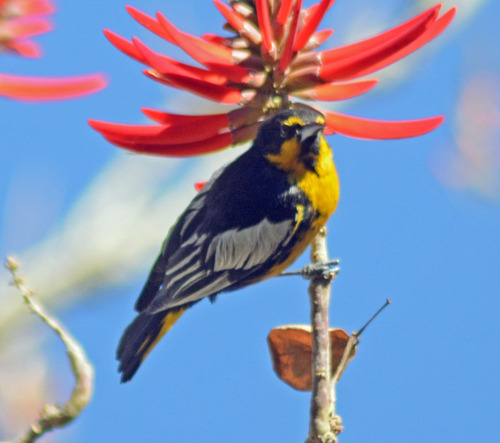
Chihuahuan Meadowlark

Chihuahuan Meadowlark

Sturnella lilianae

Silhouette: Sheatherius · PhyloPic

Daily sighting probability <5% · Rare
at Mexico City

In 3 days <5% in a week ~10%

152 Verified sightings at Mexico City
42 In 1 park From 2019 to 2026
August Best month
☀️ Diurnal When it's spotted

About the Chihuahuan Meadowlark

The Chihuahuan meadowlark (Sturnella lilianae), also known as Lilian's meadowlark, is a bird in the family Icteridae, the oropendolas, New World orioles, and New World blackbirds. It is found in Mexico and the United States.

The Chihuahuan meadowlark was formally described in 1930 by the American ornithologist Harry C. Oberholser as a subspecies of the eastern meadowlark based on a holotype that had been collected in the Huachuca Mountains of Arizona. Oberholser proposed the trinomial Sturnella magna lilianae. The subspecific epithet lilianae was chosen to honor Lilian Hanna Baldwin (wife of ornithologist Samuel Prentiss Baldwin), as she had presented the Cleveland Museum of Natural History the collection of birds that included the type specimen of the new subspecies.

The Chihuahuan meadowlark's further taxonomy is unsettled. A 2021 publication detailed morphological, vocal, and genomic differences between the Chihuahuan meadowlark and the other subspecies of the eastern meadowlark. Based largely on it, in 2022 the American Ornithological Society, the Clements taxonomy, and the IOC recognized two of the subspecies of the eastern meadowlark as the Chichuahuan... Wikipedia →

Sounds

Recording0:31

United States · 2025

© heloderma · iNaturalist · CC BY-NC 4.0

Recording0:25

United States · 2023

© Christopher Rustay · iNaturalist · CC BY-NC 4.0

Recording0:08

United States · 2025

© Davis Provan · iNaturalist · CC BY-NC 4.0

Global Distribution

Parks Where Found

# Park Country Daily sighting probability
1 Big Bend National Park 🇺🇸 United States
<5%

More parks will be added in future updates.

Cities Where Found

# City Country Daily sighting probability
1 Mexico City 🇲🇽 México
<5%

Before you go

What are the chances of seeing a Chihuahuan Meadowlark in Mexico City?

Rare

Under 5% of wildlife watchers report a Chihuahuan Meadowlark sighting in Mexico City on a given day, based on 152 verified sightings from GBIF citizen-science data. It is the 211th most-seen of the 332 birds we can rate there. Over three days the chance rises to under 5%, and over a week to about 10%, if each day is a fresh chance.

When is the best time to see a Chihuahuan Meadowlark in Mexico City?

Any time of year

In every month with enough records, under 5% of wildlife watchers report a Chihuahuan Meadowlark in Mexico City on a given day, so our monthly data shows no clear season.

What time of day is best to see a Chihuahuan Meadowlark?

Between 7 and 10 am

Across all the parks we cover, that three-hour window holds the most Chihuahuan Meadowlark sightings with a recorded time, and about 9 in 10 of them come between 6 am and 6 pm: it is a daytime animal.

Where else can you see a Chihuahuan Meadowlark?

Only Mexico City, in our data

Mexico City is the only city on Wallace's Line with enough records to rate Chihuahuan Meadowlark sightings: under 5% of wildlife watchers there report one on a given day.

Which relatives of the Chihuahuan Meadowlark live in Mexico City?

Same family: Icteridae

The closest relatives of the Chihuahuan Meadowlark that you can see in Mexico City (family Icteridae, New World Blackbirds and Orioles) are Great-tailed Grackle (about 70%), Bronzed Cowbird (about 20%) and Black-backed Oriole (about 20%), with each one's daily chance of a sighting.

Where does the Chihuahuan Meadowlark sighting chance come from?

GBIF citizen-science records

It is estimated from how often the Chihuahuan Meadowlark is recorded against all the birds logged in Mexico City (152 verified sightings), calibrated against known sighting rates. Figures are rounded to the nearest 10% because citizen-science data supports honest approximations, not decimals, and months with records from fewer than five people show "—". How it works.

← Back to Mexico City