About the Common European Greenbottle Fly
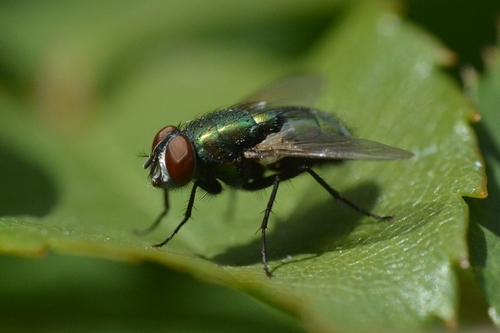
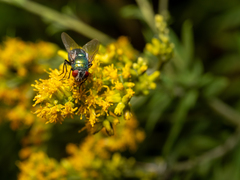
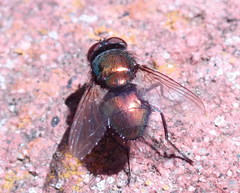
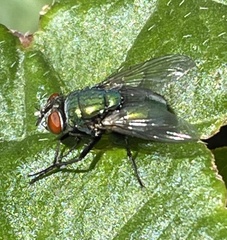
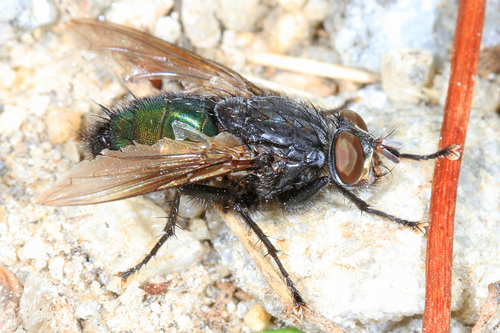
The common green bottle fly or common European green bottle fly (Lucilia sericata) is a blowfly found in most areas of the world and is the most well-known of the numerous green bottle fly species. Its body is 10–14 mm (0.39–0.55 in) in length – slightly larger than a house fly – and has brilliant, metallic, blue-green or golden coloration with black markings. It has short, sparse, black bristles (setae) and three cross-grooves on the thorax. The wings are clear with light brown veins, and the legs and antennae are black. The larvae of the fly may be used for maggot therapy, are commonly used in forensic entomology, and can be the cause of myiasis in livestock and pets. The common green bottle fly emerges in the spring for mating.
The defining characteristic of L. sericata and the one most used when identifying the adult fly is the presence of three bristles on the dorsal mesothorax, located on the middle of the back of the fly. L. sericata is almost identical to its conspecific, L. cuprina, and identification between them requires microscopic examination of two main distinguishing characteristics. L. sericata is blue-black, as opposed to L. cuprina, which has a metallic... Wikipedia →