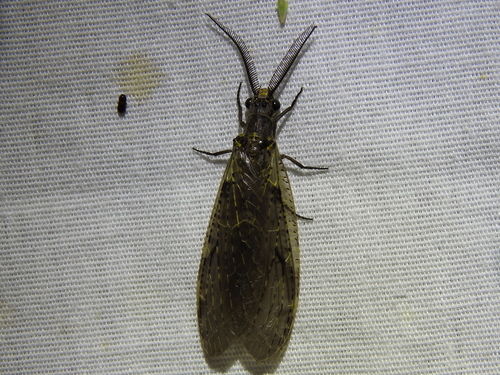



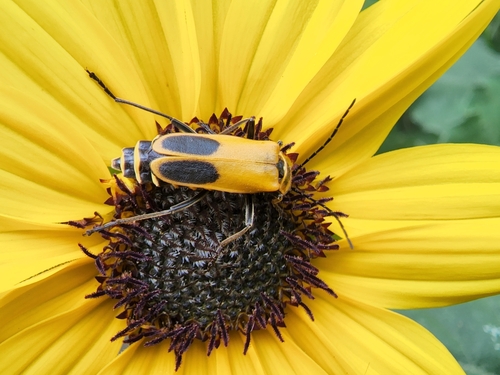
Eastern Dobsonfly
Daily sighting probability <5% · Rare
at Minneapolis [Saint Paul]

In 3 days ~10% in a week ~30%

28 Verified sightings at Minneapolis [Saint Paul]
168 In all 2 parks From 2019 to 2026
July Best month
☀️🌙 Day & Night When it's spotted

About the Eastern Dobsonfly

The eastern dobsonfly, Corydalus cornutus, is a large insect in the Corydalidae family. The larvae are known as hellgrammites and are among the top invertebrate predators in the streams in which they live, and are used by anglers as bait.

The eastern dobsonfly is found in most of eastern North America. It is usually found near the swift-flowing, unpolluted streams where its aquatic larvae develop. The origin of the word "dobsonfly" is unclear. John Henry Comstock used the term in reference to this species in his 1897 book Insect Life, but did not explain it. He also mentioned that anglers use the word "hellgrammite" for the aquatic larvae they used as bait, but the origin of this term is also unknown. These common names are still widely used for this and other species of corydalids, and essentially all that is known is that the earliest recorded uses appear to originate in the southern Appalachian region of the US (Kentucky, Tennessee, Virginia, West Virginia), where there were other archaic regional names and variants such as "helgamite", "hojack", "go-devil", and "grampus" (or "crampuss"), all with no definitive source or etymology. The latter... Wikipedia →

Global Distribution

Parks Where Found

# Park Country Daily sighting probability
1 Great Smoky Mountains National Park 🇺🇸 United States
~20%
2 Shenandoah National Park 🇺🇸 United States
~10%

Cities Where Found

# City Country Daily sighting probability
1 Baltimore 🇺🇸 United States
~10%
2 Washington 🇺🇸 United States
~10%
3 Minneapolis [Saint Paul] 🇺🇸 United States
<5%
4 Dallas 🇺🇸 United States
<5%
5 Austin 🇺🇸 United States
<5%
6 Montreal 🇨🇦 Canada
<5%
7 New York City 🇺🇸 United States
<5%

Before you go

What are the chances of seeing an Eastern Dobsonfly in Minneapolis [Saint Paul]?

Rare

Under 5% of wildlife watchers report an Eastern Dobsonfly sighting in Minneapolis [Saint Paul] on a given day, based on 28 verified sightings from GBIF citizen-science data. It is the 227th most-seen of the 672 insects we can rate there. Over three days the chance rises to about 10%, and over a week to about 30%, if each day is a fresh chance.

When is the best time to see an Eastern Dobsonfly in Minneapolis [Saint Paul]?

June and July

In those months about 10% of wildlife watchers report an Eastern Dobsonfly in Minneapolis [Saint Paul] on a given day, against under 5% in August to May, the lowest months. Those are among Minneapolis [Saint Paul]'s wettest months, with about 110 mm of rain a month against 20 mm in January.

What time of day is best to see an Eastern Dobsonfly?

Between noon and 3 pm

Across all the parks we cover, that three-hour window holds the most Eastern Dobsonfly sightings with a recorded time, and about 6 in 10 of them come between 6 am and 6 pm: it is seen both by day and at night.

Is Minneapolis [Saint Paul] the best place to see an Eastern Dobsonfly?

3rd of 7

Of the 7 cities where we can rate Eastern Dobsonfly sightings, Minneapolis [Saint Paul] ranks 3rd at under 5%. The best odds are in Baltimore (United States, about 10%) and Washington (United States, about 10%).

Where does the Eastern Dobsonfly sighting chance come from?

GBIF citizen-science records

It is estimated from how often the Eastern Dobsonfly is recorded against all the insects logged in Minneapolis [Saint Paul] (28 verified sightings), calibrated against known sighting rates. Figures are rounded to the nearest 10% because citizen-science data supports honest approximations, not decimals, and months with records from fewer than five people show "—". How it works.

← Back to Minneapolis [Saint Paul]