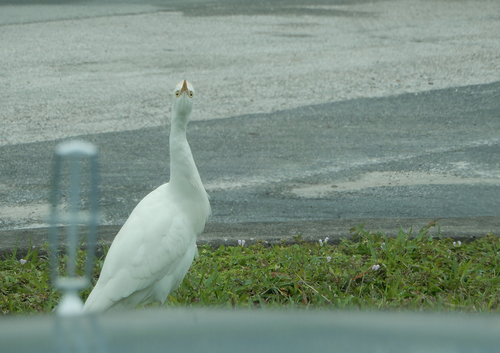
Western Reef Egret

Western Reef Egret

Egretta gularis

Silhouette: L. Shyamal · PhyloPic

LCLeast ConcernNTVUENCR
Daily sighting probability <5% · Rare
at Monrovia

In 3 days ~10% in a week ~20%

6 Verified sightings at Monrovia
66 In all 4 parks From 2019 to 2026
February Best month
☀️ Diurnal When it's spotted

About the Western Reef Egret

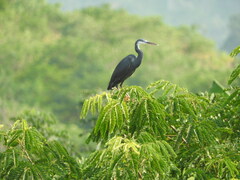
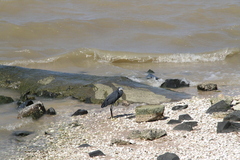
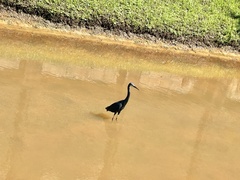
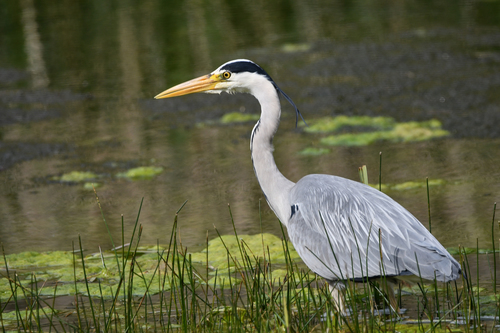
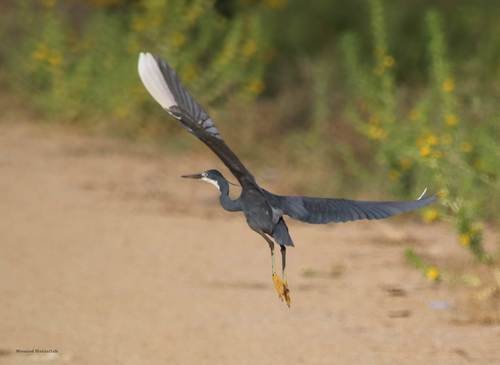
The western reef heron (Egretta gularis), also called the western reef egret, is a medium-sized heron found in Africa and parts of Asia, with vagrancy occurring in Europe and the Americas. It has a mainly coastal distribution and occurs in several plumage forms: a slaty-grey plumage which can only be confused with the rather uncommon dark morph of the little egret (Egretta garzetta); a white form which can look very similar to the little egret, although the reef heron's bill tends to be paler and larger; and a black form with a white throat, E. g. gularis, found in West Africa. There are also differences in size, structure and foraging behaviour. There have been suggestions that the species hybridizes with the little egret, and based on this, some authors treat schistacea and gularis as subspecies of Egretta garzetta. Works that consider the western reef heron as a valid species include the nominate gularis and schistacea as subspecies.

This bird has two plumage colour forms. There is an all-white morph and a dark grey morph; morphs can also occur with intermediate shades of grey which may be related to age or particoloured in grey and white. The white morph is similar... Wikipedia →

Sounds

Flight call0:29

Saudi Arabia · 2021

© Frank Lambert · XC741261 · CC BY-NC-ND 4.0

Call0:09

Guinea-Bissau · 2020

© Joost van Bruggen · XC523293 · CC BY-NC-ND 4.0

Call0:18

Oman · 2019

© Alain Malengreau · XC522263 · CC BY-NC-SA 4.0

Global Distribution

Parks Where Found

# Park Country Daily sighting probability
1 Snowdonia National Park 🇬🇧 United Kingdom
~20%
2 Gir National Park 🇮🇳 India
~10%
3 Niokolo-Koba National Park 🇸🇳 Senegal
~10%
4 Yala National Park 🇱🇰 Sri Lanka
<5%

Cities Where Found

# City Country Daily sighting probability
1 Manama 🇧🇭 Bahrain
~70%
2 Kuwait City 🇰🇼 Kuwait
~50%
3 Karachi 🇵🇰 Pakistan
~40%
4 Dakar 🇸🇳 Senegal
~40%
5 Serrekunda 🇬🇲 Gambia
~40%
6 Dammam 🇸🇦 Saudi Arabia
~30%
7 Lagos 🇳🇬 Nigeria
~30%
8 Accra 🇬🇭 Ghana
~20%
9 Abidjan 🇨🇮 Côte d'Ivoire
~20%
10 Abu Dhabi 🇦🇪 United Arab Emirates
~20%

Before you go

What are the chances of seeing a Western Reef Egret in Monrovia?

Rare

Under 5% of wildlife watchers report a Western Reef Egret sighting in Monrovia on a given day, based on 6 verified sightings from GBIF citizen-science data. It is the 43rd most-seen of the 59 birds we can rate there. Over three days the chance rises to about 10%, and over a week to about 20%, if each day is a fresh chance.

When is the best time to see a Western Reef Egret in Monrovia?

February

In that month about 20% of wildlife watchers report a Western Reef Egret in Monrovia on a given day, against under 5% in June to December, the lowest months. That is one of Monrovia's driest months, with about 25 mm of rain against 400 mm in August. March to May have too few records to rate.

What time of day is best to see a Western Reef Egret?

Between 8 and 11 am

Across all the parks we cover, that three-hour window holds the most Western Reef Egret sightings with a recorded time, and about 9 in 10 of them come between 6 am and 6 pm: it is a daytime animal.

Is Monrovia the best place to see a Western Reef Egret?

22nd of 29

Of the 29 cities where we can rate Western Reef Egret sightings, Monrovia ranks 22nd at under 5%. The best odds are in Manama (Bahrain, about 70%), Kuwait City (Kuwait, about 50%) and Karachi (Pakistan, about 40%).

Where does the Western Reef Egret sighting chance come from?

GBIF citizen-science records

It is estimated from how often the Western Reef Egret is recorded against all the birds logged in Monrovia (6 verified sightings), calibrated against known sighting rates. Figures are rounded to the nearest 10% because citizen-science data supports honest approximations, not decimals, and months with records from fewer than five people show "—". How it works.
← Back to Monrovia