Southern Flannel Moth

Southern Flannel Moth

Megalopyge opercularis

Daily sighting probability <5% · Rare
at Monterrey

In 3 days ~10% in a week ~30%

17 Verified sightings at Monterrey
120 In all 5 parks From 2019 to 2026
October Best month
☀️🌙 Day & Night When it's spotted

About the Southern Flannel Moth

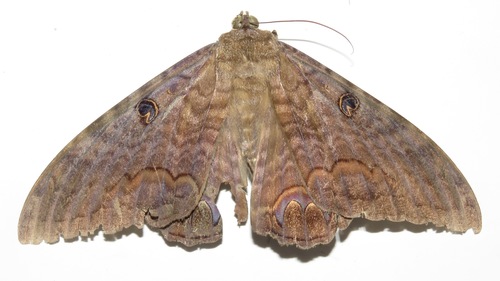
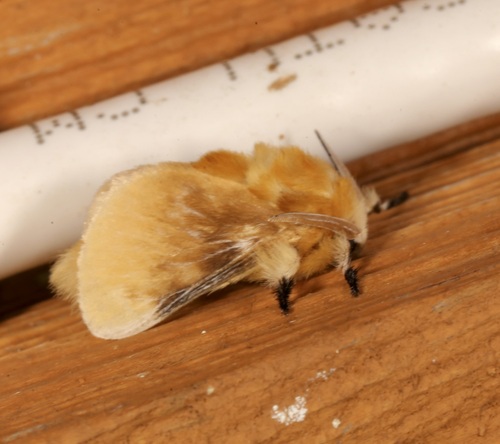
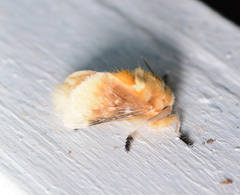
Megalopyge opercularis is a moth of the family Megalopygidae. It has numerous common names, including southern flannel moth for its adult form, and puss caterpillar, asp, Italian asp, fire caterpillar, woolly slug, opossum bug, puss moth, tree asp, or asp caterpillar.

The inch-long larva is generously coated in long, luxuriant hair-like setae, making it resemble a tiny Persian cat, the characteristic that presumably gave it the name "puss." It is variable in color, from downy, grayish white to golden brown to dark, charcoal gray. It often has a streak of bright orange running longitudinally. The "fur" on early-stage larvae is sometimes extremely curly, giving them a cottony, puffed-up look. The body tapers to a tail that extends well beyond the body, unlike its relative M. crispata. The middle instar has a more disheveled, "bad-hair-day" appearance, without a distinctive tail. The "fur" of the larva contains venomous spines that cause extremely painful reactions in human skin upon contact. The adult moth is covered in long fur in colors ranging from dull orange to lemon yellow, with hairy legs and fuzzy black feet. The cocoons that these caterpillars emerge from... Wikipedia →
Global Distribution

Parks Where Found

# Park Country Daily sighting probability
1 Everglades National Park 🇺🇸 United States
~10%
2 Big Cypress National Preserve 🇺🇸 United States
~10%
3 Congaree National Park 🇺🇸 United States
~10%
4 Merritt Island National Wildlife Refuge 🇺🇸 United States
<5%
5 Cumbres de Monterrey National Park 🇲🇽 Mexico
<5%

Cities Where Found

# City Country Daily sighting probability
1 Houston 🇺🇸 United States
~10%
2 Miami 🇺🇸 United States
~10%
3 Austin 🇺🇸 United States
~10%
4 Orlando 🇺🇸 United States
~10%
5 San Antonio 🇺🇸 United States
~10%
6 Monterrey 🇲🇽 México
<5%
7 Dallas 🇺🇸 United States
<5%
8 Washington 🇺🇸 United States
<5%

Before you go

What are the chances of seeing a Southern Flannel Moth in Monterrey?

Rare

Under 5% of wildlife watchers report a Southern Flannel Moth sighting in Monterrey on a given day, based on 17 verified sightings from GBIF citizen-science data. It is the 177th most-seen of the 413 insects we can rate there. Over three days the chance rises to about 10%, and over a week to about 30%, if each day is a fresh chance.

When is the best time to see a Southern Flannel Moth in Monterrey?

May, July–August and October–December

In those months about 10% of wildlife watchers report a Southern Flannel Moth in Monterrey on a given day, against under 5% in January–April, June and September, the lowest months.

What time of day is best to see a Southern Flannel Moth?

Between 11 am and 2 pm

Across all the parks we cover, that three-hour window holds the most Southern Flannel Moth sightings with a recorded time, and about half of them come between 6 am and 6 pm: it is seen both by day and at night.

Is Monterrey the best place to see a Southern Flannel Moth?

6th of 8

Of the 8 cities where we can rate Southern Flannel Moth sightings, Monterrey ranks 6th at under 5%. The best odds are in Houston (United States, about 10%), Miami (United States, about 10%) and Austin (United States, about 10%).

Which relatives of the Southern Flannel Moth live in Monterrey?

Same order: Lepidoptera

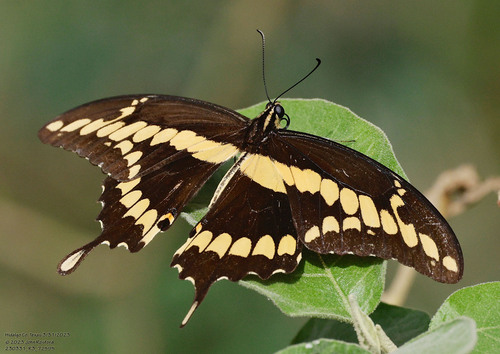
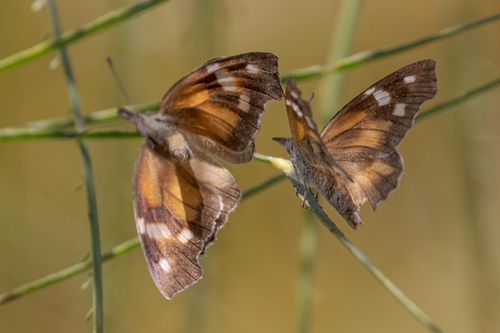
The closest relatives of the Southern Flannel Moth that you can see in Monterrey (order Lepidoptera, Butterflies and Moths) are Monarch (about 30%), Western Giant Swallowtail (about 20%) and American Snout (about 20%), with each one's daily chance of a sighting.

Where does the Southern Flannel Moth sighting chance come from?

GBIF citizen-science records

It is estimated from how often the Southern Flannel Moth is recorded against all the insects logged in Monterrey (17 verified sightings), calibrated against known sighting rates. Figures are rounded to the nearest 10% because citizen-science data supports honest approximations, not decimals, and months with records from fewer than five people show "—". How it works.

← Back to Monterrey