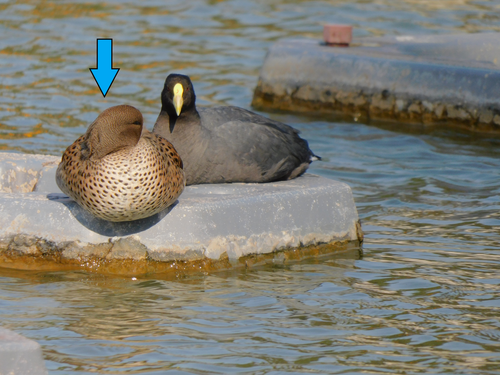
Silver Teal

Silver Teal

Spatula versicolor

Silhouette: Sheatherius · PhyloPic

LCLeast ConcernNTVUENCR
Daily sighting probability <5% · Rare
at Montevideo

In 3 days ~10% in a week ~30%

89 Verified sightings at Montevideo
271 In all 2 parks From 2019 to 2026
October Best month
☀️ Diurnal When it's spotted

About the Silver Teal

The silver teal or versicolor teal (Spatula versicolor) is a species of dabbling duck in the genus Spatula. It breeds in South America. Between April and June they prefer reed beds and will lay 6 to 10 creamy-pink eggs. The eggs will hatch after 25 to 27 days. As with swans and geese, both parents will rear the ducklings. A pair may bond long term. It lives on fresh water in small groups, and feeds primarily on vegetable matter such as seeds and aquatic plants.

The silver teal's range includes southern Bolivia, southern Brazil, Paraguay, Argentina, Chile, Uruguay, South Georgia, South Sandwich Islands, and the Falkland Islands. The southernmost birds migrate to southern Brazil in the winter.

Silver teals are on the whole placid ducks but may be protective of eggs, young and females. They have a black cap that extends below the eyes, and a bluish bill with a yellow tip. They also have a green speculum with a white border. The female's plumage is slightly duller and has less yellow at the base of the beak.

The Puna teal was previously regarded as a subspecies of this bird. Currently, there are two subspecies: S. versicolor versicolor northern silver teal located... Wikipedia →

Sounds

Call0:15

Argentina · 1986

© Miguel Angel Roda · XC50346 · CC BY-NC-ND 2.5

Song0:05

Argentina · 2007

© Bernabe Lopez-Lanus · XC52160 · CC BY-NC-SA 3.0

Call0:08

Brazil · 2009

© Cláudio Dias Timm · XC37919 · CC BY-NC-ND 2.5

Global Distribution

Parks Where Found

# Park Country Daily sighting probability
1 Iberá National Park 🇦🇷 Argentina
~10%
2 Torres del Paine National Park 🇨🇱 Chile
<5%

Cities Where Found

# City Country Daily sighting probability
1 Buenos Aires 🇦🇷 Argentina
~20%
2 Curitiba 🇧🇷 Brazil
~20%
3 Rosario 🇦🇷 Argentina
<5%
4 Montevideo 🇺🇾 Uruguay
<5%
5 São Paulo 🇧🇷 Brazil
<5%
6 Cordoba 🇦🇷 Argentina
<5%

Zoos & Centres Where Found

# Zoo / Centre Country
1 Ostrava Zoo 🇨🇿 Czechia In captivity
2 Zoo Pilsen 🇨🇿 Czechia In captivity
3 Cologne Zoological Garden 🇩🇪 Germany In captivity
4 Philadelphia Zoo 🇺🇸 United States In captivity
5 London Zoo 🇬🇧 United Kingdom In captivity
6 Cleres Zoological Park 🇫🇷 France In captivity
7 Vogelpark Avifauna 🇳🇱 Netherlands In captivity
8 Ménagerie du Jardin des Plantes 🇫🇷 France In captivity
9 Palm Beach Zoo 🇺🇸 United States In captivity
10 Bird Park Steinen 🇩🇪 Germany In captivity
11 Santillana Zoo 🇪🇸 Spain In captivity
12 Buttonwood Park Zoo 🇺🇸 United States In captivity
13 Dallas World Aquarium 🇺🇸 United States In captivity
14 Cologne Zoo Aquarium 🇩🇪 Germany In captivity

Before you go

What are the chances of seeing a Silver Teal in Montevideo?

Rare

Under 5% of wildlife watchers report a Silver Teal sighting in Montevideo on a given day, based on 89 verified sightings from GBIF citizen-science data. It is the 82nd most-seen of the 178 birds we can rate there. Over three days the chance rises to about 10%, and over a week to about 30%, if each day is a fresh chance.

When is the best time to see a Silver Teal in Montevideo?

March and October–November

In those months about 10% of wildlife watchers report a Silver Teal in Montevideo on a given day, against under 5% in April–September and December–February, the lowest months.

What time of day is best to see a Silver Teal?

Between 3 and 6 pm

Across all the parks we cover, that three-hour window holds the most Silver Teal sightings with a recorded time, and nearly all of them come between 6 am and 6 pm: it is a daytime animal.

Is Montevideo the best place to see a Silver Teal?

4th of 6

Of the 6 cities where we can rate Silver Teal sightings, Montevideo ranks 4th at under 5%. The best odds are in Buenos Aires (Argentina, about 20%), Curitiba (Brazil, about 20%) and Rosario (Argentina, under 5%).

Where does the Silver Teal sighting chance come from?

GBIF citizen-science records

It is estimated from how often the Silver Teal is recorded against all the birds logged in Montevideo (89 verified sightings), calibrated against known sighting rates. Figures are rounded to the nearest 10% because citizen-science data supports honest approximations, not decimals, and months with records from fewer than five people show "—". How it works.

← Back to Montevideo