Dusky Pearl

Dusky Pearl

Udea prunalis

Daily sighting probability <5% · Rare
at Moscow

In 3 days ~10% in a week ~20%

17 Verified sightings at Moscow
26 In all 2 parks From 2019 to 2026
July Best month
☀️ Diurnal When it's spotted

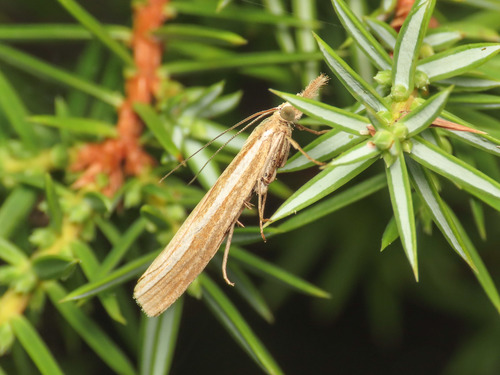
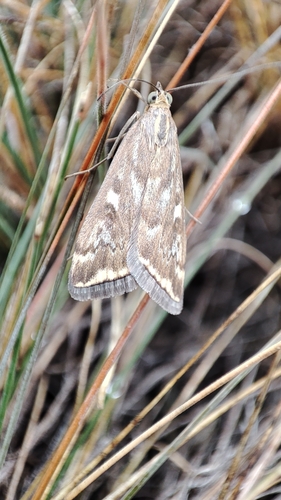
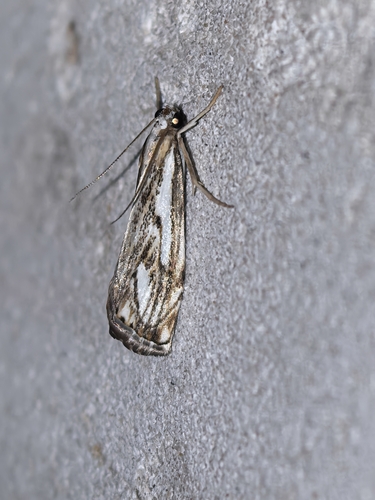
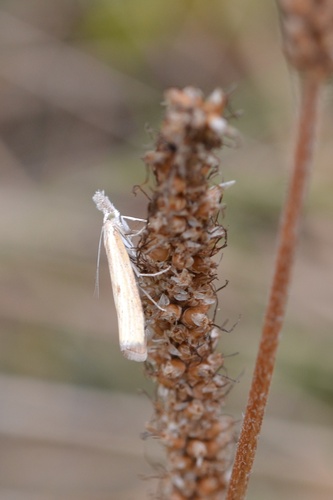
About the Dusky Pearl

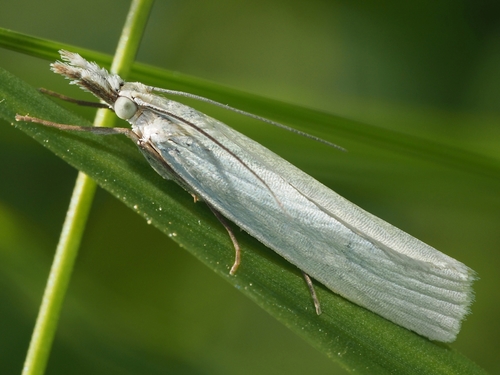
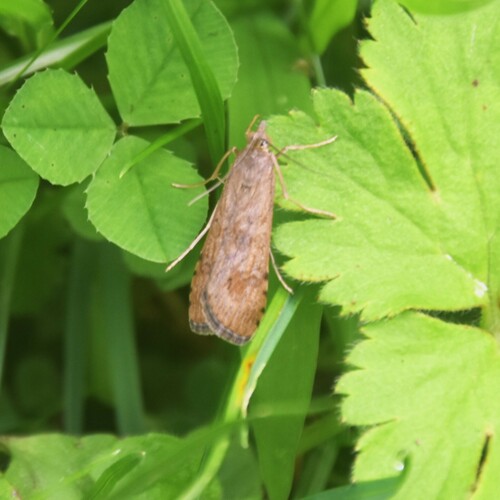
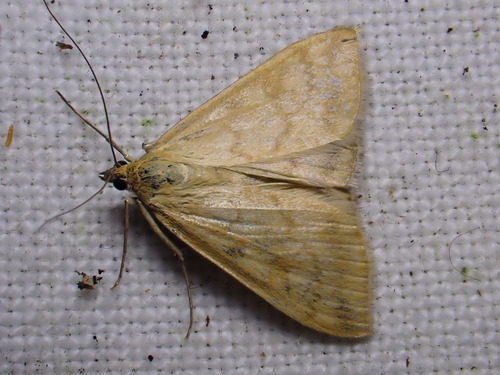
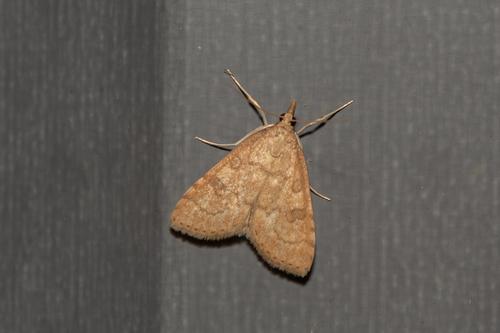
Udea prunalis is a moth of the family Crambidae. It is found in Europe and China (Gansu, Heilongjiang, Ningxia, Shanxi, Sichuan, Xinjiang). The species was first described by Matthew Denis and Ignaz Schiffermüller in 1775. In the Butterfly Conservation's Microlepidoptera Report 2011 this species was classified as common in the UK.

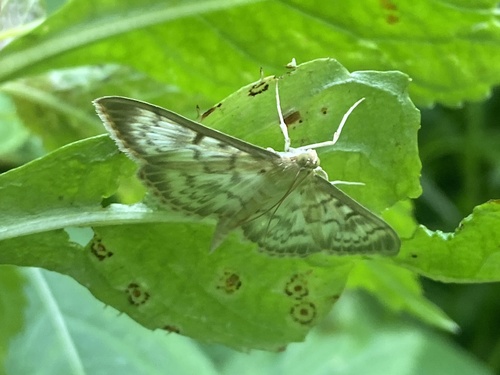
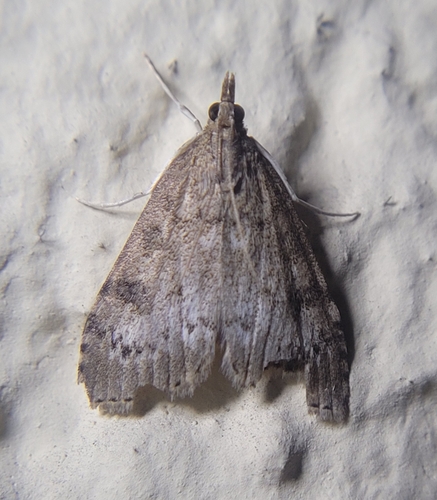
The wingspan is 23–26 mm. The forewings are fuscous-grey with a brownish base. The first line is indistinct, and the second is serrate, blackish, and curved, with a narrow deep sinuation inwards below middle, on dorsum whitish-edged posteriorly. The orbicular and 8-shaped discal spots are darker grey, and the costa posteriorly is spotted darker and sometimes whitish. The hindwings are fuscous-grey, apex darker with two dark fuscous discal dots and a faint second line. The larva is bright deep green with a subdorsal line shining white and a grey-whitish head.

The moth flies from June to August depending on location. The larvae feed on various herbaceous plants, shrubs and deciduous trees. Wikipedia →
Global Distribution

Parks Where Found

# Park Country Daily sighting probability
1 Snowdonia National Park 🇬🇧 United Kingdom
~10%
2 Wadden Sea National Park 🇩🇪 Germany
~10%

Cities Where Found

# City Country Daily sighting probability
1 Copenhagen 🇩🇰 Denmark
~10%
2 London 🇬🇧 United Kingdom
<5%
3 Birmingham 🇬🇧 United Kingdom
<5%
4 Helsinki 🇫🇮 Finland
<5%
5 Moscow 🇷🇺 Russia
<5%

Before you go

What are the chances of seeing a Dusky Pearl in Moscow?

Rare

Under 5% of wildlife watchers report a Dusky Pearl sighting in Moscow on a given day, based on 17 verified sightings from GBIF citizen-science data. It is the 486th most-seen of the 1111 insects we can rate there. Over three days the chance rises to about 10%, and over a week to about 20%, if each day is a fresh chance.

When is the best time to see a Dusky Pearl in Moscow?

July

In that month about 10% of wildlife watchers report a Dusky Pearl in Moscow on a given day, against under 5% in August to June, the lowest months. That is one of Moscow's wettest months, with about 95 mm of rain against 40 mm in February.

What time of day is best to see a Dusky Pearl?

Between 6 and 9 am

Across all the parks we cover, that three-hour window holds the most Dusky Pearl sightings with a recorded time, and about 8 in 10 of them come between 6 am and 6 pm: it is a daytime animal.

Is Moscow the best place to see a Dusky Pearl?

5th of 5

Of the 5 cities where we can rate Dusky Pearl sightings, Moscow ranks 5th at under 5%. The best odds are in Copenhagen (Denmark, about 10%), London (United Kingdom, under 5%) and Birmingham (United Kingdom, under 5%).

Where does the Dusky Pearl sighting chance come from?

GBIF citizen-science records

It is estimated from how often the Dusky Pearl is recorded against all the insects logged in Moscow (17 verified sightings), calibrated against known sighting rates. Figures are rounded to the nearest 10% because citizen-science data supports honest approximations, not decimals, and months with records from fewer than five people show "—". How it works.

← Back to Moscow