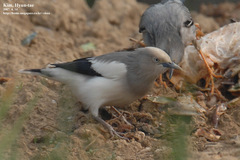
White-shouldered Starling

White-shouldered Starling

Sturnia sinensis

Silhouette: Rafael Maia · PhyloPic

LCLeast ConcernNTVUENCR
Daily sighting probability <5% · Rare
at Naha

In 3 days ~10% in a week ~20%

9 Verified sightings at Naha
11 In all 2 parks From 2019 to 2026
November Best month

About the White-shouldered Starling

The white-shouldered starling (Sturnia sinensis) is a species of bird in the starling family Sturnidae. It breeds in southern China and northern Vietnam; it winters in Southeast Asia. The white-shouldered starling was formally described in 1788 by the German naturalist Johann Friedrich Gmelin in his revised and expanded edition of Carl Linnaeus's Systema Naturae. He placed it with the orioles in the genus Oriolus and coined the binomial name Oriolus sinensis. The specific epithet sinensis is Modern Latin for "Chinese". Gmelin based his description on "Le Kink" from China that had been described in 1775 by the French polymath the Comte de Buffon in his Histoire Naturelle des Oiseaux. A hand-coloured engraving by François-Nicolas Martinet was published to accompany Buffon's text.

The white-shouldered starling was formerly placed in the genus Sturnus. A molecular phylogenetic study published in 2008 found the genus was polyphyletic. In the reorganization to create monotypic genera, the white-shouldered starling was one of five starlings moved to the resurrected genus Sturnia that had been introduced in 1837 by René Lesson. The species is monotypic: no subspecies are recognised... Wikipedia →

Sounds

Song0:55

China · 2020

© Geoff Carey · XC815816 · CC BY-NC-SA 4.0

Alarm call0:34

China · 2024

© Dave GUO · XC906308 · CC BY-NC-SA 4.0

Call0:15

Taiwan · 2023

© 蔡明剛 · XC788073 · CC BY-NC-SA 4.0

Global Distribution

Parks Where Found

# Park Country Daily sighting probability
1 Taroko National Park 🇹🇼 Taiwan
<5%
2 Cat Tien National Park 🇻🇳 Vietnam
<5%

Cities Where Found

# City Country Daily sighting probability
1 Xiuying District 🇨🇳 China
~30%
2 Xiamen City 🇨🇳 China
~10%
3 Quanzhou 🇨🇳 China
~10%
4 Đà Nẵng 🇻🇳 Vietnam
~10%
5 Tuen Mun 🇨🇳 China
~10%
6 Ho Chi Minh City 🇻🇳 Vietnam
~10%
7 Hong Kong 🇨🇳 China
~10%
8 Phnom Penh 🇰🇭 Cambodia
<5%
9 Wenzhou 🇨🇳 China
<5%
10 Kaohsiung 🇹🇼 Taiwan
<5%

Zoos & Centres Where Found

# Zoo / Centre Country
1 Prague Zoo 🇨🇿 Czechia In captivity
2 Ostrava Zoo 🇨🇿 Czechia In captivity
3 Walsrode World Bird Park 🇩🇪 Germany In captivity
4 Singapore Zoo 🇸🇬 Singapore In captivity
5 Wilhelma 🇩🇪 Germany In captivity
6 Bird Paradise 🇸🇬 Singapore In captivity
7 Green World Ecological Farm 🇹🇼 Taiwan In captivity
8 Rainforest Wild Asia 🇸🇬 Singapore In captivity
9 Selwo Marina 🇪🇸 Spain In captivity
10 Rákosův pavilon 🇨🇿 Czechia In captivity
11 Velemlokárium 🇨🇿 Czechia In captivity

Before you go

What are the chances of seeing a White-shouldered Starling in Naha?

Rare

Under 5% of wildlife watchers report a White-shouldered Starling sighting in Naha on a given day, based on 9 verified sightings from GBIF citizen-science data. It is the 67th most-seen of the 81 birds we can rate there. Over three days the chance rises to about 10%, and over a week to about 20%, if each day is a fresh chance.

When is the best time to see a White-shouldered Starling in Naha?

October and November

In those months about 10% of wildlife watchers report a White-shouldered Starling in Naha on a given day, against under 5% in December to September, the lowest months.

Is Naha the best place to see a White-shouldered Starling?

12th of 18

Of the 18 cities where we can rate White-shouldered Starling sightings, Naha ranks 12th at under 5%. The best odds are in Xiuying District (China, about 30%), Xiamen City (China, about 10%) and Quanzhou (China, about 10%).

Where does the White-shouldered Starling sighting chance come from?

GBIF citizen-science records

It is estimated from how often the White-shouldered Starling is recorded against all the birds logged in Naha (9 verified sightings), calibrated against known sighting rates. Figures are rounded to the nearest 10% because citizen-science data supports honest approximations, not decimals, and months with records from fewer than five people show "—". How it works.

← Back to Naha