About the King Eider
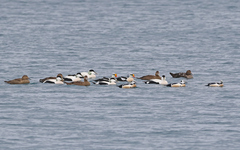
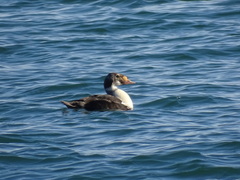
The king eider (pronounced ) (Somateria spectabilis) is a large sea duck that breeds along Northern Hemisphere Arctic coasts of northeast Europe, North America and Asia. The birds spend most of the year in coastal marine ecosystems at high latitudes, and migrate to Arctic tundra to breed in June and July. They lay four to seven eggs in a scrape on the ground lined with grass and down.
When he first described the king eider in 1758, in the 10th edition of his opus Systema Naturae, Carl Linnaeus assigned it to the genus Anas, along with the rest of the ducks. In 1819, William Elford Leach moved it and the other large eiders to the genus Somateria, where it has remained since. It is very closely related to the other members of its genus, and is known to hybridise with the common eider. Despite its very large range, it is monotypic.
The genus name Somateria is a combination of the Greek words sōma, meaning "body", and erion, meaning "wool"; the combination (i.e. "wooly body") is a reference to the eider's famously thick, soft down. The specific name spectabilis is Latin for "showy", "remarkable" or "worth seeing", a reference to the handsomeness of the adult... Wikipedia →