Turbine Cylindrical Weevil

Turbine Cylindrical Weevil

Larinus turbinatus

Daily sighting probability ~10% · With luck
at Novosibirsk

In 3 days ~20% in a week ~40%

12 Verified sightings at Novosibirsk
43 In all 4 parks From 2019 to 2026
July Best month
☀️ Diurnal When it's spotted

About the Turbine Cylindrical Weevil

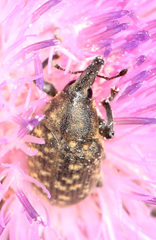
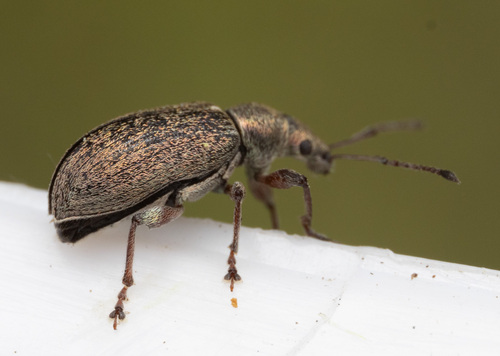
Larinus turbinatus is a species of true weevil in the family of beetles known as Curculionidae. The genus name Larínus (from ancient Greek λαρίνος, fat ) refers to the rounded body shape. The Latin species name turbinātus, means "cone-shaped" and refers to the shape of the snout.

This species is native to western Palaearctic and it is present in southern and central Europe (Albania, Austria, Bosnia and Herzegovina, Bulgaria, Croatia, Czech Republic, France, Germany, Greece, Hungary, Italy, Republic of Moldova, Poland, Portugal, Romania, Slovakia, Slovenia, Spain, Switzerland, Ukraine and Yugoslavia), Caucasus, western Russia, Asia Minor, Central Asia, Siberia and North Africa. It has been introduced in United States.

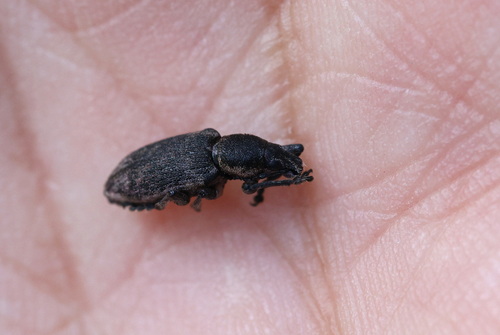
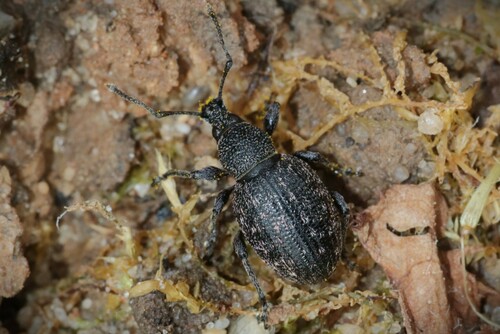
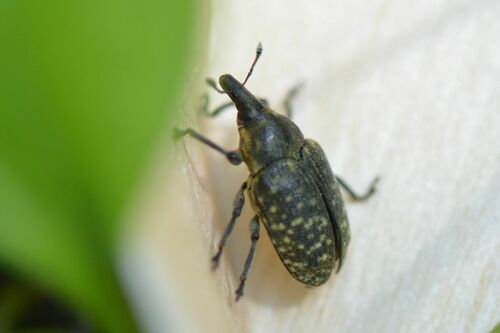
These warmth-loving weevils manly occur on open, warm slopes, in grassland, wet meadows and pastures, where thistles are also present. Larinus turbinatus can reach a body length of about 4.00–9.00 mm (0.157–0.354 in). These weevils have a robust, oval, black body with many patches of gray setae, that appear yellowish by a yellowish secretion and adhering pollen. Its antennae are short with conspicuous... Wikipedia →
Global Distribution

Parks Where Found

# Park Country Daily sighting probability
1 Sierra Nevada National Park 🇪🇸 Spain
~10%
2 Bavarian Forest National Park 🇩🇪 Germany
~10%
3 Shenandoah National Park 🇺🇸 United States
~10%
4 Pyrénées National Park 🇫🇷 France
<5%

Cities Where Found

# City Country Daily sighting probability
1 Kharkiv 🇺🇦 Ukraine
~20%
2 Novosibirsk 🇷🇺 Russia
~10%
3 Lyon 🇫🇷 France
~10%
4 Brussels 🇧🇪 Belgium
~10%
5 Warsaw 🇵🇱 Poland
~10%
6 Munich 🇩🇪 Germany
~10%
7 Paris 🇫🇷 France
<5%
8 Copenhagen 🇩🇰 Denmark
<5%
9 Cologne 🇩🇪 Germany
<5%
10 Berlin 🇩🇪 Germany
<5%

Before you go

What are the chances of seeing a Turbine Cylindrical Weevil in Novosibirsk?

With luck

About 10% of wildlife watchers report a Turbine Cylindrical Weevil sighting in Novosibirsk on a given day, based on 12 verified sightings from GBIF citizen-science data. It is the 102nd most-seen of the 216 insects we can rate there. Over three days the chance rises to about 20%, and over a week to about 40%, if each day is a fresh chance.

When is the best time to see a Turbine Cylindrical Weevil in Novosibirsk?

May to July

In those months about 10% of wildlife watchers report a Turbine Cylindrical Weevil in Novosibirsk on a given day, against under 5% in August to April, the lowest months.

What time of day is best to see a Turbine Cylindrical Weevil?

Between 9 am and noon

Across all the parks we cover, that three-hour window holds the most Turbine Cylindrical Weevil sightings with a recorded time, and about 9 in 10 of them come between 6 am and 6 pm: it is a daytime animal.

Is Novosibirsk the best place to see a Turbine Cylindrical Weevil?

2nd of 21

Of the 21 cities where we can rate Turbine Cylindrical Weevil sightings, Novosibirsk ranks 2nd at about 10%. The best odds are in Kharkiv (Ukraine, about 20%).

Which relatives of the Turbine Cylindrical Weevil live in Novosibirsk?

Same family: Curculionidae

The closest relatives of the Turbine Cylindrical Weevil that you can see in Novosibirsk (family Curculionidae, True Weevils) are Lixus fasciculatus (about 10%), Tanymecus palliatus (about 10%) and Common Leaf Weevil (about 10%), with each one's daily chance of a sighting.

Where does the Turbine Cylindrical Weevil sighting chance come from?

GBIF citizen-science records

It is estimated from how often the Turbine Cylindrical Weevil is recorded against all the insects logged in Novosibirsk (12 verified sightings), calibrated against known sighting rates. Figures are rounded to the nearest 10% because citizen-science data supports honest approximations, not decimals, and months with records from fewer than five people show "—". How it works.

← Back to Novosibirsk