


Completed


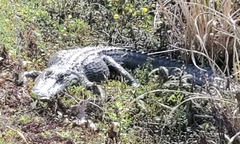

American Alligator
Alligator mississippiensis
Silhouette: Ferran Sayol · PhyloPic
- KingdomAnimalia (Animals)
- PhylumChordata (Chordates)
- ClassCrocodylia
- FamilyAlligatoridae (Alligators and Caimans)
- GenusAlligator (Alligators)
- SpeciesAlligator mississippiensis (American Alligator)
In 3 days ~50% in a week ~80%
148 Verified sightings at Orlando
7,231 In all 4 parks From 2019 to 2026
February Best month
☀️ Diurnal When it's spotted
About the American Alligator
The American alligator (Alligator mississippiensis), sometimes referred to as a common alligator or just gator, is a large crocodilian reptile native to the Southeastern United States. It is one of the two extant species in the genus Alligator, and is larger than the only other living alligator species, the Chinese alligator.
Adult male American alligators measure 3.4 to 4.8 m (11.2 to 15.7 ft) in length, and can weigh up to 450 kg (1,000 lb), with unverified sizes of up to 5.84 m (19.2 ft) and weights of 1,000 kg (2,200 lb) making it the heaviest member of the family Alligatoridae, and the second longest one, after the black caiman. Females are smaller, measuring 2.6 to 3.35 m (8.5 to 11.0 ft) in length. The American alligator inhabits subtropical and tropical freshwater wetlands, such as marshes and cypress swamps, from southern Oklahoma and Texas to North Carolina. It is distinguished from the sympatric American crocodile by its broader U-shaped snout, with overlapping jaws and darker coloration, and is less tolerant of saltwater but more tolerant of cooler climates than the American crocodile, which is found only in tropical and warm subtropical climates.
American alligators are apex predators and consume fish, amphibians, reptiles, birds, mammals, and other American alligators. Hatchlings feed mostly on invertebrates. They play an important role as ecosystem engineers in wetland ecosystems through the creation of alligator holes, which provide both wet and dry habitats for other organisms. Throughout the year (in particular during the breeding season), American alligators bellow to declare territory, and locate suitable mates. Male American alligators use infrasound to attract females. Eggs are laid in a nest of vegetation, sticks, leaves, and mud in a sheltered spot on land near water. Young are born with yellow bands around their bodies and are protected by their mother for up to one year. This species displays parental care, which is rare for most reptiles. Mothers protect their eggs during the incubation period, and move the hatchlings to the water using their mouths. American alligators exhibit parental care for up to 3 years post birth.
The conservation status of the American alligator is listed as Least Concern by the International Union for Conservation of Nature. Historically, hunting had decimated their population, and the American alligator was listed as an endangered species by the Endangered Species Act of 1973. Wikipedia →
Sounds
Recording0:19
United States · 2018
© Chris Harrison · iNaturalist · CC BY-NC 4.0
Recording0:13
United States · 2026
© A. Sabol · iNaturalist · CC BY-NC 4.0
Recording0:18
United States · 2025
© Ashley M Bradford · iNaturalist · CC BY-NC 4.0
Recent sightings of American Alligator in Orlando
LIVEiNaturalistGlobal Distribution
Parks Where Found
| # | Park | Country | Daily sighting probability |
|---|---|---|---|
| 1 | Big Cypress National Preserve | 🇺🇸 United States | |
| 2 | Everglades National Park | 🇺🇸 United States | |
| 3 | Merritt Island National Wildlife Refuge | 🇺🇸 United States | |
| 4 | Congaree National Park | 🇺🇸 United States |
Zoos & Centres Where Found
Closest Relatives at Orlando
No species of the same family or order lives in Orlando, so these are its closest relatives here: other reptiles.


Before you go
What are the chances of seeing an American Alligator in Orlando?
Possible
About 20% of wildlife watchers report an American Alligator sighting in Orlando on a given day, based on 148 verified sightings from GBIF citizen-science data. It is the 7th most-seen of the 32 reptiles we can rate there. Over three days the chance rises to about 50%, and over a week to about 80%, if each day is a fresh chance.
When is the best time to see an American Alligator in Orlando?
October to August
In those months about 20% of wildlife watchers report an American Alligator in Orlando on a given day, against about 10% in September, the lowest month.
What time of day is best to see an American Alligator?
Between 8 and 11 am
Across all the parks we cover, that three-hour window holds the most American Alligator sightings with a recorded time, and about 8 in 10 of them come between 6 am and 6 pm: it is a daytime animal.
Is Orlando the best place to see an American Alligator?
Among the best
Of the 3 cities where we can rate American Alligator sightings, Orlando ranks 2nd at about 20%, level with the leaders once rounded. The best odds are in Miami (United States, about 20%).
Where does the American Alligator sighting chance come from?
GBIF citizen-science records
It is estimated from how often the American Alligator is recorded against all the reptiles logged in Orlando (148 verified sightings), calibrated against known sighting rates. Figures are rounded to the nearest 10% because citizen-science data supports honest approximations, not decimals, and months with records from fewer than five people show "—". How it works.
