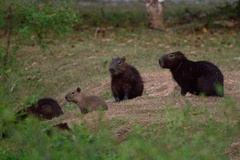
Lesser Capybara

Lesser Capybara

Hydrochoerus isthmius

Silhouette: Steven Traver · PhyloPic

Daily sighting probability ~10% · With luck
at Panama City

In 3 days ~20% in a week ~30%

8 Verified sightings at Panama City
119 In all 2 parks From 2019 to 2026
April Best month
🌅 Crepuscular When it's spotted

About the Lesser Capybara

The lesser capybara (Hydrochoerus isthmius) is a large semi-aquatic rodent found in South America that has vast similarities with, yet subtle differences from, the slightly larger common capybara (Hydrochoerus hydrochaeris), the largest species of rodent in the world.

The lesser capybara mainly inhabits areas close to water such as marshes, ponds, and lagoon habitats as these places offer water, which is essential for these capybaras to fulfil their niches' of maintain body temperature homeostasis, provide suitable food, hide from predators, and mate. They were first observed in Pacific river valleys in Panama as early as 1912 as a subspecies of the common capybara. However, after thorough studies on the anatomy and genealogy of them, the lesser capybara was classified as its own species some time in the 1980s. Currently, this species has expanded its range to parts of Eastern Panama and Western Colombia and Venezuela, just west of the Andes Mountains. The lesser capybara constitutes the northernmost population of any extant capybara species, other than the now extinct H. hesperotiganites from Pleistocene California.

Lesser capybaras are herbivores that mainly... Wikipedia →

Global Distribution

Parks Where Found

# Park Country Daily sighting probability
1 Soberanía National Park 🇵🇦 Panama
~30%
2 Parque Natural Metropolitano 🇵🇦 Panama
~10%

Cities Where Found

# City Country Daily sighting probability
1 Panama City 🇵🇦 Panama
~10%

Zoos & Centres Where Found

# Zoo / Centre Country
1 Taman Safari Bali (Bali Safari) 🇮🇩 Indonesia In captivity
2 Yumka' 🇲🇽 Mexico In captivity
3 Parque Municipal Summit 🇵🇦 Panama In captivity
4 Africam Safari 🇲🇽 Mexico In captivity
5 Parque Zoologico Guátika 🇨🇴 Colombia In captivity
6 Zacango Zoo 🇲🇽 Mexico In captivity
7 Chapultepec Zoo 🇲🇽 Mexico In captivity
8 Schönbrunn Zoo 🇦🇹 Austria In captivity
9 Gladys Porter Zoo 🇺🇸 United States In captivity
10 Parque de la Conservación 🇨🇴 Colombia In captivity
11 Parc zoologique de Bordeaux Pessac 🇫🇷 France In captivity
12 Zoológico Municipal de Loja 🇪🇨 Ecuador In captivity
13 Buenaventura Zoo 🇵🇦 Panama In captivity
14 Selva Viva Park 🇵🇪 Peru In captivity
15 Acuario Michin Guadalajara 🇲🇽 Mexico In captivity

Before you go

What are the chances of seeing a Lesser Capybara in Panama City?

With luck

About 10% of wildlife watchers report a Lesser Capybara sighting in Panama City on a given day, based on 8 verified sightings from GBIF citizen-science data. It is the 10th most-seen of the 11 mammals we can rate there. Over three days the chance rises to about 20%, and over a week to about 30%, if each day is a fresh chance.

When is the best time to see a Lesser Capybara in Panama City?

March–April, August and November–December

In those months about 10% of wildlife watchers report a Lesser Capybara in Panama City on a given day, against under 5% in January–February, May–July and September–October, the lowest months.

What time of day is best to see a Lesser Capybara?

Between 3 and 6 pm

Across all the parks we cover, that three-hour window holds the most Lesser Capybara sightings with a recorded time, and about 7 in 10 of them come between 6 am and 6 pm: it is most active around dawn and dusk.

Where else can you see a Lesser Capybara?

Only Panama City, in our data

Panama City is the only city on Wallace's Line with enough records to rate Lesser Capybara sightings: about 10% of wildlife watchers there report one on a given day.

Which relatives of the Lesser Capybara live in Panama City?

Same order: Rodentia

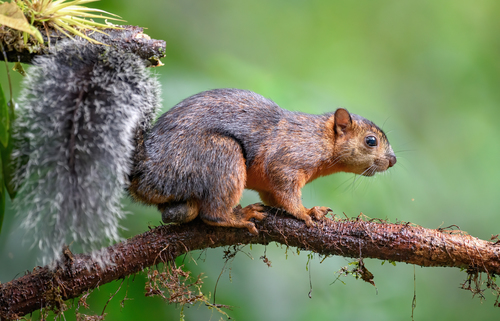
The closest relatives of the Lesser Capybara that you can see in Panama City (order Rodentia, Rodents) are Variegated Squirrel (about 40%) and Central American Agouti (about 30%), with each one's daily chance of a sighting.

Where does the Lesser Capybara sighting chance come from?

GBIF citizen-science records

It is estimated from how often the Lesser Capybara is recorded against all the mammals logged in Panama City (8 verified sightings), calibrated against known sighting rates. Figures are rounded to the nearest 10% because citizen-science data supports honest approximations, not decimals, and months with records from fewer than five people show "—". How it works.

← Back to Panama City