Oilbird

Oilbird

Steatornis caripensis

Silhouette: Sheatherius · PhyloPic

LCLeast ConcernNTVUENCR
Daily sighting probability <5% · Rare
at Panama City

In 3 days <5%

86 Verified sightings at Panama City
166 In all 3 parks From 2019 to 2026
October Best month
☀️ Diurnal When it's spotted

About the Oilbird

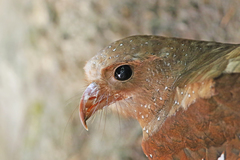
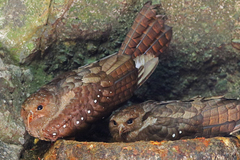
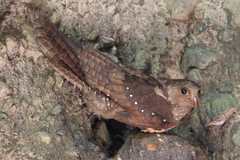
The oilbird (Steatornis caripensis), locally known as the guácharo, is a bird species found in the northern areas of South America including the Caribbean island of Trinidad. It is the only living species in the genus Steatornis, the family Steatornithidae, and the order Steatornithiformes. Nesting in colonies in caves, oilbirds are nocturnal feeders on the fruits of the oil palm and tropical laurels. They are the only nocturnal flying fruit-eating birds in the world (the kākāpō, also nocturnal, is flightless). They forage at night, with specially adapted eyesight. However, they navigate by echolocation in the same way as bats, one of the few birds to do so. They produce a high-pitched clicking sound of around 2 kHz that is audible to humans.

Oilbirds are related to the nightjars, both being in Strisores, and were previously placed alongside nightjars in the order Caprimulgiformes. However, the nightjars and their relatives are insectivores while the oilbird is a specialist frugivore, and it is now deemed sufficiently distinctive to be placed in its own order Steatornithiformes, suborder Steatornithes, and family Steatornithidae.

The specific name caripensis... Wikipedia →

Sounds

Nocturnal flight call0:12

Brazil · 2026

© JAYRSON ARAUJO DE OLIVEIRA · XC1186230 · CC BY-NC-SA 4.0

Call0:59

Ecuador · 2021

© Marcin Sołowiej · XC701940 · CC BY-NC-SA 4.0

Alarm call1:15

Ecuador · 1996

© Richard Fleming · XC532026 · CC BY-NC-SA 4.0

Global Distribution

Parks Where Found

# Park Country Daily sighting probability
1 Corcovado National Park 🇨🇷 Costa Rica
<5%
2 Parque Natural Metropolitano 🇵🇦 Panama
<5%
3 Monteverde Cloud Forest Reserve 🇨🇷 Costa Rica
<5%

Cities Where Found

# City Country Daily sighting probability
1 Panama City 🇵🇦 Panama
<5%

Before you go

What are the chances of seeing an Oilbird in Panama City?

Rare

Under 5% of wildlife watchers report an Oilbird sighting in Panama City on a given day, based on 86 verified sightings from GBIF citizen-science data. It is the 281st most-seen of the 363 birds we can rate there. Over three days the chance rises to under 5%, if each day is a fresh chance.

When is the best time to see an Oilbird in Panama City?

Any time of year

In every month with enough records, under 5% of wildlife watchers report an Oilbird in Panama City on a given day, so our monthly data shows no clear season.

What time of day is best to see an Oilbird?

Between 9 am and noon

Across all the parks we cover, that three-hour window holds the most Oilbird sightings with a recorded time, and about 9 in 10 of them come between 6 am and 6 pm: it is a daytime animal.

Where else can you see an Oilbird?

Only Panama City, in our data

Panama City is the only city on Wallace's Line with enough records to rate Oilbird sightings: under 5% of wildlife watchers there report one on a given day.

Where does the Oilbird sighting chance come from?

GBIF citizen-science records

It is estimated from how often the Oilbird is recorded against all the birds logged in Panama City (86 verified sightings), calibrated against known sighting rates. Figures are rounded to the nearest 10% because citizen-science data supports honest approximations, not decimals, and months with records from fewer than five people show "—". How it works.

← Back to Panama City