



Completed



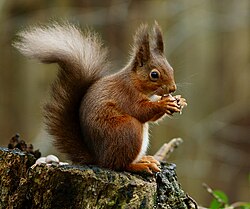
Pallas's Squirrel
Callosciurus erythraeus
Silhouette: Kai Caspar · PhyloPic
- KingdomAnimalia (Animals)
- PhylumChordata (Chordates)
- ClassMammalia (Mammals)
- OrderRodentia (Rodents)
- FamilySciuridae (Squirrels)
- GenusCallosciurus (Beautiful Squirrels)
- SpeciesCallosciurus erythraeus (Pallas's Squirrel)
In 3 days ~90% in a week >90%
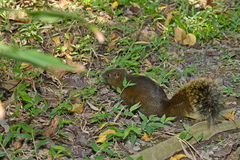
12 Verified sightings at Phnom Penh
123 In all 4 parks From 2019 to 2026
March Best month
🌅 Crepuscular When it's spotted
About the Pallas's Squirrel
Pallas's squirrel (Callosciurus erythraeus), also known as the red-bellied tree squirrel, is a species of squirrel native to China, Taiwan, India, Bhutan, and Southeast Asia. Pallas's squirrel is a medium-sized tree squirrel, with a head-body length of 16 to 28 cm (6.3 to 11.0 in), and a tail 11 to 26 cm (4.3 to 10.2 in) in length. Both sexes are of similar size and appearance, and weigh between 310 and 460 g (11 and 16 oz). The colour of the pelt varies considerably between the many different subspecies, but is generally brownish on the upper body with a more reddish tint on the belly, and often with some black on the tail. The precise pattern and shades of the fur are often used to distinguish subspecies from one another, but make it difficult to distinguish the species as a whole from other, similarly variable, tree squirrel species.
Over 30 subspecies have been identified, although not all are recognised by all authorities: Pallas's squirrel is found throughout much of southeastern Asia, including far eastern India, Bhutan, northern and eastern Myanmar, Vietnam, parts of Cambodia and Laos, much of Thailand, northern... Wikipedia →
Recent sightings of Pallas's Squirrel in Phnom Penh
LIVEiNaturalistGlobal Distribution
Parks Where Found
| # | Park | Country | Daily sighting probability |
|---|---|---|---|
| 1 | Cat Tien National Park | 🇻🇳 Vietnam | |
| 2 | Doi Inthanon National Park | 🇹🇭 Thailand | |
| 3 | Taroko National Park | 🇹🇼 Taiwan | |
| 4 | Kaeng Krachan National Park | 🇹🇭 Thailand |
Cities Where Found
| # | City | Country | Daily sighting probability |
|---|---|---|---|
| 1 | Hanoi | 🇻🇳 Vietnam | |
| 2 | Taichung | 🇹🇼 Taiwan | |
| 3 | Tainan | 🇹🇼 Taiwan | |
| 4 | Ho Chi Minh City | 🇻🇳 Vietnam | |
| 5 | Kunming | 🇨🇳 China | |
| 6 | Kaohsiung | 🇹🇼 Taiwan | |
| 7 | Phnom Penh | 🇰🇭 Cambodia | |
| 8 | Taipei | 🇹🇼 Taiwan | |
| 9 | Hangzhou | 🇨🇳 China | |
| 10 | Xiuying District | 🇨🇳 China |
Zoos & Centres Where Found
| # | Zoo / Centre | Country | |
|---|---|---|---|
| 1 | Beijing Wildlife Park | 🇨🇳 China | |
| 2 | Parken Zoo | 🇸🇪 Sweden | |
| 3 | Hong Kong Zoological and Botanical Gardens | 🇨🇳 China | |
| 4 | Machida Squirrel Garden | 🇯🇵 Japan | |
| 5 | Edward Youde Aviary | 🇭🇰 Hong Kong SAR China | |
| 6 | Kinkazan Squirrel Village | 🇯🇵 Japan | |
| 7 | Ocean Park Hong Kong | 🇨🇳 China |
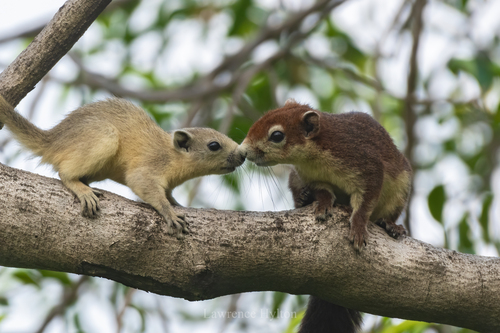
Closest Relatives at Phnom Penh

Before you go
What are the chances of seeing a Pallas's Squirrel in Phnom Penh?
Likely
About 50% of wildlife watchers report a Pallas's Squirrel sighting in Phnom Penh on a given day, based on 12 verified sightings from GBIF citizen-science data. Over three days the chance rises to about 90%, and over a week to over 90%, if each day is a fresh chance.
When is the best time to see a Pallas's Squirrel in Phnom Penh?
March, August and December
In those months about 70% of wildlife watchers report a Pallas's Squirrel in Phnom Penh on a given day, against about 10% in January–February, April–May, July and September–October, the lowest months.
What time of day is best to see a Pallas's Squirrel?
Between 9 am and noon
Across all the parks we cover, that three-hour window holds the most Pallas's Squirrel sightings with a recorded time, and about 6 in 10 of them come between 6 am and 6 pm: it is most active around dawn and dusk.
Is Phnom Penh the best place to see a Pallas's Squirrel?
7th of 29
Of the 29 cities where we can rate Pallas's Squirrel sightings, Phnom Penh ranks 7th at about 50%. The best odds are in Hanoi (Vietnam, about 70%), Taichung (Taiwan, about 60%) and Tainan (Taiwan, about 60%).
Where does the Pallas's Squirrel sighting chance come from?
GBIF citizen-science records
It is estimated from how often the Pallas's Squirrel is recorded against all the mammals logged in Phnom Penh (12 verified sightings), calibrated against known sighting rates. Figures are rounded to the nearest 10% because citizen-science data supports honest approximations, not decimals, and months with records from fewer than five people show "—". How it works.
