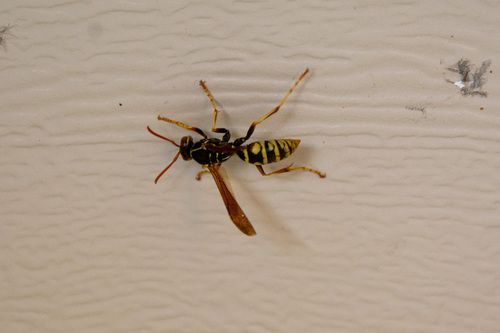
Centris pallida
Daily sighting probability <5% · Rare
at Phoenix

In 3 days ~10% in a week ~30%

15 Verified sightings at Phoenix
32 In 1 park From 2019 to 2026
April Best month
☀️ Diurnal When it's spotted

About the Centris pallida

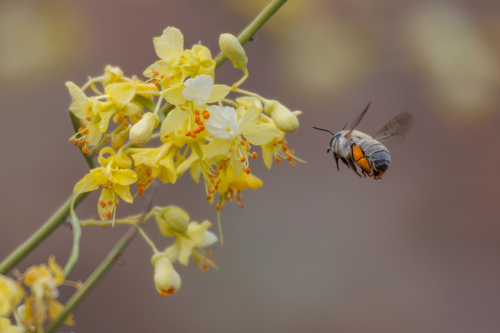
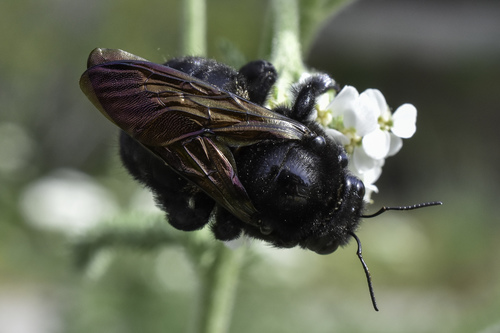
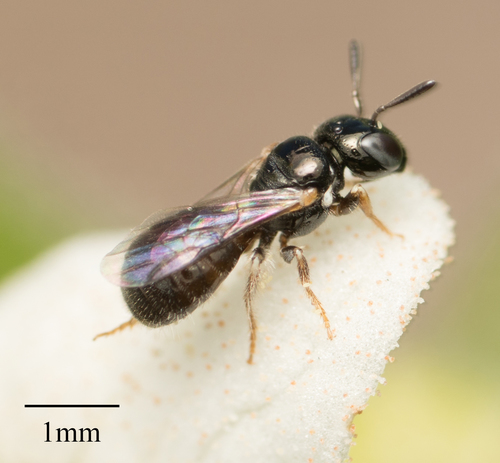
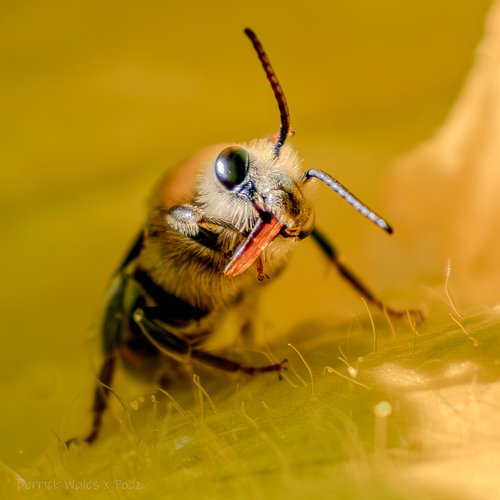
Centris pallida is a species of solitary bee native to North America. It lacks an accepted common name; however, it has been called the digger bee, the desert bee, and the pallid bee due to its actions, habitat, and color respectively. The solitary nature of this bee allows for a dual-strategy mating system which produces an evolutionarily stable state resistant to invading strategies. These bees have also evolved to withstand the high temperatures of their native habitat. C. pallida routinely has internal temperatures within 3 degrees Celsius of death.

Centris pallida was officially discovered and catalogued by William J. Fox in 1899 near Phoenix, Arizona. Fox also discovered Centris cockerelli, Centris errans, and Sphex subhyalinus. This species is closely related to Centris cockerelli in terms of habitat and genus, but is different in terms of mating, color, and subgenus. This bee also belongs to the superfamily Apoidea, and the subfamily Apinae.

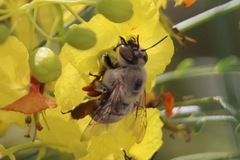
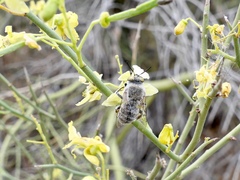
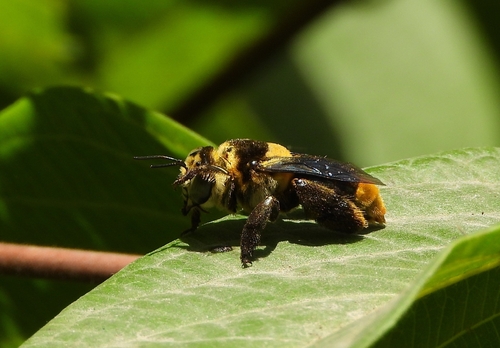
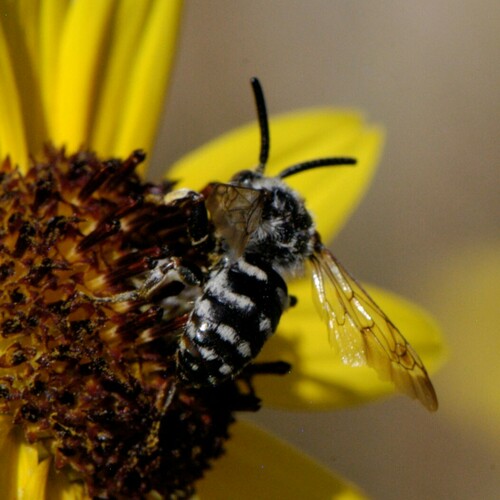
This bee is black and densely covered in a grey pubescence or fur on the dorsal side. The thorax fur has a slightly yellow color. The legs have a mixture of black and... Wikipedia →

Global Distribution

Parks Where Found

# Park Country Daily sighting probability
1 Saguaro National Park 🇺🇸 United States
~10%

More parks will be added in future updates.

Cities Where Found

# City Country Daily sighting probability
1 Mesa 🇺🇸 United States
<5%
2 Phoenix 🇺🇸 United States
<5%

Before you go

What are the chances of seeing a Centris pallida in Phoenix?

Rare

Under 5% of wildlife watchers report a Centris pallida sighting in Phoenix on a given day, based on 15 verified sightings from GBIF citizen-science data. It is the 126th most-seen of the 264 insects we can rate there. Over three days the chance rises to about 10%, and over a week to about 30%, if each day is a fresh chance.

When is the best time to see a Centris pallida in Phoenix?

April and May

In those months about 10% of wildlife watchers report a Centris pallida in Phoenix on a given day, against under 5% in June to March, the lowest months. Those are among Phoenix's driest months, with about 5 mm of rain a month against 35 mm in January.

What time of day is best to see a Centris pallida?

Between 9 am and noon

Across all the parks we cover, that three-hour window holds the most Centris pallida sightings with a recorded time, and about 9 in 10 of them come between 6 am and 6 pm: it is a daytime animal.

Is Phoenix the best place to see a Centris pallida?

Among the best

Of the 2 cities where we can rate Centris pallida sightings, Phoenix ranks 2nd at under 5%, level with the leaders once rounded. The best odds are in Mesa (United States, under 5%).

Where does the Centris pallida sighting chance come from?

GBIF citizen-science records

It is estimated from how often the Centris pallida is recorded against all the insects logged in Phoenix (15 verified sightings), calibrated against known sighting rates. Figures are rounded to the nearest 10% because citizen-science data supports honest approximations, not decimals, and months with records from fewer than five people show "—". How it works.

← Back to Phoenix