Atlantic Puffin

Atlantic Puffin

Fratercula arctica

Silhouette: Richard Bartz (photo) and Albertonykus (silhouette) · PhyloPic

LCNTVUVulnerableENCR
Daily sighting probability <5% · Rare
at Porto

In 3 days ~10% in a week ~30%

91 Verified sightings at Porto
1,390 In all 3 parks From 2019 to 2026
February Best month
☀️ Diurnal When it's spotted

About the Atlantic Puffin

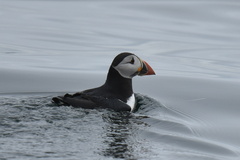
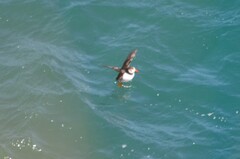
The Atlantic puffin (Fratercula arctica), also known as the common puffin, is a species of seabird in the auk family. It is the only puffin native to the Atlantic Ocean; two related species, the tufted puffin and the horned puffin, are found in the northeastern Pacific. The Atlantic puffin breeds in Russia, Iceland, Ireland, Britain, Norway, Greenland, Newfoundland and Labrador, Nova Scotia, and the Faroe Islands, and as far south as Maine in the west and France (Brittany). It is most commonly found in the Westman Islands, Iceland. Although it has a large population and a wide range, the species has declined rapidly, at least in parts of its range, resulting in it being rated as vulnerable by the IUCN. On land, it has the typical upright stance of an auk. At sea, it swims on the surface and feeds on zooplankton, small fish, and crabs, which it catches by diving underwater, using its wings for propulsion.

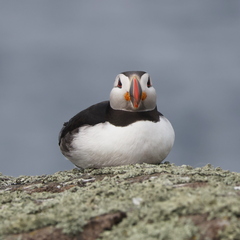
This puffin has a black crown and back, light grey cheek patches, and a white body and underparts. Its broad, boldly marked red-and-black beak and orange legs contrast with its plumage. It moults while at sea in the winter, and some of the brightly coloured facial characteristics are lost, with colour returning during the spring. The external appearances of the adult male and female are identical, though the male is usually slightly larger. The juvenile has similar plumage, but its cheek patches are dark grey. The juvenile does not have brightly coloured head ornamentation, its bill is narrower and is dark grey with a yellowish-brown tip, and its legs and feet are also dark. Puffins from northern populations are typically larger than those in the south, and these populations are generally considered to be a different subspecies.

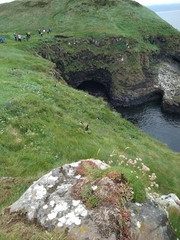
Spending the autumn and winter in the open ocean of the cold northern seas, the Atlantic puffin returns to coastal areas at the start of the breeding season in late spring. It nests in clifftop colonies, digging a burrow in which a single white egg is laid. Chicks mostly feed on whole fish and grow rapidly. After about 6 weeks, they are fully fledged and make their way at night to the sea. They swim away from the shore and do not return to land for several years.

Colonies are mostly on islands with no terrestrial predators, but adult birds and newly fledged chicks are at risk of attacks from the air by gulls and skuas. The puffin's striking appearance, large, colourful bill, waddling gait, and behaviour have given rise to nicknames such as "clown of the sea" or "sea parrot". Wikipedia →

Sounds

Call1:18

Ireland · 2021

© Irish Wildlife Sounds · XC667981 · CC BY-NC-SA 4.0

Alarm call0:30

Netherlands · 2019

© Vincent van der Spek · XC500860 · CC BY-NC-SA 4.0

Begging call1:08

Iceland · 2018

© Stanislas Wroza · XC479186 · CC BY-NC-SA 4.0

Global Distribution

Parks Where Found

# Park Country Daily sighting probability
1 Svalbard 🇳🇴 Norway
~40%
2 Vatnajokull National Park 🇮🇸 Iceland
~10%
3 Acadia National Park 🇺🇸 United States
<5%

Cities Where Found

# City Country Daily sighting probability
1 Porto 🇵🇹 Portugal
<5%
2 Dublin 🇮🇪 Ireland
<5%
3 Barcelona 🇪🇸 Spain
<5%

Zoos & Centres Where Found

# Zoo / Centre Country
1 SeaWorld San Diego 🇺🇸 United States In captivity
2 The Blue Planet 🇩🇰 Denmark In captivity
3 Lisbon Oceanarium 🇵🇹 Portugal In captivity
4 Omaha’s Henry Doorly Zoo and Aquarium 🇺🇸 United States In captivity
5 The Maryland Zoo 🇺🇸 United States In captivity
6 Point Defiance Zoo & Aquarium 🇺🇸 United States In captivity
7 Loro Parque 🇪🇸 Spain In captivity
8 Queens Zoo 🇺🇸 United States In captivity
9 L'Oceanogràfic 🇪🇸 Spain In captivity
10 Cornish Seal Sanctuary 🇬🇧 United Kingdom In captivity
11 Prospect Park Zoo 🇺🇸 United States In captivity
12 Central Park Zoo 🇺🇸 United States In captivity
13 Oklahoma Aquarium 🇺🇸 United States In captivity
14 Oceanium 🇳🇱 Netherlands In captivity
15 National Aquarium 🇺🇸 United States In captivity
16 Bed-Stuy Aquarium 🇺🇸 United States In captivity
17 Löbbecke Museum und Aquazoo 🇩🇪 Germany In captivity
18 Montreal Biodome 🇨🇦 Canada In captivity
19 Sæheimar Aquarium 🇮🇸 Iceland In captivity
20 The National Aquarium Abu Dhabi 🇦🇪 United Arab Emirates In captivity

Before you go

What are the chances of seeing an Atlantic Puffin in Porto?

Rare

Under 5% of wildlife watchers report an Atlantic Puffin sighting in Porto on a given day, based on 91 verified sightings from GBIF citizen-science data. It is the 78th most-seen of the 175 birds we can rate there. Over three days the chance rises to about 10%, and over a week to about 30%, if each day is a fresh chance.

When is the best time to see an Atlantic Puffin in Porto?

February

In that month about 20% of wildlife watchers report an Atlantic Puffin in Porto on a given day, against under 5% in March to January, the lowest months.

What time of day is best to see an Atlantic Puffin?

Between 9 am and noon

Across all the parks we cover, that three-hour window holds the most Atlantic Puffin sightings with a recorded time, and about 8 in 10 of them come between 6 am and 6 pm: it is a daytime animal.

Is Porto the best place to see an Atlantic Puffin?

Yes

Of the 3 cities where we can rate Atlantic Puffin sightings, Porto has the highest daily chance: under 5%. Next come Dublin (Ireland, under 5%) and Barcelona (Spain, under 5%).

Where does the Atlantic Puffin sighting chance come from?

GBIF citizen-science records

It is estimated from how often the Atlantic Puffin is recorded against all the birds logged in Porto (91 verified sightings), calibrated against known sighting rates. Figures are rounded to the nearest 10% because citizen-science data supports honest approximations, not decimals, and months with records from fewer than five people show "—". How it works.

← Back to Porto