Japanese Grosbeak

Japanese Grosbeak

Eophona personata

Silhouette: Sheatherius · PhyloPic

LCLeast ConcernNTVUENCR
Daily sighting probability ~10% · With luck
at Qingdao

In 3 days ~20% in a week ~30%

7 Verified sightings at Qingdao
78 In 1 park From 2019 to 2026
January Best month
☀️ Diurnal When it's spotted

About the Japanese Grosbeak

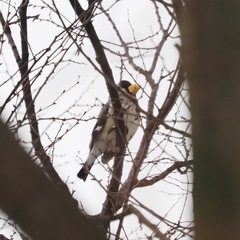
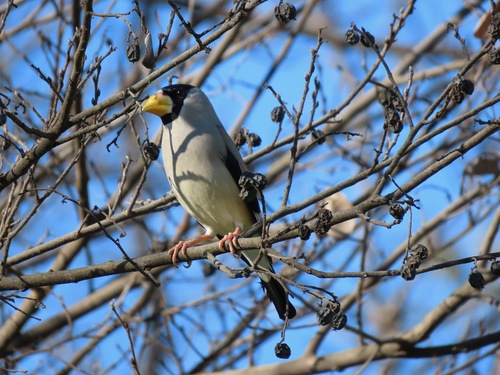
The Japanese grosbeak (Eophona personata) or Ikaru is a finch native to the East Palearctic. It is also sometimes referred to as the Japanese or masked hawfinch due to superficial similarities to the well-known Eurasian species.

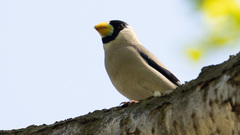
This is a large finch, with a reported weight of 80 g (2.8 oz) (for a single male) and a length of 18 to 23 cm (7.1 to 9.1 in). Among standard measurements, the wing chord is 10.2 to 11.7 cm (4.0 to 4.6 in), the tail is 8.3 to 9.5 cm (3.3 to 3.7 in) and the culmen is 2.1 to 2.6 cm (0.83 to 1.02 in). The signature feature of the Japanese grosbeak is its large, pointed bright yellow bill. The adult grosbeak has a large black marking extending from the nape to the chin and ear-coverts to the neck. The side of the neck is a contrasting pale whitish grey. The bird's underside is a more dull grey. The back is greyish-brown while the flanks are washed with a gingery or tawny-brown colour. The wings and tail are black but for a white patch on the inner-coverts and band of white in the middle of the primaries, which is visible in flight. Juveniles are a duller grey overall with no black on head. Wikipedia →

Sounds

Recording0:11

Japan · 2026

Hunter Stevens · iNaturalist · CC0

Recording0:04

Japan · 2024

© chiffon14 · iNaturalist · CC BY-NC 4.0

Recording0:26

Japan · 2025

© ITÔ, Hiroki · iNaturalist · CC BY 4.0

Global Distribution

Parks Where Found

# Park Country Daily sighting probability
1 Nikko National Park 🇯🇵 Japan
~20%

More parks will be added in future updates.

Cities Where Found

# City Country Daily sighting probability
1 Sendai 🇯🇵 Japan
~10%
2 Osaka 🇯🇵 Japan
~10%
3 Qingdao 🇨🇳 China
~10%
4 Hiroshima 🇯🇵 Japan
<5%
5 Nagoya 🇯🇵 Japan
<5%
6 Fukuoka 🇯🇵 Japan
<5%
7 Shanghai 🇨🇳 China
<5%
8 Sapporo 🇯🇵 Japan
<5%
9 Nanjing 🇨🇳 China
<5%
10 Tokyo 🇯🇵 Japan
<5%

Zoos & Centres Where Found

# Zoo / Centre Country
1 Beijing Wildlife Park 🇨🇳 China In captivity

Before you go

What are the chances of seeing a Japanese Grosbeak in Qingdao?

With luck

About 10% of wildlife watchers report a Japanese Grosbeak sighting in Qingdao on a given day, based on 7 verified sightings from GBIF citizen-science data. It is the 61st most-seen of the 73 birds we can rate there. Over three days the chance rises to about 20%, and over a week to about 30%, if each day is a fresh chance.

When is the best time to see a Japanese Grosbeak in Qingdao?

January

In that month about 20% of wildlife watchers report a Japanese Grosbeak in Qingdao on a given day, against under 5% in March and May–November, the lowest months. That is one of Qingdao's driest months, with about 10 mm of rain against 180 mm in July.

What time of day is best to see a Japanese Grosbeak?

Between 8 and 11 am

Across all the parks we cover, that three-hour window holds the most Japanese Grosbeak sightings with a recorded time, and nearly all of them come between 6 am and 6 pm: it is a daytime animal.

Is Qingdao the best place to see a Japanese Grosbeak?

Among the best

Of the 16 cities where we can rate Japanese Grosbeak sightings, Qingdao ranks 3rd at about 10%, level with the leaders once rounded. The best odds are in Sendai (Japan, about 10%) and Osaka (Japan, about 10%).

Where does the Japanese Grosbeak sighting chance come from?

GBIF citizen-science records

It is estimated from how often the Japanese Grosbeak is recorded against all the birds logged in Qingdao (7 verified sightings), calibrated against known sighting rates. Figures are rounded to the nearest 10% because citizen-science data supports honest approximations, not decimals, and months with records from fewer than five people show "—". How it works.
← Back to Qingdao