Criolla Frog

Criolla Frog

Leptodactylus latrans

Silhouette: Jose Carlos Arenas-Monroy · PhyloPic

LCLeast ConcernNTVUENCR
Daily sighting probability ~10% · With luck
at Rio de Janeiro

In 3 days ~10% in a week ~30%

6 Verified sightings at Rio de Janeiro
April Best month
🌅 Crepuscular When it's spotted

About the Criolla Frog

Leptodactylus latrans is a species of frog in the family Leptodactylidae. It is native to much of South America east of the Andes, and Trinidad and Tobago. It has many common names, including rana criolla, sapo-rana llanero, butter frog, argus frog, and lesser foam frog.

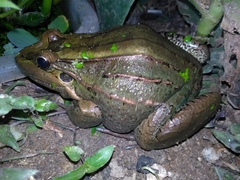
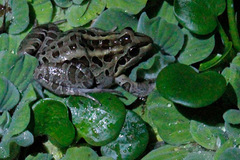
The adult male frog measures 90-120 mm in snout-vent length and the adult female frog is 80-110 mm. The skin of the dorsum is dark gray or red-brown in color with folded skin. There are dark ocelli spots with white around the edges, resembling eyes. The male frog has robust front legs. This frog has only fringed skin on its feet rather than full webbing, so it can swim well but also jump and move effectively on land.

The adult frog can alter the length of its gut. The male frogs have longer guts during the warm part of the year when food is most abundant, and female frogs have longer guts during the cold part of the year when they develop eggs.

This is a common species in many parts of its range. It can be found in a variety of habitat types, including swamps, savannah, grasslands, and tropical forest ecosystems. It tolerates disturbed habitat and can be seen in gardens and... Wikipedia →

Global Distribution

Parks Where Found

# Park Country Daily sighting probability

More parks will be added in future updates.

Cities Where Found

# City Country Daily sighting probability
1 Rio de Janeiro 🇧🇷 Brazil
~10%

Before you go

What are the chances of seeing a Criolla Frog in Rio de Janeiro?

With luck

About 10% of wildlife watchers report a Criolla Frog sighting in Rio de Janeiro on a given day, based on 6 verified sightings from GBIF citizen-science data. It is the 8th most-seen of the 11 amphibians we can rate there. Over three days the chance rises to about 10%, and over a week to about 30%, if each day is a fresh chance.

When is the best time to see a Criolla Frog in Rio de Janeiro?

April–May, July, September and November

In those months about 10% of wildlife watchers report a Criolla Frog in Rio de Janeiro on a given day, against under 5% in June, August, October and December–March, the lowest months.

What time of day is best to see a Criolla Frog?

Between 6 and 9 pm

Across all the parks we cover, that three-hour window holds the most Criolla Frog sightings with a recorded time, and about 7 in 10 of them come between 6 pm and 6 am: it is most active around dawn and dusk.

Where else can you see a Criolla Frog?

Only Rio de Janeiro, in our data

Rio de Janeiro is the only city on Wallace's Line with enough records to rate Criolla Frog sightings: about 10% of wildlife watchers there report one on a given day.

Which relatives of the Criolla Frog live in Rio de Janeiro?

Same order: Anura

The closest relatives of the Criolla Frog that you can see in Rio de Janeiro (order Anura, Frogs and Toads) are Ornate Forest toad (about 10%), Gaudichaud's Frog (about 10%) and White-edged Treefrog (about 10%), with each one's daily chance of a sighting.

Where does the Criolla Frog sighting chance come from?

GBIF citizen-science records

It is estimated from how often the Criolla Frog is recorded against all the amphibians logged in Rio de Janeiro (6 verified sightings), calibrated against known sighting rates. Figures are rounded to the nearest 10% because citizen-science data supports honest approximations, not decimals, and months with records from fewer than five people show "—". How it works.

← Back to Rio de Janeiro