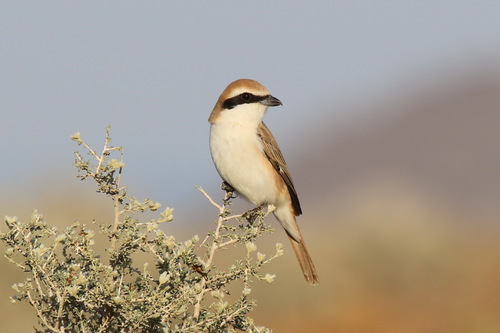
Masked Shrike

Masked Shrike

Lanius nubicus

Silhouette: Andy Wilson · PhyloPic

LCLeast ConcernNTVUENCR
Daily sighting probability ~10% · With luck
at Riyadh

In 3 days ~30% in a week ~60%

16 Verified sightings at Riyadh
9 In 1 park From 2019 to 2026
April Best month
☀️ Diurnal When it's spotted

About the Masked Shrike

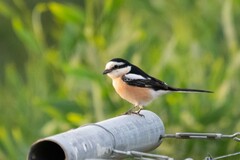
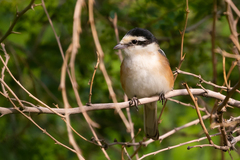
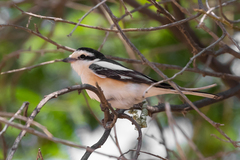
The masked shrike (Lanius nubicus) is a species of bird in the shrike family, Laniidae. It breeds in southeastern Europe and at the eastern end of the Mediterranean, with a separate population in eastern Iraq and western Iran. It is migratory, wintering mainly in northeast Africa. Although it is a short-range migrant, vagrants have occurred widely elsewhere, including northern and western Europe. It is the smallest member of its genus, long-tailed and with a hooked bill. The male has mainly black upperparts, with white on its crown, forehead and supercilium and large white patches on the shoulders and wings. The throat, neck sides and underparts are white, with orange flanks and breast. The female is a duller version of the male, with brownish black upperparts and a grey or buff tone to the shoulders and underparts. The juvenile has grey-brown upperparts with a paler forehead and barring from the head to rump, barred off-white underparts and brown wings аpart from the white primary patches. The species' calls are short and grating, but the song has melodic warbler-like components.

The masked shrike's preferred habitat is open woodland with bushes and some large trees. It is less conspicuous than its relatives, avoiding very open country and often perching in less exposed locations. The nest is a neat cup built in a tree by both adults, and the clutch is normally 4–6 eggs, which are incubated by the female for 14–16 days until hatching. The chicks are fed by both parents until they fledge 18–20 days later, and remain dependent on the adults for about 3–4 weeks after leaving the nest. The masked shrike eats mainly large insects, occasionally small vertebrates; it sometimes impales its prey on thorns or barbed wire. Populations are decreasing in parts of the European range, but not rapidly enough to raise serious conservation concerns, and the species is therefore classified by the International Union for Conservation of Nature as being of least concern. Wikipedia →

Sounds

Alarm call0:34

Turkey · 2018

© Murat Uyman · XC425941 · CC BY-NC-SA 4.0

Song0:10

Turkey · 2007

© Tero Linjama · XC348238 · CC BY-NC-SA 4.0

Call0:10

Israel · 2016

© Heidi Vibe Frederiksen · XC336506 · CC BY-NC-SA 4.0

Global Distribution

Parks Where Found

# Park Country Daily sighting probability
1 Awash National Park 🇪🇹 Ethiopia
~10%

More parks will be added in future updates.

Cities Where Found

# City Country Daily sighting probability
1 Jerusalem 🇮🇱 Israel
~30%
2 Doha 🇶🇦 Qatar
~30%
3 Kuwait City 🇰🇼 Kuwait
~20%
4 Ramallah 🇵🇸 Palestine
~20%
5 Antalya 🇹🇷 Turkey
~10%
6 Beirut 🇱🇧 Lebanon
~10%
7 Tel Aviv 🇮🇱 Israel
~10%
8 Riyadh 🇸🇦 Saudi Arabia
~10%
9 Ankara 🇹🇷 Turkey
~10%
10 Luxor 🇪🇬 Egypt
~10%

Before you go

What are the chances of seeing a Masked Shrike in Riyadh?

With luck

About 10% of wildlife watchers report a Masked Shrike sighting in Riyadh on a given day, based on 16 verified sightings from GBIF citizen-science data. It is the 39th most-seen of the 78 birds we can rate there. Over three days the chance rises to about 30%, and over a week to about 60%, if each day is a fresh chance.

When is the best time to see a Masked Shrike in Riyadh?

April

In that month about 40% of wildlife watchers report a Masked Shrike in Riyadh on a given day, against under 5% in March and November, the lowest months.

What time of day is best to see a Masked Shrike?

Between 7 and 10 am

Across all the parks we cover, that three-hour window holds the most Masked Shrike sightings with a recorded time, and about 9 in 10 of them come between 6 am and 6 pm: it is a daytime animal.

Is Riyadh the best place to see a Masked Shrike?

8th of 17

Of the 17 cities where we can rate Masked Shrike sightings, Riyadh ranks 8th at about 10%. The best odds are in Jerusalem (Israel, about 30%), Doha (Qatar, about 30%) and Kuwait City (Kuwait, about 20%).

Which relatives of the Masked Shrike live in Riyadh?

Same genus: Lanius

The closest relatives of the Masked Shrike that you can see in Riyadh (genus Lanius, Typical Shrikes) are Red-backed Shrike (about 10%), Isabelline Shrike (about 10%) and Lesser Grey Shrike (about 10%), with each one's daily chance of a sighting.

Where does the Masked Shrike sighting chance come from?

GBIF citizen-science records

It is estimated from how often the Masked Shrike is recorded against all the birds logged in Riyadh (16 verified sightings), calibrated against known sighting rates. Figures are rounded to the nearest 10% because citizen-science data supports honest approximations, not decimals, and months with records from fewer than five people show "—". How it works.

← Back to Riyadh