Red Malachite Beetle

Red Malachite Beetle

Anthocomus rufus

Daily sighting probability <5% · Rare
at Saint Petersburg

In 3 days ~10% in a week ~20%

13 Verified sightings at Saint Petersburg
15 In 1 park From 2019 to 2026
August Best month
☀️ Diurnal When it's spotted

About the Red Malachite Beetle

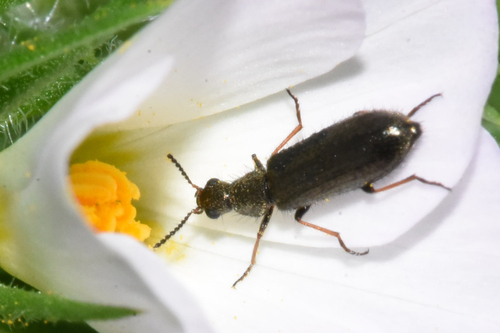
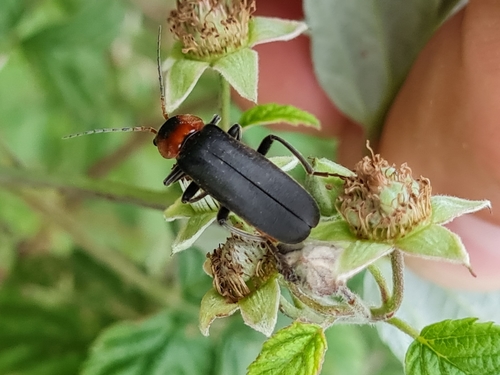
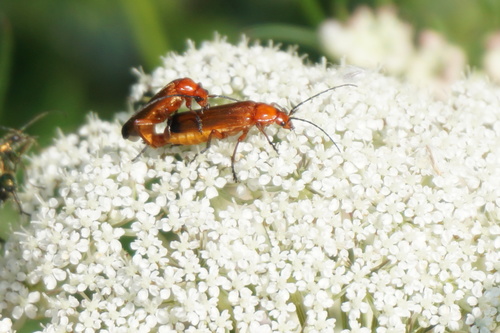
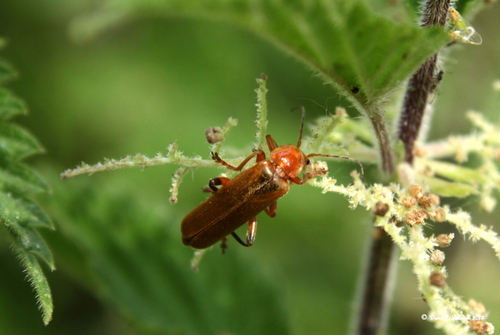
Anthocomus rufus is a species of beetle belonging to the family Melyridae. It is commonly known as the red malachite beetle. It is native to Europe. The elongated body has a lightly sclerotized outer skeleton. It is sparsely hairy and reaches an average length of just under five millimeters.

The elongate black head is slightly tilted downward. The mouthparts point forward. The mandibles have a two-toothed tip. The thread-like maxillary palps have three segments, with the terminal segment spindle-shaped and ending in a point. The labial palps are short, with the second and third segments being the same length. The eleven-segmented antennae are thread-like, originating in front of the eyes, not between them.

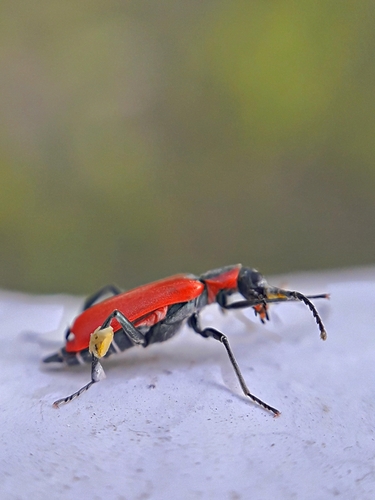
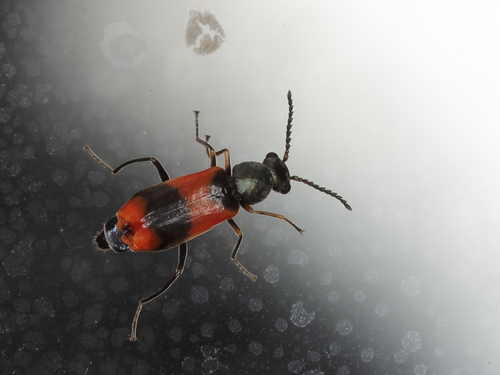
The pronotum is wider than it is long. The base has a fine edge and tapers to a rounded shape. It is black with red on the sides, or red with a broad black middle stripe. The red and black colours are not sharply defined but flow smoothly into each other. The elytra only partially cover the abdomen in females. They are only slightly wider than the pronotum. The frequently occurring double hair within the family is absent: the elytra are only softly hairy in a downy way. They are the same red as the edges of the pronotum. Around the scutellum, there is usually a blurry black spot. In females, the elytra are slightly widened at the back, while in males, they are almost parallel. At the tip of the elytra in males, there is a striking structure called the excitator. It consists of a black, intricately curved chitin ridge that resembles a musical note.

The animals are active during the day and love the sun and warmth. The beetles eat pollen from the reed (Phragmites communis). They also consume dead insects, preferably prey of the reed spider. The beetles are often found in large numbers on their host plant and mate there as well. Mating is usually preceded by a so-called tasting courtship (gustatory courtship), as is only seen in the longhorn beetles. Wikipedia →
Global Distribution

Parks Where Found

# Park Country Daily sighting probability
1 Wadden Sea National Park 🇩🇪 Germany
~10%

More parks will be added in future updates.

Cities Where Found

# City Country Daily sighting probability
1 Helsinki 🇫🇮 Finland
~10%
2 Warsaw 🇵🇱 Poland
<5%
3 Copenhagen 🇩🇰 Denmark
<5%
4 Nizhny Novgorod 🇷🇺 Russia
<5%
5 Kyiv 🇺🇦 Ukraine
<5%
6 Saint Petersburg 🇷🇺 Russia
<5%
7 Berlin 🇩🇪 Germany
<5%
8 London 🇬🇧 United Kingdom
<5%
9 Vienna 🇦🇹 Austria
<5%
10 Moscow 🇷🇺 Russia
<5%

Before you go

What are the chances of seeing a Red Malachite Beetle in Saint Petersburg?

Rare

Under 5% of wildlife watchers report a Red Malachite Beetle sighting in Saint Petersburg on a given day, based on 13 verified sightings from GBIF citizen-science data. It is the 184th most-seen of the 448 insects we can rate there. Over three days the chance rises to about 10%, and over a week to about 20%, if each day is a fresh chance.

When is the best time to see a Red Malachite Beetle in Saint Petersburg?

August and September

In those months about 10% of wildlife watchers report a Red Malachite Beetle in Saint Petersburg on a given day, against under 5% in October to July, the lowest months.

What time of day is best to see a Red Malachite Beetle?

Between 11 am and 2 pm

Across all the parks we cover, that three-hour window holds the most Red Malachite Beetle sightings with a recorded time, and about 8 in 10 of them come between 6 am and 6 pm: it is a daytime animal.

Is Saint Petersburg the best place to see a Red Malachite Beetle?

6th of 10

Of the 10 cities where we can rate Red Malachite Beetle sightings, Saint Petersburg ranks 6th at under 5%. The best odds are in Helsinki (Finland, about 10%), Warsaw (Poland, under 5%) and Copenhagen (Denmark, under 5%).

Where does the Red Malachite Beetle sighting chance come from?

GBIF citizen-science records

It is estimated from how often the Red Malachite Beetle is recorded against all the insects logged in Saint Petersburg (13 verified sightings), calibrated against known sighting rates. Figures are rounded to the nearest 10% because citizen-science data supports honest approximations, not decimals, and months with records from fewer than five people show "—". How it works.

← Back to Saint Petersburg