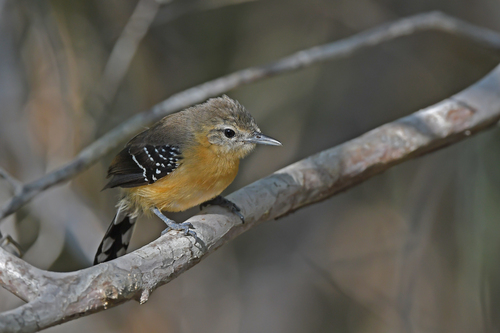
Southern White-fringed Antwren

Southern White-fringed Antwren

Formicivora grisea

Silhouette: Sheatherius · PhyloPic

LCLeast ConcernNTVUENCR
Daily sighting probability <5% · Rare
at Salvador

In 3 days ~10%

14 Verified sightings at Salvador
June Best month
☀️ Diurnal When it's spotted

About the Southern White-fringed Antwren

The southern white-fringed antwren (Formicivora grisea) is an insectivorous bird in subfamily Thamnophilinae of family Thamnophilidae, the "typical antbirds". It is found in Brazil, Colombia, French Guiana, Guyana, Suriname, and Venezuela.

The southern white-fringed antwren was described by the French polymath Georges-Louis Leclerc, Comte de Buffon in his Histoire Naturelle des Oiseaux in 1775 from a specimen collected in Cayenne, French Guiana. The bird was also illustrated in a hand-colored plate engraved by François-Nicolas Martinet in the Planches Enluminées D'Histoire Naturelle which was produced under the supervision of Edme-Louis Daubenton to accompany Buffon's text. Neither the plate caption nor Buffon's description included a scientific name but in 1783 the Dutch naturalist Pieter Boddaert coined the binomial name Turdus griseus in his catalogue of the Planches Enluminées. The southern white-fringed antwren is now placed in the genus Formicivora that was introduced by the English naturalist William Swainson in 1824. The generic name combines the Latin words formica for "ant" and -vorus "eating" from vorare "to devour". The specific epithet grisea... Wikipedia →

Sounds

Call0:17

Brazil · 2026

© JAYRSON ARAUJO DE OLIVEIRA · XC1162256 · CC BY-NC-SA 4.0

Song0:45

Brazil · 2025

© Joost van Bruggen · XC1050607 · CC BY-NC-ND 4.0

Alarm call1:18

Brazil · 2020

© Robson Silva e Silva · XC589576 · CC BY-NC-SA 4.0

Global Distribution

Parks Where Found

# Park Country Daily sighting probability

More parks will be added in future updates.

Cities Where Found

# City Country Daily sighting probability
1 São Luís 🇧🇷 Brazil
~20%
2 Belém 🇧🇷 Brazil
~10%
3 Fortaleza 🇧🇷 Brazil
<5%
4 Maceió 🇧🇷 Brazil
<5%
5 Salvador 🇧🇷 Brazil
<5%

Before you go

What are the chances of seeing a Southern White-fringed Antwren in Salvador?

Rare

Under 5% of wildlife watchers report a Southern White-fringed Antwren sighting in Salvador on a given day, based on 14 verified sightings from GBIF citizen-science data. It is the 83rd most-seen of the 107 birds we can rate there. Over three days the chance rises to about 10%, if each day is a fresh chance.

When is the best time to see a Southern White-fringed Antwren in Salvador?

June

In that month about 10% of wildlife watchers report a Southern White-fringed Antwren in Salvador on a given day, against under 5% in July to May, the lowest months.

What time of day is best to see a Southern White-fringed Antwren?

Between 7 and 10 am

Across all the parks we cover, that three-hour window holds the most Southern White-fringed Antwren sightings with a recorded time, and about 9 in 10 of them come between 6 am and 6 pm: it is a daytime animal.

Is Salvador the best place to see a Southern White-fringed Antwren?

5th of 5

Of the 5 cities where we can rate Southern White-fringed Antwren sightings, Salvador ranks 5th at under 5%. The best odds are in São Luís (Brazil, about 20%), Belém (Brazil, about 10%) and Fortaleza (Brazil, under 5%).

Which relatives of the Southern White-fringed Antwren live in Salvador?

Same order: Passeriformes

The closest relatives of the Southern White-fringed Antwren that you can see in Salvador (order Passeriformes, Perching Birds) are Great Kiskadee (over 90%), Bananaquit (about 90%) and Social Flycatcher (about 90%), with each one's daily chance of a sighting.

Where does the Southern White-fringed Antwren sighting chance come from?

GBIF citizen-science records

It is estimated from how often the Southern White-fringed Antwren is recorded against all the birds logged in Salvador (14 verified sightings), calibrated against known sighting rates. Figures are rounded to the nearest 10% because citizen-science data supports honest approximations, not decimals, and months with records from fewer than five people show "—". How it works.
← Back to Salvador

