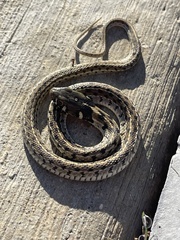
Checkered Garter Snake

Checkered Garter Snake

Thamnophis marcianus

Silhouette: Alex Slavenko · PhyloPic

LCLeast ConcernNTVUENCR
Daily sighting probability ~10% · With luck
at San Antonio

In 3 days ~30% in a week ~60%

149 Verified sightings at San Antonio
84 In all 3 parks From 2019 to 2026
June Best month
☀️🌙 Day & Night When it's spotted

About the Checkered Garter Snake

The checkered garter snake (Thamnophis marcianus) is a species of garter snake in the subfamily Natricinae of the family Colubridae. The species is native to the southwestern United States, Mexico, and Central America. There are two recognized subspecies.

The specific epithet marcianus is in honor of American Brigadier General Randolph B. Marcy, who led surveying expeditions to the frontier areas in the mid-19th century. The checkered garter snake is typically greenish in color, with a distinct, black checkerboard pattern down its back. It is capable of growing to a total length (tail included) of 42 inches (107 cm), but is usually 18 to 24 inches (46 to 61 cm).

The preferred natural habitats of Thamnophis marcianus are desert, grassland, shrubland, and forest, usually close to water, at altitudes from sea level to 2,200 m (7,200 ft). The diet of Thamnophis marcianus includes small frogs, toads, small fish, and earthworms. If kept as a pet, it can be trained on live or freeze-thawed mice, but even so, it is a fussy eater and can suddenly start to refuse mice at any point.

Unlike most garter snakes, the checkered... Wikipedia →

Global Distribution

Parks Where Found

# Park Country Daily sighting probability
1 Padre Island National Seashore 🇺🇸 United States
~30%
2 Big Bend National Park 🇺🇸 United States
~10%
3 Saguaro National Park 🇺🇸 United States
~10%

Cities Where Found

# City Country Daily sighting probability
1 San Antonio 🇺🇸 United States
~10%
2 Austin 🇺🇸 United States
~10%
3 Monterrey 🇲🇽 México
<5%

Zoos & Centres Where Found

# Zoo / Centre Country
1 Phoenix Zoo 🇺🇸 United States In captivity
2 Silesian Zoological Garden 🇵🇱 Poland In captivity
3 Warsaw Zoo 🇵🇱 Poland In captivity
4 Wrocław Zoological Garden 🇵🇱 Poland In captivity
5 Parque museo La Venta 🇲🇽 Mexico In captivity
6 Africarium 🇵🇱 Poland In captivity
7 Children's Aquarium at Fair Park 🇺🇸 United States In captivity
8 herpetarium warszawskiego ZOO 🇵🇱 Poland In captivity
9 hipopotamiarnia i akwarium morskie warszawskiego ZOO 🇵🇱 Poland In captivity
10 terrarium ogrodu zoologicznego we Wrocławiu 🇵🇱 Poland In captivity

Before you go

What are the chances of seeing a Checkered Garter Snake in San Antonio?

With luck

About 10% of wildlife watchers report a Checkered Garter Snake sighting in San Antonio on a given day, based on 149 verified sightings from GBIF citizen-science data. It is the 11th most-seen of the 33 reptiles we can rate there. Over three days the chance rises to about 30%, and over a week to about 60%, if each day is a fresh chance.

When is the best time to see a Checkered Garter Snake in San Antonio?

May–June, August and October

In those months about 20% of wildlife watchers report a Checkered Garter Snake in San Antonio on a given day, against under 5% in February, the lowest month.

What time of day is best to see a Checkered Garter Snake?

Between 8 and 11 pm

Across all the parks we cover, that three-hour window holds the most Checkered Garter Snake sightings with a recorded time, and about half of them come between 6 am and 6 pm: it is seen both by day and at night.

Is San Antonio the best place to see a Checkered Garter Snake?

Yes

Of the 3 cities where we can rate Checkered Garter Snake sightings, San Antonio has the highest daily chance: about 10%. Next come Austin (United States, about 10%) and Monterrey (México, under 5%).

Where does the Checkered Garter Snake sighting chance come from?

GBIF citizen-science records

It is estimated from how often the Checkered Garter Snake is recorded against all the reptiles logged in San Antonio (149 verified sightings), calibrated against known sighting rates. Figures are rounded to the nearest 10% because citizen-science data supports honest approximations, not decimals, and months with records from fewer than five people show "—". How it works.

← Back to San Antonio