About the Texas Leafcutter Ant
The Texas leafcutter ant (Atta texana) is a species of fungus-farming ant in the subfamily Myrmicinae. It is found in Texas, Louisiana, and north-eastern Mexico. Other common names include town ant, parasol ant, fungus ant, cut ant, and night ant. It harvests leaves from over 200 plant species, and is considered a major pest of agricultural and ornamental plants, as it can defoliate a citrus tree in less than 24 hours. Every colony has several queens and up to 2 million workers. Nests are built in well-drained, sandy or loamy soil, and may reach a depth of 6 m (20 ft), have 1000 entrance holes, and occupy 420 m2 (4,500 ft2).
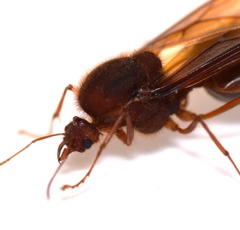
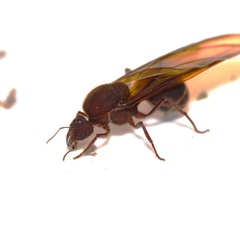
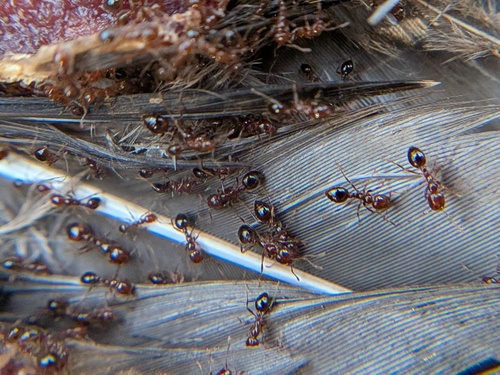
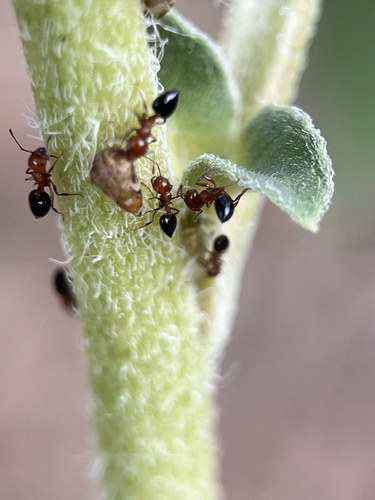
Workers measure 3 to 18 mm (0.12 to 0.71 in) in length, and are highly polymorphic. The back of the thorax has three pairs of spines. The ant has a narrow waist and is rusty brown in color. Its closely related cousin, Atta mexicana has colonies up to 8 million, and the queen for A. mexicana is larger than the M. texana queen. Atta mexicana is only able to have a single queen, while A. texana may have multiple queens (often 2). This makes the species polygyne and because of this trait, A. texana can form massive super colonies with upwards of 10... Wikipedia →