About the Southern House Mosquito
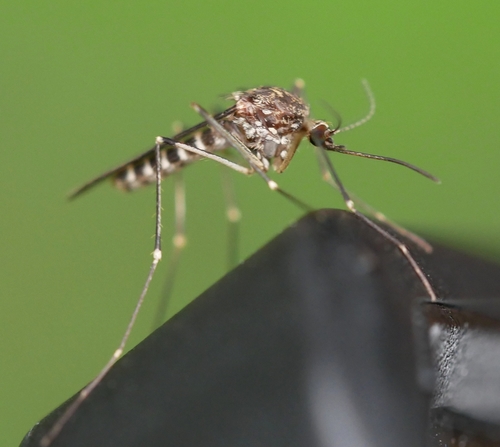
Culex quinquefasciatus (originally named Culex fatigans), commonly known as the southern house mosquito, is a medium-sized mosquito found in tropical and subtropical regions of the world. It is a vector of Wuchereria bancrofti, avian malaria, and arboviruses including St. Louis encephalitis virus, Western equine encephalitis virus, Zika virus and West Nile virus. It is taxonomically regarded as a member of the Culex pipiens species complex. Its genome was sequenced in 2010, and was shown to have 18,883 protein-coding genes.
American entomologist Thomas Say described Culex quinquefasciatus, which he collected along the Mississippi River, in 1823. Originally written as "C. 5-fasciatus", the name refers to five (quinque) black, broad, transverse bands ("fasciatus" or "fasciae") on the mosquito's dorsal abdomen. The name remains despite later revelations of more than five fasciae, thanks to improved microscopy. Although quinquefasciatus is the official scientific name, there are at least five synonymous names for this species.
Cx. quinquefasciatus is a member of the Culex pipiens species complex. Smith et al. 2004 develop an assay specifically for this complex... Wikipedia →