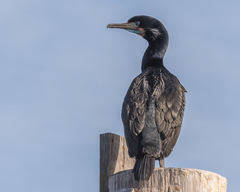

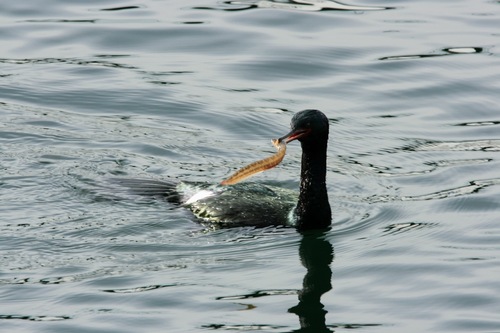


Townsend's Cormorant

Townsend's Cormorant

Urile penicillatus

Silhouette: Caleb M. Gordon · PhyloPic

LCLeast ConcernNTVUENCR
Daily sighting probability ~10% · With luck
at San Diego

In 3 days ~40% in a week ~70%

7,220 Verified sightings at San Diego
5,763 In all 8 parks From 2019 to 2026
August Best month
☀️ Diurnal When it's spotted

About the Townsend's Cormorant

Brandt's cormorant (Urile penicillatus) is a strictly marine bird of the cormorant family of seabirds that inhabits the Pacific coast of North America. It ranges, in the summer, from Alaska to the Gulf of California, but the population north of Vancouver Island migrates south during the winter. Its specific name, penicillatus is Latin for a painter's brush (pencil of hairs), in reference to white plumes on its neck and back during the early breeding season. The common name honors the German naturalist Johann Friedrich von Brandt of the Academy of Sciences at St. Petersburg, who described the species from specimens collected on expeditions to the Pacific during the early 19th century.

It was formerly classified in the genus Phalacrocorax, but a 2014 study supported reclassifying it and several other Pacific cormorant species into the genus Urile. The IOU followed this classification in 2021. The average size of a Brandt's cormorant is 4.6 pounds. They have a length of about 34 inches and their wingspan is 4 feet. During the breeding season, adults have a blue throat patch.

Brandt's cormorants live on the Pacific coast of... Wikipedia →

Sounds

Begging call0:11

United States · 2016

© David Vander Pluym · XC354689 · CC BY-NC-SA 4.0

Recording0:18

United States · 2021

© Cricket Raspet · iNaturalist · CC BY 4.0

Global Distribution

Parks Where Found

# Park Country Daily sighting probability
1 Channel Islands National Park 🇺🇸 United States
~40%
2 Cabo Pulmo National Park 🇲🇽 Mexico
~20%
3 Bahía de Loreto National Park 🇲🇽 Mexico
~20%
4 El Vizcaíno Biosphere Reserve 🇲🇽 Mexico
~20%
5 Pacific Rim National Park Reserve 🇨🇦 Canada
~20%
6 Olympic National Park 🇺🇸 United States
~10%
7 Redwood National Park 🇺🇸 United States
~10%
8 Great Bear Rainforest 🇨🇦 Canada
~10%

Cities Where Found

# City Country Daily sighting probability
1 San Diego 🇺🇸 United States
~10%
2 Tijuana 🇲🇽 México
~10%
3 San Francisco 🇺🇸 United States
~10%
4 Seattle 🇺🇸 United States
<5%
5 Los Angeles 🇺🇸 United States
<5%
6 Vancouver 🇨🇦 Canada
<5%

Zoos & Centres Where Found

# Zoo / Centre Country
1 SeaWorld San Diego 🇺🇸 United States In captivity

Before you go

What are the chances of seeing a Townsend's Cormorant in San Diego?

With luck

About 10% of wildlife watchers report a Townsend's Cormorant sighting in San Diego on a given day, based on 7,220 verified sightings from GBIF citizen-science data. It is the 56th most-seen of the 386 birds we can rate there. Over three days the chance rises to about 40%, and over a week to about 70%, if each day is a fresh chance.

When is the best time to see a Townsend's Cormorant in San Diego?

January–February and August–September

In those months about 20% of wildlife watchers report a Townsend's Cormorant in San Diego on a given day, against about 10% in March–July and October–December, the lowest months.

What time of day is best to see a Townsend's Cormorant?

Between 2 and 5 pm

Across all the parks we cover, that three-hour window holds the most Townsend's Cormorant sightings with a recorded time, and about 9 in 10 of them come between 6 am and 6 pm: it is a daytime animal.

Is San Diego the best place to see a Townsend's Cormorant?

Yes

Of the 6 cities where we can rate Townsend's Cormorant sightings, San Diego has the highest daily chance: about 10%. Next come Tijuana (México, about 10%) and San Francisco (United States, about 10%).

Where does the Townsend's Cormorant sighting chance come from?

GBIF citizen-science records

It is estimated from how often the Townsend's Cormorant is recorded against all the birds logged in San Diego (7,220 verified sightings), calibrated against known sighting rates. Figures are rounded to the nearest 10% because citizen-science data supports honest approximations, not decimals, and months with records from fewer than five people show "—". How it works.

← Back to San Diego