Western Skink

Western Skink

Plestiodon skiltonianus

Silhouette: David Orr · PhyloPic

LCLeast ConcernNTVUENCR
Daily sighting probability <5% · Rare
at San Francisco

In 3 days ~10% in a week ~20%

60 Verified sightings at San Francisco
40 In all 3 parks From 2019 to 2026
March Best month
☀️ Diurnal When it's spotted

About the Western Skink

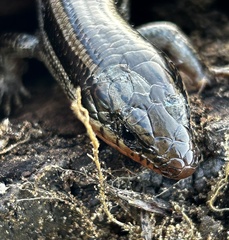
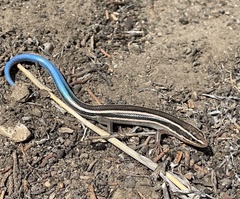
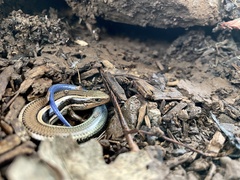
The western skink (Plestiodon skiltonianus) is a species of small, smooth-scaled lizard with relatively small limbs. It measures about 100 to 210 mm (about 4 to 8.25 inches) in total length (body + tail). It is one of six species of lizards in Canada. They spend much of their day basking in the sun. Their diet ranges widely, including spiders and beetles. Western skinks will bite if grasped and will flee if they feel threatened. It is a common but secretive species whose range extends from southern British Columbia and throughout Washington, Oregon, Nevada, Utah, Idaho, and Wyoming and into western Montana and northern Arizona and Missouri. They can also live in some areas of Texas It is widespread in northern California but primarily restricted to the coast in central and southern California. Found in a variety of habitats, this lizard is most common in early successional stages or open areas of late successional stages. Heavy brush and densely forested areas are generally avoided. Western skinks are found from sea level to at least 2,130 m (7,000 ft). This diurnal reptile is active during the warm seasons.

Initially described in 1852 by Baird and Girard, the Western... Wikipedia →

Global Distribution

Parks Where Found

# Park Country Daily sighting probability
1 Zion National Park 🇺🇸 United States
~20%
2 Redwood National Park 🇺🇸 United States
~10%
3 Grand Canyon National Park 🇺🇸 United States
~10%

Cities Where Found

# City Country Daily sighting probability
1 San Diego 🇺🇸 United States
~10%
2 Portland 🇺🇸 United States
<5%
3 Los Angeles 🇺🇸 United States
<5%
4 San Francisco 🇺🇸 United States
<5%

Zoos & Centres Where Found

# Zoo / Centre Country
1 Zoologico Caliente 🇲🇽 Mexico In captivity

Closest Relatives at San Francisco

No species of the same family or order lives in San Francisco, so these are its closest relatives here: other reptiles.

Before you go

What are the chances of seeing a Western Skink in San Francisco?

Rare

Under 5% of wildlife watchers report a Western Skink sighting in San Francisco on a given day, based on 60 verified sightings from GBIF citizen-science data. It is the 11th most-seen of the 21 reptiles we can rate there. Over three days the chance rises to about 10%, and over a week to about 20%, if each day is a fresh chance.

When is the best time to see a Western Skink in San Francisco?

March

In that month about 10% of wildlife watchers report a Western Skink in San Francisco on a given day, against under 5% in April to February, the lowest months. That is one of San Francisco's wettest months, with about 75 mm of rain against almost none in July.

What time of day is best to see a Western Skink?

Between noon and 3 pm

Across all the parks we cover, that three-hour window holds the most Western Skink sightings with a recorded time, and about 9 in 10 of them come between 6 am and 6 pm: it is a daytime animal.

Is San Francisco the best place to see a Western Skink?

4th of 4

Of the 4 cities where we can rate Western Skink sightings, San Francisco ranks 4th at under 5%. The best odds are in San Diego (United States, about 10%), Portland (United States, under 5%) and Los Angeles (United States, under 5%).

Where does the Western Skink sighting chance come from?

GBIF citizen-science records

It is estimated from how often the Western Skink is recorded against all the reptiles logged in San Francisco (60 verified sightings), calibrated against known sighting rates. Figures are rounded to the nearest 10% because citizen-science data supports honest approximations, not decimals, and months with records from fewer than five people show "—". How it works.

← Back to San Francisco