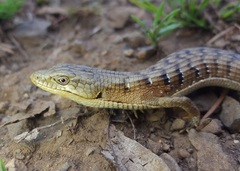
Southern Alligator Lizard

Southern Alligator Lizard

Elgaria multicarinata

Silhouette: Jose Carlos Arenas-Monroy · PhyloPic

LCLeast ConcernNTVUENCR
Daily sighting probability ~10% · With luck
at San Francisco

In 3 days ~40% in a week ~70%

1,029 Verified sightings at San Francisco
187 In all 4 parks From 2019 to 2026
May Best month
🌅 Crepuscular When it's spotted

About the Southern Alligator Lizard

The southern alligator lizard (Elgaria multicarinata) is a common species of lizard in the family Anguidae. The species is native to the Pacific coast of North America. It ranges from Baja California to the state of Washington and lives in a variety of habitats including grasslands, chaparral, forests, and even urban areas. In dry climates, it is likely to be found in moist areas or near streams. There are five recognized subspecies.

Elgaria multicarinata ignava (Van Denburgh, 1905) Elgaria multicarinata multicarinata (Blainville, 1835) Elgaria multicarinata nana (Fitch, 1934) Elgaria multicarinata scincicauda (Skilton, 1849) Elgaria multicarinata webbii (Baird, 1859)

The generic name Elgaria is possibly named for an "Elgar" or a pun on "alligator." The specific name multicarinata refers to the keeled scales characteristic of this species. The common name "alligator lizard" is a reference to the fact that the back and belly scales of these lizards are reinforced by bone, as they are in alligators.

The subspecific name webbii is in honor... Wikipedia →

Global Distribution

Parks Where Found

# Park Country Daily sighting probability
1 Channel Islands National Park 🇺🇸 United States
~30%
2 Sequoia and Kings Canyon National Parks 🇺🇸 United States
~20%
3 Yosemite National Park 🇺🇸 United States
~10%
4 Redwood National Park 🇺🇸 United States
~10%

Cities Where Found

# City Country Daily sighting probability
1 Tijuana 🇲🇽 México
~30%
2 Los Angeles 🇺🇸 United States
~30%
3 Sacramento 🇺🇸 United States
~30%
4 San Diego 🇺🇸 United States
~20%
5 San Francisco 🇺🇸 United States
~10%

Zoos & Centres Where Found

# Zoo / Centre Country
1 San Diego Zoo 🇺🇸 United States In captivity
2 Los Angeles Zoo 🇺🇸 United States In captivity
3 California Living Museum 🇺🇸 United States In captivity
4 Lindsay Wildlife Experience 🇺🇸 United States In captivity

Before you go

What are the chances of seeing a Southern Alligator Lizard in San Francisco?

With luck

About 10% of wildlife watchers report a Southern Alligator Lizard sighting in San Francisco on a given day, based on 1,029 verified sightings from GBIF citizen-science data. It is the 4th most-seen of the 21 reptiles we can rate there. Over three days the chance rises to about 40%, and over a week to about 70%, if each day is a fresh chance.

When is the best time to see a Southern Alligator Lizard in San Francisco?

April to June

In those months about 20% of wildlife watchers report a Southern Alligator Lizard in San Francisco on a given day, against about 10% in July to March, the lowest months. Those are among San Francisco's driest months, with about 20 mm of rain a month against 110 mm in December.

What time of day is best to see a Southern Alligator Lizard?

Between 6 and 9 pm

Across all the parks we cover, that three-hour window holds the most Southern Alligator Lizard sightings with a recorded time, and about half of them come between 6 am and 6 pm: it is most active around dawn and dusk.

Is San Francisco the best place to see a Southern Alligator Lizard?

5th of 5

Of the 5 cities where we can rate Southern Alligator Lizard sightings, San Francisco ranks 5th at about 10%. The best odds are in Tijuana (México, about 30%), Los Angeles (United States, about 30%) and Sacramento (United States, about 30%).

Where does the Southern Alligator Lizard sighting chance come from?

GBIF citizen-science records

It is estimated from how often the Southern Alligator Lizard is recorded against all the reptiles logged in San Francisco (1,029 verified sightings), calibrated against known sighting rates. Figures are rounded to the nearest 10% because citizen-science data supports honest approximations, not decimals, and months with records from fewer than five people show "—". How it works.

← Back to San Francisco