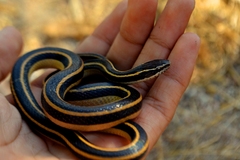
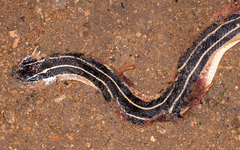
Cope's Black-striped Snake

Cope's Black-striped Snake

Coniophanes piceivittis

Silhouette: Alex Slavenko · PhyloPic

LCLeast ConcernNTVUENCR
Daily sighting probability ~10% · With luck
at San José

In 3 days ~10% in a week ~30%

7 Verified sightings at San José
44 In all 3 parks From 2019 to 2026
January Best month
☀️🌙 Day & Night When it's spotted

About the Cope's Black-striped Snake

Coniophanes piceivittis, known commonly as Cope's black-striped snake, is a species of small snake in the subfamily Dipsadinae of the family Colubridae. The species is endemic to Central America and Mexico, and is found in a wide range of habitats.

C. piceivittis is found in Costa Rica, El Salvador, Guatemala, Honduras, southern Mexico, and Nicaragua. C. piceivittis is oviparous. Two subspecies are recognized as being valid, including the nominotypical subspecies. Coniophanes piceivittis frangivirgatus J. Peters, 1950

Coniophanes piceivittis piceivittis Cope, 1869 Cope ED (1869). "Seventh Contribution to the Herpetology of Tropical America". Proceedings of the American Philosophical Society, Philadelphia 11: 147–169. (Coniophanes piceiviitis, new species, pp. 149–150).

Heimes, Peter (2016). Snakes of Mexico: Herpetofauna Mexicana Vol. I. Frankfurt, Germany: Chimaira. 572 pp. ISBN 978-3899731002. Peters JA (1950). "A New Snake of the Genus Coniophanes from Veracruz, Mexico". Copeia 1950 (4): 279–280. (Coniophanes frangivirgatus, new species). Wikipedia →

Global Distribution

Parks Where Found

# Park Country Daily sighting probability
1 Santa Rosa National Park 🇨🇷 Costa Rica
~30%
2 Palo Verde National Park 🇨🇷 Costa Rica
~20%
3 Cañón del Sumidero National Park 🇲🇽 Mexico
~10%

Cities Where Found

# City Country Daily sighting probability
1 San Pedro Sula 🇭🇳 Honduras
~10%
2 San José 🇨🇷 Costa Rica
~10%

Before you go

What are the chances of seeing a Cope's Black-striped Snake in San José?

With luck

About 10% of wildlife watchers report a Cope's Black-striped Snake sighting in San José on a given day, based on 7 verified sightings from GBIF citizen-science data. It is the 17th most-seen of the 24 reptiles we can rate there. Over three days the chance rises to about 10%, and over a week to about 30%, if each day is a fresh chance.

When is the best time to see a Cope's Black-striped Snake in San José?

January, March–April, June and October

In those months about 10% of wildlife watchers report a Cope's Black-striped Snake in San José on a given day, against under 5% in February, May, July–September and November–December, the lowest months.

What time of day is best to see a Cope's Black-striped Snake?

Between 6 and 9 pm

Across all the parks we cover, that three-hour window holds the most Cope's Black-striped Snake sightings with a recorded time, and about half of them come between 6 am and 6 pm: it is seen both by day and at night.

Is San José the best place to see a Cope's Black-striped Snake?

Among the best

Of the 2 cities where we can rate Cope's Black-striped Snake sightings, San José ranks 2nd at about 10%, level with the leaders once rounded. The best odds are in San Pedro Sula (Honduras, about 10%).

Which relatives of the Cope's Black-striped Snake live in San José?

Same family: Colubridae

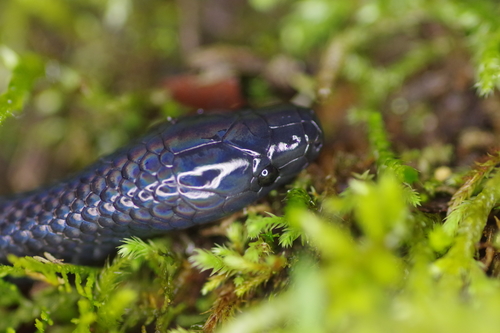
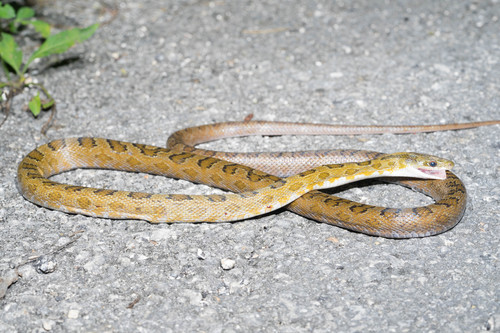
The closest relatives of the Cope's Black-striped Snake that you can see in San José (family Colubridae, Colubrid Snakes) are Spotted Coffee Snake (about 10%), Hoffmann's Earth Snake (about 10%) and Green Rat Snake (about 10%), with each one's daily chance of a sighting.

Where does the Cope's Black-striped Snake sighting chance come from?

GBIF citizen-science records

It is estimated from how often the Cope's Black-striped Snake is recorded against all the reptiles logged in San José (7 verified sightings), calibrated against known sighting rates. Figures are rounded to the nearest 10% because citizen-science data supports honest approximations, not decimals, and months with records from fewer than five people show "—". How it works.

← Back to San José