


Completed

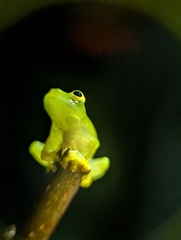
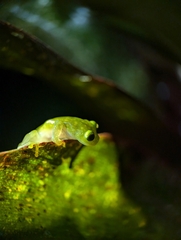
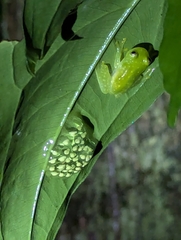
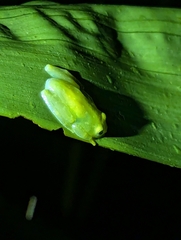

Fleischmann's Glass Frog
Hyalinobatrachium fleischmanni
Silhouette: Jose Carlos Arenas-Monroy · PhyloPic
- KingdomAnimalia (Animals)
- PhylumChordata (Chordates)
- ClassAmphibia (Amphibians)
- OrderAnura (Frogs and Toads)
- FamilyCentrolenidae (Glass Frogs)
- GenusHyalinobatrachium
- SpeciesHyalinobatrachium fleischmanni (Fleischmann's Glass Frog)
In 3 days ~30% in a week ~50%
22 Verified sightings at San José
26 In all 3 parks From 2019 to 2026
October Best month
🌙 Nocturnal When it's spotted
About the Fleischmann's Glass Frog
Hyalinobatrachium fleischmanni, also known as Fleischmann's glass frog or the northern glass frog, is a species of frog in the family Centrolenidae. It is found in the tropical Americas from southern Mexico to Ecuador. Specifically, these frogs occur in Mexico, Belize, Costa Rica, El Salvador, Guatemala, Honduras, Nicaragua, and Panama, Colombia, and Ecuador. It has often been confused with related species, and the exact distribution depends on the source. This frog tends to have green skin, pale yellowish spots, yellow fingertips and translucent skin covering its stomach.
The specific name fleischmanni honors Carl Fleischmann, a collector in Costa Rica in the 1890s. H. fleischmanni are small and arboreal frogs that lives in lowland and mid-elevation forests of Central and South America. They call during the rainy season.
Glass frogs have similarities to tree frogs. They look very close to the naked eye except glass frog's eyes point forward and are golden. During the day, these frogs camouflage themselves under leaves but above water. Male glass frogs are 19–28 mm long, while females measure from 23–32 mm long. They have a green semi-translucent color... Wikipedia →
Sounds
Advertisement call0:21
Costa Rica · 2014
© Chris Harrison · XC893988 · CC BY-NC-SA 4.0
Recording0:23
Costa Rica · 2023
© Diego Lobo Montoya · iNaturalist · CC BY-NC 4.0
Recording0:11
Costa Rica · 2026
© Jorbin D. Cruz · iNaturalist · CC BY-NC 4.0
Recent sightings of Fleischmann's Glass Frog in San José
LIVEiNaturalistGlobal Distribution
Parks Where Found
| # | Park | Country | Daily sighting probability |
|---|---|---|---|
| 1 | Monteverde Cloud Forest Reserve | 🇨🇷 Costa Rica | |
| 2 | Braulio Carrillo National Park | 🇨🇷 Costa Rica | |
| 3 | Arenal Volcano National Park | 🇨🇷 Costa Rica |
Cities Where Found
| # | City | Country | Daily sighting probability |
|---|---|---|---|
| 1 | San José | 🇨🇷 Costa Rica |
Zoos & Centres Where Found
| # | Zoo / Centre | Country | |
|---|---|---|---|
| 1 | Toledo Zoo | 🇺🇸 United States | |
| 2 | Nifrel | 🇯🇵 Japan | |
| 3 | Monteverde Theme Park | 🇨🇷 Costa Rica |
Closest Relatives at San José



Before you go
What are the chances of seeing a Fleischmann's Glass Frog in San José?
With luck
About 10% of wildlife watchers report a Fleischmann's Glass Frog sighting in San José on a given day, based on 22 verified sightings from GBIF citizen-science data. It is the 5th most-seen of the 8 amphibians we can rate there. Over three days the chance rises to about 30%, and over a week to about 50%, if each day is a fresh chance.
When is the best time to see a Fleischmann's Glass Frog in San José?
October
In that month about 20% of wildlife watchers report a Fleischmann's Glass Frog in San José on a given day, against under 5% in April, June and December–January, the lowest months. That is one of San José's wettest months, with about 300 mm of rain against 20 mm in February.
What time of day is best to see a Fleischmann's Glass Frog?
Between 7 and 10 pm
Across all the parks we cover, that three-hour window holds the most Fleischmann's Glass Frog sightings with a recorded time, and about 7 in 10 of them come between 6 pm and 6 am: it is mostly seen at night.
Where else can you see a Fleischmann's Glass Frog?
Only San José, in our data
San José is the only city on Wallace's Line with enough records to rate Fleischmann's Glass Frog sightings: about 10% of wildlife watchers there report one on a given day.
Where does the Fleischmann's Glass Frog sighting chance come from?
GBIF citizen-science records
It is estimated from how often the Fleischmann's Glass Frog is recorded against all the amphibians logged in San José (22 verified sightings), calibrated against known sighting rates. Figures are rounded to the nearest 10% because citizen-science data supports honest approximations, not decimals, and months with records from fewer than five people show "—". How it works.
