
Drab Tree Frog

Drab Tree Frog

Smilisca sordida

Silhouette: Dmitry Bogdanov (vectorized by T. Michael Keesey) · PhyloPic

LCLeast ConcernNTVUENCR
Daily sighting probability ~10% · With luck
at San José

In 3 days ~40% in a week ~70%

45 Verified sightings at San José
185 In all 9 parks From 2019 to 2026
September Best month
🌙 Nocturnal When it's spotted

About the Drab Tree Frog

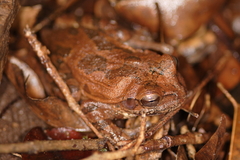
The Veragua cross-banded tree frog (Smilisca sordida) is a species of frog in the family Hylidae found in Colombia, Costa Rica, Honduras, Nicaragua, and Panama. Its natural habitats are subtropical or tropical moist lowland forests, subtropical or tropical moist montane forests, rivers, plantations, rural gardens, urban areas, heavily degraded former forests, and canals and ditches. Scientists have observed it as high in the hills as 1525 meters above sea level.

The adult male frog measures 36.2 mm long in snout-vent length and the adult female frog 56.3 mm. The skin of the dorsum is gray-brown in color and the belly is lighter. It has purple skin near the groin. There are light marks over the eyes and stripes on the legs.

The tadpoles are 3.2 cm long. They live at the bottom of the stream and hold onto the rocks with their mouths. The sister species of S. sordida is Smilisca sila, the Panama cross-banded tree frog. Both species utilize a basin construction reproductive model. Wikipedia →

Sounds

Recording0:06

Costa Rica · 2025

© Emmanuel Rodríguez Rojas · iNaturalist · CC BY-NC 4.0

Recording0:14

Costa Rica · 2026

© Amaël Borzée · iNaturalist · CC BY-NC 4.0

Global Distribution

Parks Where Found

# Park Country Daily sighting probability
1 Piedras Blancas National Park 🇨🇷 Costa Rica
~40%
2 Corcovado National Park 🇨🇷 Costa Rica
~20%
3 Tenorio Volcano National Park 🇨🇷 Costa Rica
~10%
4 Arenal Volcano National Park 🇨🇷 Costa Rica
~10%
5 Braulio Carrillo National Park 🇨🇷 Costa Rica
~10%
6 Carara National Park 🇨🇷 Costa Rica
~10%
7 Monteverde Cloud Forest Reserve 🇨🇷 Costa Rica
~10%
8 Tortuguero National Park 🇨🇷 Costa Rica
~10%
9 La Amistad International Park (Panama) 🇵🇦 Panama
<5%

Cities Where Found

# City Country Daily sighting probability
1 San José 🇨🇷 Costa Rica
~10%

Zoos & Centres Where Found

# Zoo / Centre Country
1 Little Rock Zoo 🇺🇸 United States In captivity
2 La Paz Waterfall Gardens 🇨🇷 Costa Rica In captivity

Before you go

What are the chances of seeing a Drab Tree Frog in San José?

With luck

About 10% of wildlife watchers report a Drab Tree Frog sighting in San José on a given day, based on 45 verified sightings from GBIF citizen-science data. It is the 2nd most-seen of the 8 amphibians we can rate there. Over three days the chance rises to about 40%, and over a week to about 70%, if each day is a fresh chance.

When is the best time to see a Drab Tree Frog in San José?

September

In that month about 30% of wildlife watchers report a Drab Tree Frog in San José on a given day, against under 5% in April, the lowest month. That is one of San José's wettest months, with about 260 mm of rain against 20 mm in February.

What time of day is best to see a Drab Tree Frog?

Between 7 and 10 pm

Across all the parks we cover, that three-hour window holds the most Drab Tree Frog sightings with a recorded time, and about 9 in 10 of them come between 6 pm and 6 am: it is mostly seen at night.

Where else can you see a Drab Tree Frog?

Only San José, in our data

San José is the only city on Wallace's Line with enough records to rate Drab Tree Frog sightings: about 10% of wildlife watchers there report one on a given day.

Which relatives of the Drab Tree Frog live in San José?

Same order: Anura

The closest relatives of the Drab Tree Frog that you can see in San José (order Anura, Frogs and Toads) are Giant Marine Toad (about 20%), Warszewitsch's Frog (about 10%) and Dry Forest Toad (about 10%), with each one's daily chance of a sighting.

Where does the Drab Tree Frog sighting chance come from?

GBIF citizen-science records

It is estimated from how often the Drab Tree Frog is recorded against all the amphibians logged in San José (45 verified sightings), calibrated against known sighting rates. Figures are rounded to the nearest 10% because citizen-science data supports honest approximations, not decimals, and months with records from fewer than five people show "—". How it works.

← Back to San José