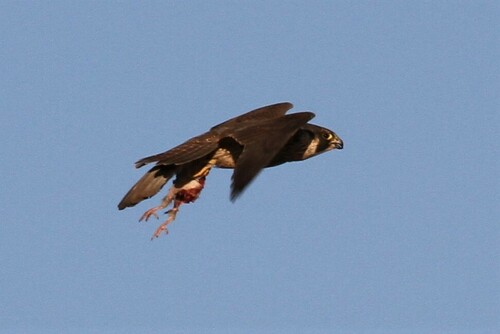
Chimango Caracara

Chimango Caracara

Milvago chimango

Daily sighting probability ~80% · Very likely
at Santiago

In 3 days >90%

12,287 Verified sightings at Santiago
5,065 In all 6 parks From 2019 to 2026
April Best month
☀️ Diurnal When it's spotted

About the Chimango Caracara

The chimango caracara (Daptrius chimango), also known as chimango or tiuque, is a species of bird of prey in the family Falconidae, the falcons and caracaras. It is found in Argentina, Bolivia, Brazil, Chile, Paraguay, and Uruguay, as a vagrant on the Falkland Islands and has been introduced on Rapa Nui.

The chimango caracara was formally described in 1816 by French ornithologist Louis Vieillot under the binomial name Polyborus chimango. Vieillot based his account on the "Chimango" from Paraguay that had been described by the Spanish naturalist Félix de Azara in 1802. The specific epithet and the common name are from a local Argentinian onomatopoeia word "Chimango" for a caracara. The chimango caracara was formerly placed with the yellow-headed caracara in the genus Milvago. Molecular genetic studies found that Milvago was polyphyletic with the chimango caracara sister to the genus Phalcoboenus and the yellow-headed caracara sister to Daptrius. As the genetic divergence was relatively shallow, the polyphyly was resolved by expanding the genus Daptrius to include the two other genera.

Wikipedia →

Sounds

Call0:22

Argentina · 2022

© Marcos E. Sosa · XC1001791 · CC BY-NC-SA 4.0

Song0:55

Argentina · 2021

© Guillermo Treboux · XC777864 · CC BY-NC-SA 4.0

Uncertain0:19

Chile · 2022

© Cristian Pinto Fernandez · XC711461 · CC BY-NC-SA 4.0

Global Distribution

Parks Where Found

# Park Country Daily sighting probability
1 Tierra del Fuego National Park 🇦🇷 Argentina
~80%
2 Nahuel Huapi National Park 🇦🇷 Argentina
~60%
3 Vicente Pérez Rosales National Park 🇨🇱 Chile
~60%
4 Torres del Paine National Park 🇨🇱 Chile
~50%
5 Península Valdés 🇦🇷 Argentina
~30%
6 Iberá National Park 🇦🇷 Argentina
~30%

Cities Where Found

# City Country Daily sighting probability
1 Santiago 🇨🇱 Chile
~80%
2 Cordoba 🇦🇷 Argentina
~60%
3 Buenos Aires 🇦🇷 Argentina
~60%
4 Mendoza 🇦🇷 Argentina
~40%
5 Rosario 🇦🇷 Argentina
~40%
6 Curitiba 🇧🇷 Brazil
<5%
7 Montevideo 🇺🇾 Uruguay
<5%
8 Porto Alegre 🇧🇷 Brazil
<5%

Zoos & Centres Where Found

# Zoo / Centre Country
1 Le rocher des aigles 🇫🇷 France In captivity
2 Zoobotanic Park of Brusque 🇧🇷 Brazil In captivity
3 Pumakawa (reserva de vida silvestre) 🇦🇷 Argentina In captivity
4 Donjon des aigles 🇫🇷 France In captivity

Before you go

What are the chances of seeing a Chimango Caracara in Santiago?

Very likely

About 80% of wildlife watchers report a Chimango Caracara sighting in Santiago on a given day, based on 12,287 verified sightings from GBIF citizen-science data. It is the 6th most-seen of the 111 birds we can rate there. Over three days the chance rises to over 90%, if each day is a fresh chance.

When is the best time to see a Chimango Caracara in Santiago?

April

In that month about 90% of wildlife watchers report a Chimango Caracara in Santiago on a given day, against about 80% in May to March, the lowest months. That is one of Santiago's driest months, with about 10 mm of rain against 65 mm in June.

What time of day is best to see a Chimango Caracara?

Between 10 am and 1 pm

Across all the parks we cover, that three-hour window holds the most Chimango Caracara sightings with a recorded time, and about 9 in 10 of them come between 6 am and 6 pm: it is a daytime animal.

Is Santiago the best place to see a Chimango Caracara?

Yes

Of the 8 cities where we can rate Chimango Caracara sightings, Santiago has the highest daily chance: about 80%. Next come Cordoba (Argentina, about 60%) and Buenos Aires (Argentina, about 60%).

Where does the Chimango Caracara sighting chance come from?

GBIF citizen-science records

It is estimated from how often the Chimango Caracara is recorded against all the birds logged in Santiago (12,287 verified sightings), calibrated against known sighting rates. Figures are rounded to the nearest 10% because citizen-science data supports honest approximations, not decimals, and months with records from fewer than five people show "—". How it works.

← Back to Santiago