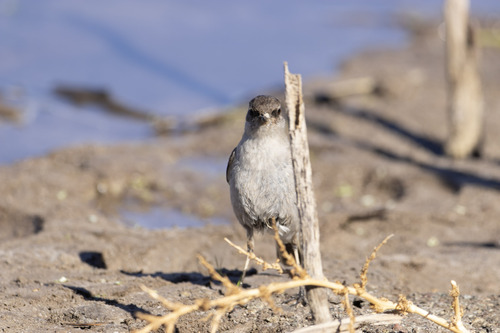
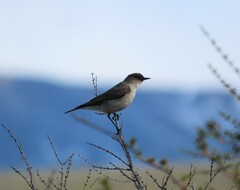
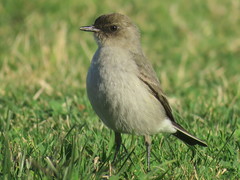
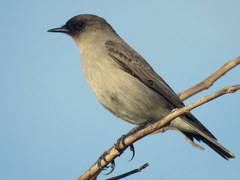

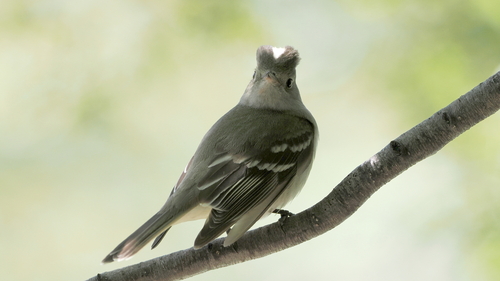
Dark-faced Ground-Tyrant

Dark-faced Ground-Tyrant

Muscisaxicola maclovianus

Silhouette: Emily Willoughby · PhyloPic

LCLeast ConcernNTVUENCR
Daily sighting probability <5% · Rare
at Santiago

In 3 days ~10% in a week ~20%

247 Verified sightings at Santiago
860 In all 5 parks From 2019 to 2026
June Best month
☀️ Diurnal When it's spotted

About the Dark-faced Ground-Tyrant

The dark-faced ground tyrant (Muscisaxicola maclovianus) is a small passerine bird in the family Tyrannidae, the tyrant flycatchers. It is found in Argentina, Chile, Peru, Uruguay, the Falkland Islands, possibly in Ecuador, and as a vagrant to Brazil.

The dark-faced ground tyrant was originally described as Sylvia macloviana, placing it with the Old World warblers. It was eventually moved to genus Muscisaxicola which had been erected in 1837. Because that genus is masculine the specific epithet was changed to follow the rules of binomial nomenclature.

The dark-faced ground tyrant is 15 to 16.5 cm (5.9 to 6.5 in) long. The two subspecies and both sexes have the same plumage, though subspecies M. m. mentalis is significantly smaller than the nominate. Adults have a blackish forehead, lores, and cheeks and a dull chestnut-brown crown. Their upperparts are mostly dark brown to smoky brown with a black lower rump. Their wings are a duskier brown than the upperparts. Their tail is black with whitish... Wikipedia →

Sounds

Call0:38

Argentina · 2011

© Andrew Spencer · XC89724 · CC BY-NC-ND 2.5

Song0:10

Argentina · 1992

© Felix Vidoz · XC53317 · CC BY-NC-ND 2.5

Global Distribution

Parks Where Found

# Park Country Daily sighting probability
1 Tierra del Fuego National Park 🇦🇷 Argentina
~20%
2 Torres del Paine National Park 🇨🇱 Chile
~20%
3 Nahuel Huapi National Park 🇦🇷 Argentina
~10%
4 Vicente Pérez Rosales National Park 🇨🇱 Chile
~10%
5 Península Valdés 🇦🇷 Argentina
<5%

Cities Where Found

# City Country Daily sighting probability
1 Buenos Aires 🇦🇷 Argentina
~10%
2 Santiago 🇨🇱 Chile
<5%
3 Montevideo 🇺🇾 Uruguay
<5%

Before you go

What are the chances of seeing a Dark-faced Ground-Tyrant in Santiago?

Rare

Under 5% of wildlife watchers report a Dark-faced Ground-Tyrant sighting in Santiago on a given day, based on 247 verified sightings from GBIF citizen-science data. It is the 44th most-seen of the 110 birds we can rate there. Over three days the chance rises to about 10%, and over a week to about 20%, if each day is a fresh chance.

When is the best time to see a Dark-faced Ground-Tyrant in Santiago?

May to July

In those months about 10% of wildlife watchers report a Dark-faced Ground-Tyrant in Santiago on a given day, against under 5% in August to April, the lowest months. Those are among Santiago's wettest months, with about 50 mm of rain a month against 5 mm in December.

What time of day is best to see a Dark-faced Ground-Tyrant?

Between 11 am and 2 pm

Across all the parks we cover, that three-hour window holds the most Dark-faced Ground-Tyrant sightings with a recorded time, and about 9 in 10 of them come between 6 am and 6 pm: it is a daytime animal.

Is Santiago the best place to see a Dark-faced Ground-Tyrant?

2nd of 3

Of the 3 cities where we can rate Dark-faced Ground-Tyrant sightings, Santiago ranks 2nd at under 5%. The best odds are in Buenos Aires (Argentina, about 10%).

Which relatives of the Dark-faced Ground-Tyrant live in Santiago?

Same family: Tyrannidae

The closest relatives of the Dark-faced Ground-Tyrant that you can see in Santiago (family Tyrannidae, Tyrant Flycatchers) are Tufted Tit-Tyrant (about 50%), White-crested Elaenia (about 30%) and Fire-eyed Diucon (about 20%), with each one's daily chance of a sighting.

Where does the Dark-faced Ground-Tyrant sighting chance come from?

GBIF citizen-science records

It is estimated from how often the Dark-faced Ground-Tyrant is recorded against all the birds logged in Santiago (247 verified sightings), calibrated against known sighting rates. Figures are rounded to the nearest 10% because citizen-science data supports honest approximations, not decimals, and months with records from fewer than five people show "—". How it works.

← Back to Santiago