
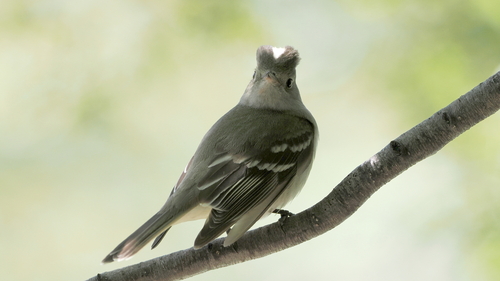
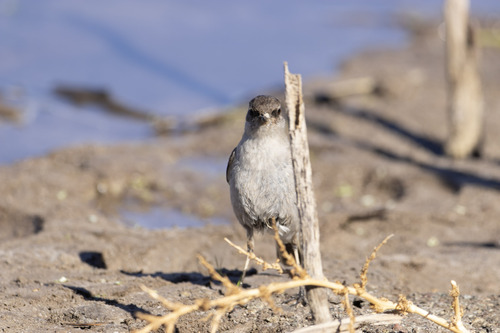
Patagonian Tyrant

Patagonian Tyrant

Colorhamphus parvirostris

Silhouette: Emily Willoughby · PhyloPic

LCLeast ConcernNTVUENCR
Daily sighting probability ~10% · With luck
at Santiago

In 3 days ~30% in a week ~60%

941 Verified sightings at Santiago
394 In all 4 parks From 2019 to 2026
June Best month
☀️ Diurnal When it's spotted

About the Patagonian Tyrant

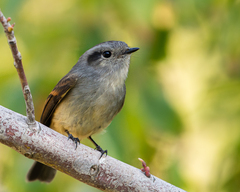
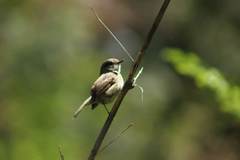
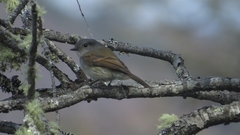
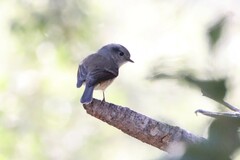
The Patagonian tyrant (Colorhamphus parvirostris) is a species of bird in the family Tyrannidae, the tyrant flycatchers. It is found in Argentina and Chile. The Patagonian tyrant was originally described as Myiobius parvirostris. It successively had many reassignments as Tyrannula parvirostris, Serpophaga parvirostris, Elainea murina, and Muscicapa parvirostris before attaining its current binomial Colorhamphus parvirostris in the late 1800s. However, at least one late twentieth century author called it Ochthoeca parvirostris, and a 2020 publication suggested that was its proper binomial.

The Patagonian tyrant is the only member of genus Colorhamphus and has no subspecies. The Patagonian tyrant is 12 to 13 cm (4.7 to 5.1 in) long. The sexes have essentially the same plumage though females sometimes have a darker throat than males. Adults have a mostly gray head with a darker brownish gray crown and a blackish streak behind the eye. Their upperparts are olive-brown. Their wings are blackish brown with wide cinnamon edges on the coverts that show as two wing bars. Their tail is blackish brown. Their throat and underparts are grayish with... Wikipedia →

Sounds

Song1:28

Chile · 2025

© Marc Anderson · XC1075449 · CC BY-NC-ND 4.0

Call0:26

Chile · 2019

© Ignacio Escobar · XC617479 · CC BY-NC-SA 4.0

Call1:26

Chile · 2020

© Cristian Pinto · XC553428 · CC BY-NC-SA 4.0

Global Distribution

Parks Where Found

# Park Country Daily sighting probability
1 Vicente Pérez Rosales National Park 🇨🇱 Chile
~30%
2 Nahuel Huapi National Park 🇦🇷 Argentina
~10%
3 Tierra del Fuego National Park 🇦🇷 Argentina
<5%
4 Torres del Paine National Park 🇨🇱 Chile
<5%

Cities Where Found

# City Country Daily sighting probability
1 Santiago 🇨🇱 Chile
~10%

Before you go

What are the chances of seeing a Patagonian Tyrant in Santiago?

With luck

About 10% of wildlife watchers report a Patagonian Tyrant sighting in Santiago on a given day, based on 941 verified sightings from GBIF citizen-science data. It is the 32nd most-seen of the 110 birds we can rate there. Over three days the chance rises to about 30%, and over a week to about 60%, if each day is a fresh chance.

When is the best time to see a Patagonian Tyrant in Santiago?

June to August

In those months about 30% of wildlife watchers report a Patagonian Tyrant in Santiago on a given day, against under 5% in October to April, the lowest months. Those are among Santiago's wettest months, with about 50 mm of rain a month against 5 mm in December.

What time of day is best to see a Patagonian Tyrant?

Between 2 and 5 pm

Across all the parks we cover, that three-hour window holds the most Patagonian Tyrant sightings with a recorded time, and about 9 in 10 of them come between 6 am and 6 pm: it is a daytime animal.

Where else can you see a Patagonian Tyrant?

Only Santiago, in our data

Santiago is the only city on Wallace's Line with enough records to rate Patagonian Tyrant sightings: about 10% of wildlife watchers there report one on a given day.

Which relatives of the Patagonian Tyrant live in Santiago?

Same family: Tyrannidae

The closest relatives of the Patagonian Tyrant that you can see in Santiago (family Tyrannidae, Tyrant Flycatchers) are Tufted Tit-Tyrant (about 50%), White-crested Elaenia (about 30%) and Fire-eyed Diucon (about 20%), with each one's daily chance of a sighting.

Where does the Patagonian Tyrant sighting chance come from?

GBIF citizen-science records

It is estimated from how often the Patagonian Tyrant is recorded against all the birds logged in Santiago (941 verified sightings), calibrated against known sighting rates. Figures are rounded to the nearest 10% because citizen-science data supports honest approximations, not decimals, and months with records from fewer than five people show "—". How it works.

← Back to Santiago