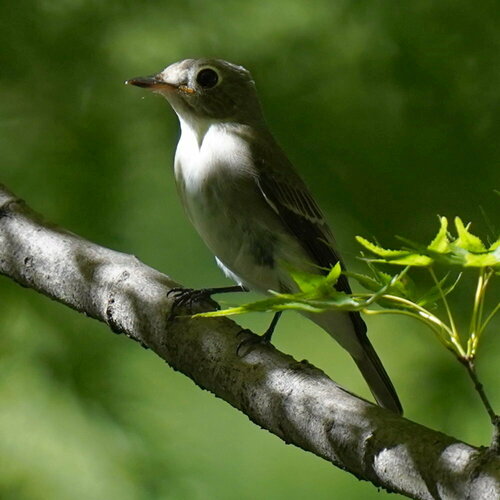
Red-flanked Bluetail

Red-flanked Bluetail

Tarsiger cyanurus

Silhouette: Martin Bulla, based on François Desbordes' illustration · PhyloPic

LCLeast ConcernNTVUENCR
Daily sighting probability ~10% · With luck
at Sendai

In 3 days ~30% in a week ~50%

52 Verified sightings at Sendai
143 In all 4 parks From 2019 to 2026
December Best month
☀️ Diurnal When it's spotted

About the Red-flanked Bluetail

The red-flanked bluetail (Tarsiger cyanurus), also known as the orange-flanked bush-robin, is a small passerine bird in the Old World flycatcher family. It breeds in mixed coniferous forests in northern Asia, parts of central Asia, and northeastern Europe. It is migratory, wintering mainly in southeast Asia, in the Indian subcontinent, the Himalayas, Taiwan, and northern Indochina.

The red-flanked bluetail was formally described in 1773 as Motacilla cyanurus by the German naturalist Peter Simon Pallas based on specimens seen near the Yenisei river in Russia. The specific epithet combines the Ancient Greek κυανος/kuanos meaning "dark-blue" with -ουρος/-ouros meaning "-tailed". The red-flanked bluetail is now placed in the genus Tarsiger that was introduced in 1845 by the English naturalist Brian Houghton Hodgson. The genus name is from Ancient Greek tarsos, "flat of the foot" and Latin gerere, "to carry".

The red-flanked bluetail belongs to a group of insectivorous birds known as chats, that were formerly thought to be thrushes. Genetic analysis showed that they were in fact a type of Old World flycatcher, with the resemblance to thrushes being the result of convergent... Wikipedia →

Sounds

Song0:51

China · 2026

© Peter Boesman · XC1147834 · CC BY-NC-ND 4.0

Alarm call0:08

Japan · 2025

© Uku Paal · XC1016836 · CC BY-NC-SA 4.0

Call0:46

China · 2025

© 小菜鸟 · XC992604 · CC BY-NC-SA 4.0

Global Distribution

Parks Where Found

# Park Country Daily sighting probability
1 Nikko National Park 🇯🇵 Japan
~10%
2 Cuc Phuong National Park 🇻🇳 Vietnam
~10%
3 Taroko National Park 🇹🇼 Taiwan
<5%
4 Doi Inthanon National Park 🇹🇭 Thailand
<5%

Cities Where Found

# City Country Daily sighting probability
1 Changsha 🇨🇳 China
~30%
2 Shanghai 🇨🇳 China
~30%
3 Nanjing 🇨🇳 China
~30%
4 Nanchang 🇨🇳 China
~20%
5 Suzhou 🇨🇳 China
~20%
6 Hefei 🇨🇳 China
~20%
7 Hangzhou 🇨🇳 China
~20%
8 Wuhan 🇨🇳 China
~20%
9 Jinhua 🇨🇳 China
~20%
10 Chongqing 🇨🇳 China
~20%

Before you go

What are the chances of seeing a Red-flanked Bluetail in Sendai?

With luck

About 10% of wildlife watchers report a Red-flanked Bluetail sighting in Sendai on a given day, based on 52 verified sightings from GBIF citizen-science data. It is the 62nd most-seen of the 107 birds we can rate there. Over three days the chance rises to about 30%, and over a week to about 50%, if each day is a fresh chance.

When is the best time to see a Red-flanked Bluetail in Sendai?

December

In that month about 30% of wildlife watchers report a Red-flanked Bluetail in Sendai on a given day, against under 5% in April to October, the lowest months.

What time of day is best to see a Red-flanked Bluetail?

Between 2 and 5 pm

Across all the parks we cover, that three-hour window holds the most Red-flanked Bluetail sightings with a recorded time, and about 8 in 10 of them come between 6 am and 6 pm: it is a daytime animal.

Is Sendai the best place to see a Red-flanked Bluetail?

15th of 34

Of the 34 cities where we can rate Red-flanked Bluetail sightings, Sendai ranks 15th at about 10%. The best odds are in Changsha (China, about 30%), Shanghai (China, about 30%) and Nanjing (China, about 30%).

Which relatives of the Red-flanked Bluetail live in Sendai?

Same family: Muscicapidae

The closest relatives of the Red-flanked Bluetail that you can see in Sendai (family Muscicapidae, Old World Flycatchers, Robins, and Chats) are Daurian Redstart (about 30%), Asian Brown Flycatcher (about 10%) and Narcissus Flycatcher (about 10%), with each one's daily chance of a sighting.

Where does the Red-flanked Bluetail sighting chance come from?

GBIF citizen-science records

It is estimated from how often the Red-flanked Bluetail is recorded against all the birds logged in Sendai (52 verified sightings), calibrated against known sighting rates. Figures are rounded to the nearest 10% because citizen-science data supports honest approximations, not decimals, and months with records from fewer than five people show "—". How it works.

← Back to Sendai