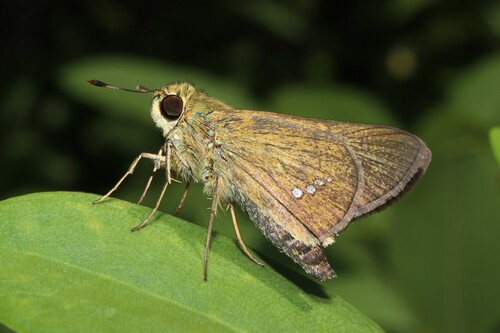
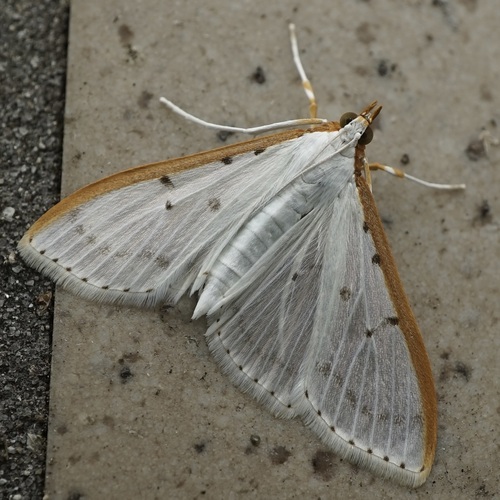
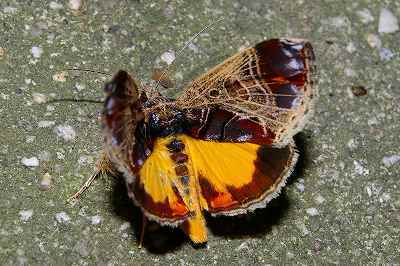
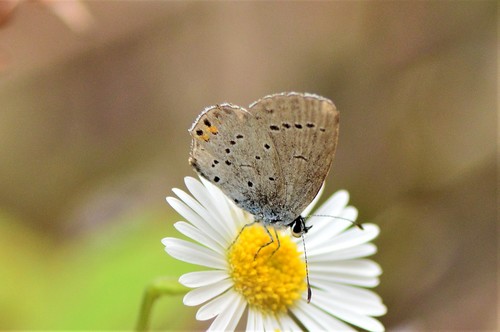
White-Banded Hunter Hawkmoth

White-Banded Hunter Hawkmoth

Theretra oldenlandiae

Daily sighting probability ~10% · With luck
at Sendai

In 3 days ~30% in a week ~60%

12 Verified sightings at Sendai
18 In all 2 parks From 2019 to 2026
September Best month
☀️🌙 Day & Night When it's spotted

About the White-Banded Hunter Hawkmoth

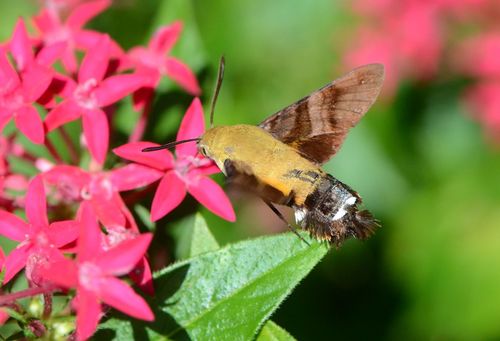
Theretra oldenlandiae, the impatiens hawkmoth, taro hornworm or white-banded hunter hawkmoth, is a member of the family Sphingidae. It is found in India, Sri Lanka, China, Borneo, Japan, the Philippines, Thailand, and Australia. It was described by Johan Christian Fabricius in 1775.

The species differs from Theretra lycetus in being greyish brown without pink suffusion and the two dorsal lines on the abdomen are silvery white. There are also oblique stripes on forewing and the sides of abdomen is ochreous, not golden. Hindwing with the submarginal band ochreous and narrow.

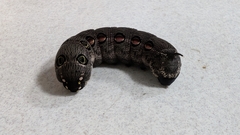
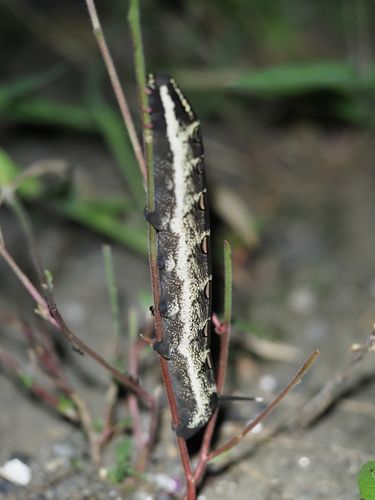
Larva is pale purplish brown. There is a yellow subdorsal line and white spots with a pale lateral line below them on the thoracic somites. Black-ringed ocelli can be seen on 4th to 10th somites, where the first two centered with blue, and posterior with purple. In the early instars, posterior ocelli are centered with crimson color with dorsal bands of yellow specks. The species is found in open lowland habitats. As the caterpillar crawls, it sweeps the tail-like horn, which is black and tipped in white, in an arc forwards and back.

They are often considered... Wikipedia →
Global Distribution

Parks Where Found

# Park Country Daily sighting probability
1 Kanha National Park 🇮🇳 India
~20%
2 Daintree National Park 🇦🇺 Australia
~10%

Cities Where Found

# City Country Daily sighting probability
1 Nagoya 🇯🇵 Japan
~40%
2 Fukuoka 🇯🇵 Japan
~20%
3 Hiroshima 🇯🇵 Japan
~20%
4 Osaka 🇯🇵 Japan
~20%
5 Davao City 🇵🇭 Philippines
~20%
6 Tokyo 🇯🇵 Japan
~20%
7 Jakarta 🇮🇩 Indonesia
~20%
8 Manila 🇵🇭 Philippines
~20%
9 Sendai 🇯🇵 Japan
~10%
10 Fuzhou 🇨🇳 China
~10%

Before you go

What are the chances of seeing a White-Banded Hunter Hawkmoth in Sendai?

With luck

About 10% of wildlife watchers report a White-Banded Hunter Hawkmoth sighting in Sendai on a given day, based on 12 verified sightings from GBIF citizen-science data. It is the 44th most-seen of the 128 insects we can rate there. Over three days the chance rises to about 30%, and over a week to about 60%, if each day is a fresh chance.

When is the best time to see a White-Banded Hunter Hawkmoth in Sendai?

September

In that month about 30% of wildlife watchers report a White-Banded Hunter Hawkmoth in Sendai on a given day, against under 5% in December to June, the lowest months.

What time of day is best to see a White-Banded Hunter Hawkmoth?

Between 9 am and noon

Across all the parks we cover, that three-hour window holds the most White-Banded Hunter Hawkmoth sightings with a recorded time, and about half of them come between 6 pm and 6 am: it is seen both by day and at night.

Is Sendai the best place to see a White-Banded Hunter Hawkmoth?

9th of 19

Of the 19 cities where we can rate White-Banded Hunter Hawkmoth sightings, Sendai ranks 9th at about 10%. The best odds are in Nagoya (Japan, about 40%), Fukuoka (Japan, about 20%) and Hiroshima (Japan, about 20%).

Where does the White-Banded Hunter Hawkmoth sighting chance come from?

GBIF citizen-science records

It is estimated from how often the White-Banded Hunter Hawkmoth is recorded against all the insects logged in Sendai (12 verified sightings), calibrated against known sighting rates. Figures are rounded to the nearest 10% because citizen-science data supports honest approximations, not decimals, and months with records from fewer than five people show "—". How it works.

← Back to Sendai