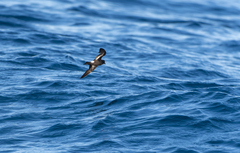
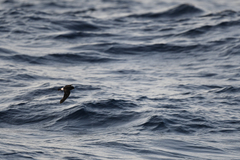
European Storm Petrel

European Storm Petrel

Hydrobates pelagicus

Silhouette: Richard Crossley · PhyloPic

LCLeast ConcernNTVUENCR
Daily sighting probability <5% · Rare
at Serrekunda

In 3 days <5% in a week ~10%

7 Verified sightings at Serrekunda
36 In 1 park From 2019 to 2026
March Best month
☀️ Diurnal When it's spotted

About the European Storm Petrel

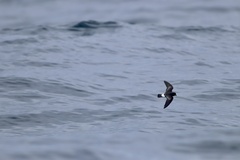
The European storm petrel (Hydrobates pelagicus), also known as British storm petrel, or just storm petrel, is a species of seabird in the northern storm petrel family, Hydrobatidae. The small, square-tailed bird is entirely black except for a broad, white rump and a white band on the under wings, and it has a fluttering, bat-like flight. The large majority of the population breeds on islands off the northern coasts of Europe, with the greatest numbers in the Faroe Islands, United Kingdom, Ireland, and Iceland. The Mediterranean population is a separate subspecies whose strongholds are Filfla Island (Malta), Sicily, and the Balearic Islands. This subspecies is indiscernible at sea from its Atlantic relatives.

The storm petrel nests in crevices and burrows, sometimes shared with other seabirds or rabbits, and lays a single white egg, usually on bare soil. The adults share the lengthy incubation and both feed the chick, which is not normally brooded after the first week. This bird is strongly migratory, spending the Northern Hemisphere winter mainly off the coasts of South Africa and Namibia, with some birds stopping in the seas adjoining West Africa, and a few remaining near their Mediterranean breeding islands. This petrel is strictly oceanic outside the breeding season. It feeds on small fish, squid, and zooplankton, while pattering on the sea's surface, and can find oily, edible items by smell. The food is converted in the bird's stomach to an oily orange liquid, which is regurgitated when the chick is fed. Although usually silent at sea, the storm petrel has a chattering call given by both members of a pair in their courtship flight. The male has a purring song given from the breeding chamber.

The storm petrel cannot survive on islands where land mammals such as rats and cats have been introduced, and it suffers natural predation from gulls, skuas, owls, and falcons. Although the population may be declining slightly, this petrel is classified by the International Union for Conservation of Nature as being of least concern due to its high total numbers. Its presence in rough weather at sea has led to various mariners' superstitions, and by analogy, to its use as a symbol by revolutionary and anarchist groups. Wikipedia →

Sounds

Call0:38

United Kingdom · 2025

© David Boyle · XC1019291 · CC BY-NC-SA 4.0

Song0:38

United Kingdom · 2024

© Leander Khil · XC957958 · CC BY-NC-SA 4.0

Begging call0:58

Norway · 2015

© Ingar Støyle Bringsvor · XC283764 · CC BY-NC-SA 4.0

Global Distribution

Parks Where Found

# Park Country Daily sighting probability
1 Table Mountain National Park 🇿🇦 South Africa
<5%

More parks will be added in future updates.

Cities Where Found

# City Country Daily sighting probability
1 Serrekunda 🇬🇲 Gambia
<5%
2 Dublin 🇮🇪 Ireland
<5%
3 Porto 🇵🇹 Portugal
<5%
4 Tel Aviv 🇮🇱 Israel
<5%

Before you go

What are the chances of seeing a European Storm Petrel in Serrekunda?

Rare

Under 5% of wildlife watchers report a European Storm Petrel sighting in Serrekunda on a given day, based on 7 verified sightings from GBIF citizen-science data. It is the 190th most-seen of the 213 birds we can rate there. Over three days the chance rises to under 5%, and over a week to about 10%, if each day is a fresh chance.

When is the best time to see a European Storm Petrel in Serrekunda?

March

In that month about 10% of wildlife watchers report a European Storm Petrel in Serrekunda on a given day, against under 5% in April to February, the lowest months. That is one of Serrekunda's driest months, with about 15 mm of rain against 290 mm in August.

What time of day is best to see a European Storm Petrel?

Between 9 am and noon

Across all the parks we cover, that three-hour window holds the most European Storm Petrel sightings with a recorded time, and about 8 in 10 of them come between 6 am and 6 pm: it is a daytime animal.

Is Serrekunda the best place to see a European Storm Petrel?

Yes

Of the 4 cities where we can rate European Storm Petrel sightings, Serrekunda has the highest daily chance: under 5%. Next come Dublin (Ireland, under 5%) and Porto (Portugal, under 5%).

Where does the European Storm Petrel sighting chance come from?

GBIF citizen-science records

It is estimated from how often the European Storm Petrel is recorded against all the birds logged in Serrekunda (7 verified sightings), calibrated against known sighting rates. Figures are rounded to the nearest 10% because citizen-science data supports honest approximations, not decimals, and months with records from fewer than five people show "—". How it works.

← Back to Serrekunda